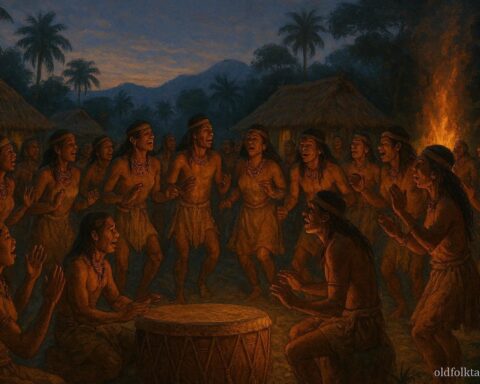
In the dense forests of central Brazil, where the land rose and fell with ancient rhythms, the Kayapó people lived beside a wide river that fed their lives. The river was not seen as water alone. It was known as a living presence, one that listened, remembered, and responded. The elders taught that the river had a mouth, just like a person, and through that mouth it spoke by flowing, feeding fish, nourishing crops, and cooling the land.
For generations, the river gave freely. Fish were plentiful, canoes moved easily along its surface, and the forest around its banks grew thick and green. The people took what they needed and returned thanks through careful rituals, songs, and restraint. Children were taught never to waste water, never to poison the river, and never to take more fish than could be eaten or shared.
As time passed, however, the village grew larger. More families settled near the riverbank. New tools made fishing easier and faster. Nets were cast wider, traps were set more often, and trees near the river were cut down to clear land. At first, the changes seemed small. The river still flowed, and the fish still came.
Some elders warned that the river was being treated as an object rather than a living being. They reminded the people of old teachings, saying that every gift demanded care in return. But many villagers, especially the younger hunters and fishers, believed the river was endless. They said water could not be offended and fish would always return.
One season, the rains were lighter than usual. The river level dropped slightly, though still enough for travel and fishing. Instead of reducing their use, the villagers worked harder. They built more traps and pulled more fish from the shallows. Waste was left near the banks, and rituals of thanks were skipped in favor of speed and convenience.
Then, one morning, the river stopped speaking.
The water near the village grew still. Its flow slowed until it barely moved. Within days, parts of the riverbed were exposed, cracked under the sun. Fish disappeared. Canoes could no longer travel beyond the bend. The elders said quietly that the river had closed its mouth.
Panic spread through the village. Without the river, crops began to fail. Drinking water had to be carried from distant streams. Children grew weak, and hunters were forced to travel far into unfamiliar forest. Still, some villagers blamed the weather, insisting the river would return on its own.
One elder woman, known for remembering the oldest stories, gathered the people together. She told them that the river had not left. It had withdrawn. “A mouth closes when it has been forced to speak without being heard,” she said. “The river listened to us. We did not listen to it.”
She explained that the river’s silence was not punishment alone but instruction. The people had forgotten restraint, gratitude, and balance. Until those were restored, the river would remain closed.
The elders instructed the village to stop all fishing along the dry banks. Waste was removed and buried far from the water. Trees were replanted along the shore. For several days, the people fasted and held ceremonies of apology. They spoke aloud to the river, acknowledging the harm done and promising change.
Children were brought forward to place clean water back into the riverbed using clay bowls, not to refill it but to show care. Songs were sung, not to demand water but to recognize the river as kin.
For many days, nothing changed.
Some villagers lost hope, believing the river would never return. But the elders insisted patience was part of respect. “A living being does not forgive on command,” they said. “It forgives when trust is restored.”
One night, after a long silence, the sound of water returned. At first it was only a trickle, barely audible. Then, slowly, the river began to move again. The cracked earth softened. Fish returned in small numbers. The river’s mouth had opened, but only slightly.
The elders declared that the river would never again be taken for granted. New rules were set. Fishing seasons were limited. Rituals of thanks were restored. The river was spoken to as a listener, not a resource.
Over time, the river regained its strength. Its flow returned, steady and clear. But the people remembered the silence. Children were taught that the river could close its mouth again if balance was forgotten.
From that time forward, the Kayapó told this story so future generations would understand that water remembers, land listens, and nature responds not only to actions but to intentions.
Explore the ancestral legends of Canada, Mesoamerica, and South America’s Indigenous tribes.
Moral Lesson
The natural world is not passive. When balance is broken and respect abandoned, even the most generous gifts can withdraw. True survival depends on restraint, responsibility, and listening to the living world.
Knowledge Check
1. Why did the river stop flowing near the village?
The river withdrew because it was overused and disrespected without gratitude or restraint.
2. What did the elders believe the river’s silence meant?
They believed it was a lesson rather than simple punishment, teaching balance and respect.
3. How did the villagers attempt to restore harmony?
They reduced harm, cleaned the riverbanks, replanted trees, fasted, and performed ceremonies of apology.
4. Why did the river return slowly instead of immediately?
Trust needed to be rebuilt, and patience was part of showing respect.
5. What rule changes followed the river’s return?
Fishing was limited, rituals were restored, and the river was treated as a living being.
6. What does the river symbolize in Kayapó belief?
It represents a sentient force that remembers actions and responds to moral behavior.
Source
Adapted from Instituto Socioambiental Brazil oral history archives.
Cultural Origin
Kayapó peoples, Brazil.