Long ago, in the rolling hills and dense forests of Secwépemc territory, there was a trail known to the elders as a narrow, twisting path connecting villages, hunting grounds, and sacred sites. Its passage was so tight that only one person could walk at a time. Travelers spoke in whispers as they navigated the uneven stones, for the path was said to watch and judge those who moved along it. The elders told that the trail carried the memory of every traveler’s intention, recording deeds of generosity and selfishness alike.
The trail was unlike any ordinary path. Its stones were uneven and its slopes steep, yet it seemed to respond to the heart of each person who walked upon it. Those who acted with selfishness or pride found the path difficult, as though the earth itself opposed them. Rocks shifted beneath their feet, brambles tangled in their clothing, and the narrow trail constricted so they had to turn back or proceed with extreme effort. But for those who helped others along the way, the path subtly widened, stones leveled, and obstacles eased. Travelers often whispered of the trail’s spirit, a quiet guardian of morality, rewarding kindness and testing the heart of every person who dared to enter.
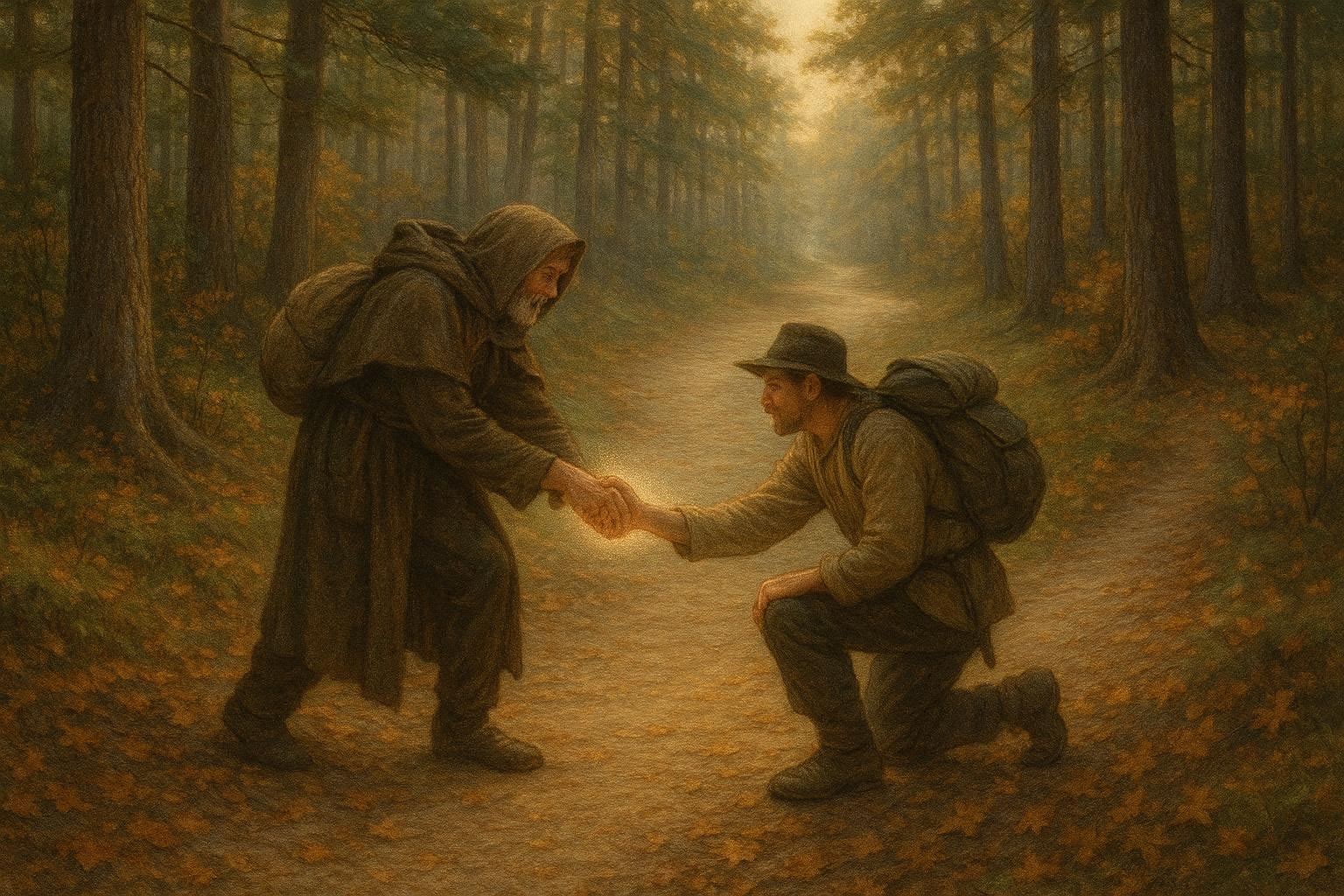
One autumn, a young woman named Skwen carried baskets of dried berries to her grandmother, who lived at the far edge of the territory. The wind was cold, the trees golden and heavy with fallen leaves. As she climbed the first incline, she noticed an elderly man struggling with a pack that was far too heavy for his age. Without hesitation, Skwen stepped forward, lifting the weight slightly and offering to guide him. As soon as she did, the stones beneath her feet seemed to smooth, the brambles parted gently, and a subtle breeze carried the scent of pine. Together, they reached the hilltop, where the river sparkled in the sunlight and the view stretched across the villages. The man bowed in gratitude, and Skwen felt the trail beneath her become lighter, almost as if it had expanded to accommodate her care.
As word of Skwen’s journey spread through the villages, the people began to observe the path’s behavior more closely. Hunters returning from a successful trip discovered that their route through a treacherous gorge became easier after they had assisted a lost child to safety. Merchants carrying furs and dried meat noticed that sections of the path were smoother after they helped an injured neighbor across a stream. Conversely, travelers who ignored others in need or acted only for personal gain found their journeys filled with difficulties that seemed to grow with every selfish act.
Parents began to teach their children about the trail, explaining that the forest and the mountains were as alive and aware as the people themselves. They said that every action, no matter how small, was recorded in the land. When children helped one another, the path widened, and when they were unkind or boastful, the earth responded accordingly. This lesson extended beyond travel, shaping daily life in the villages. Community members learned that cooperation, patience, and generosity were not just moral ideals but practical necessities that affected every part of life.
The trail also became a living guide for travelers who had to make decisions in unfamiliar territory. Those who were lost found that if they aided others along the way, the stones shifted to reveal safer footing and hidden routes. The wind carried messages and warnings for those who listened, whispering advice to the humble. Children learned to pause and observe before acting, understanding that patience and attention could literally make the path easier. Skwen’s example endured for generations, inspiring both children and adults to cultivate kindness, humility, and shared responsibility in every journey.
Elders also used the trail to teach leadership. A young person seeking the role of a village leader would be sent along the path with a group. If the individual cooperated, helped companions, and considered the needs of others, the trail widened and allowed them to complete the journey successfully. If they sought only their own advantage, the trail became narrow and treacherous, forcing reflection on the importance of community over self-interest. Over time, the trail became a living metaphor for the moral geography of the Secwépemc lands, a constant reminder that the choices of the individual shaped the well-being of the collective.
Even today, elders recount that some sections of the trail still appear to respond to the heart of travelers. Stories are told of visitors who felt the earth itself supporting their steps after acts of generosity and of others who struggled through thorns and rocks when acting selfishly. The path teaches that assistance offered without expectation is rewarded, that every step carries meaning, and that kindness is the true measure of a person. The spirit of the trail continues to serve as both a guardian and a teacher, connecting generations with lessons of morality, service, and the intricate balance between the individual and the community.
Explore the ancestral legends of Canada, Mesoamerica, and South America’s Indigenous tribes.
Moral Lesson
Acts of selfless service and kindness create paths of ease and guidance, reflecting the principles of reciprocity and balance that sustain both community and individual.
Knowledge Check
1 What was unique about the trail in Secwépemc territory?
Answer It was narrow and observed travelers, reflecting their intentions.
2 How did the path respond to travelers who acted selfishly?
Answer The trail narrowed and obstacles increased, making the journey harder.
3 What actions caused the trail to widen for travelers?
Answer Helping others, offering guidance, and sharing burdens.
4 How did the story apply lessons beyond walking the trail?
Answer It taught that cooperation and generosity benefit all areas of life, not just travel.
5 Who were the primary guardians of the trail’s knowledge?
Answer The elders of the Secwépemc communities.
6 What is the spiritual principle underlying the path’s behavior?
Answer Moral intent and reciprocity determine the ease or difficulty of the journey.
Source:
Adapted from Interior Salish journey teachings, Royal BC Museum
Cultural Origin:
Secwépemc First Peoples, Interior British Columbia