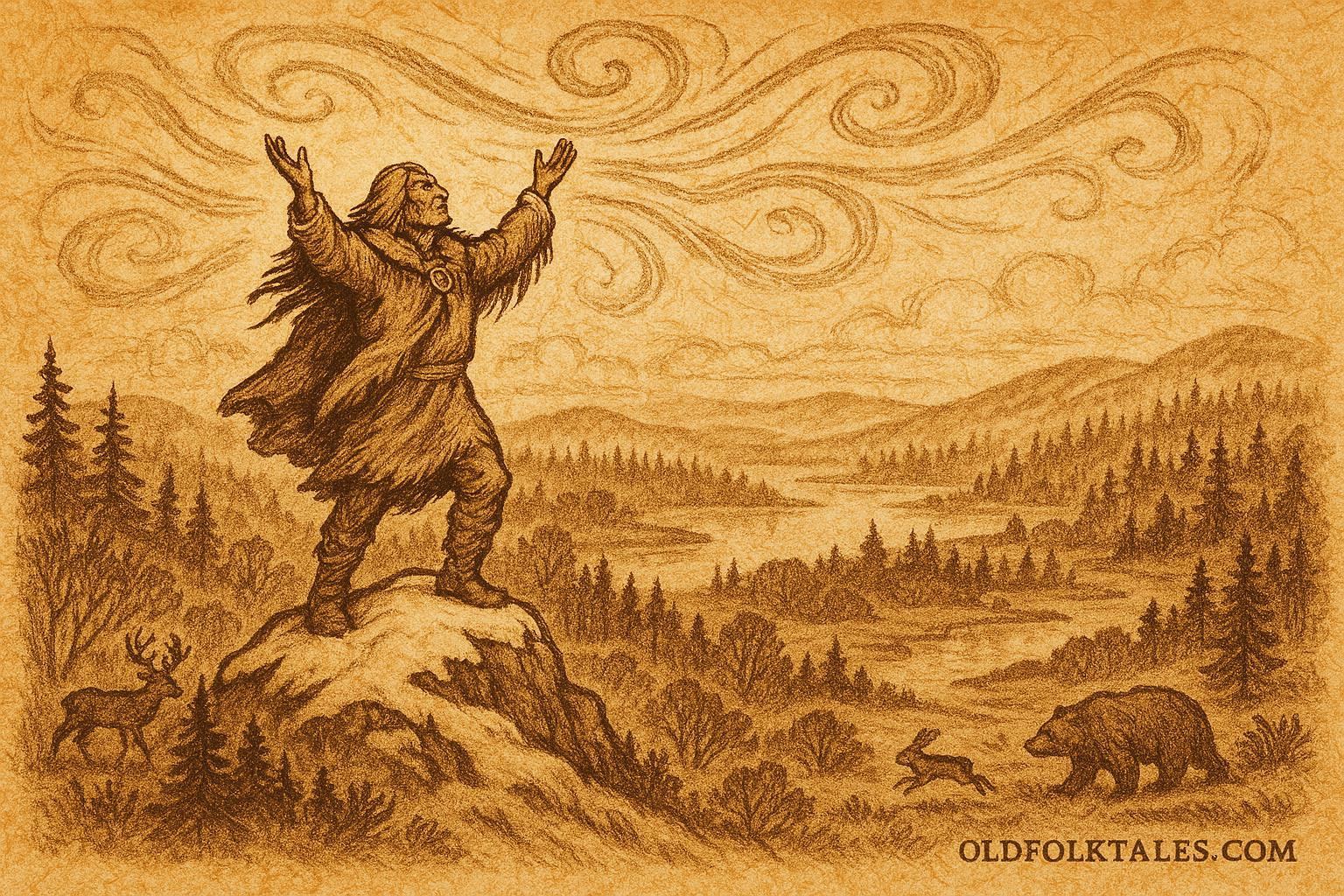
Long ago, when the world was still young and the Great Spirit’s breath had not yet stirred the earth, all things lived beneath a sky that never moved. The forests stood silent, the lakes mirrored the heavens without a ripple, and the air itself felt heavy, as if holding its breath.
The animals moved slowly, weighed down by the stillness. The deer could not cool their hides after running. The birds flapped their wings but could not feel the joy of flight. Even the mighty rivers seemed to grow weary, their surfaces thickening into ice because the air did not move to warm them.
In those days, sound was rare. Leaves did not rustle, and fire burned without a whisper. It was a world without breath, beautiful, but lifeless.
The Suffering of the Still World
As the seasons passed, the world grew colder. Without motion in the air, the sun’s warmth lingered only briefly, trapped and thin. The forests of birch and pine grew brittle, and the lakes froze solid, trapping fish beneath thick walls of ice.
The animals gathered in worry. They held council in a clearing beneath the gray, silent sky.
The wise Wolf spoke first. “Our fur grows heavy, but no wind comes to lift it. The cold clings to us like death.”
The Owl nodded solemnly. “There is no song in the night. I open my wings and feel nothing.”
The Moose, the Bear, and even the small ones, the Rabbit and the Mouse, sat in a circle, their breath hanging still in the unmoving air. They knew something was missing, something that once should have lived between the earth and the sky.
Among them sat an old Spirit, gray with age and wrapped in the smoke of cedar. He had watched over the world since the first dawn. His eyes were deep with knowing, and his heart carried the memory of the Great Spirit who had made all things.
After a long silence, he spoke. “The world has no breath because it has forgotten to ask for it. Life must always speak to Life. I will go to the highest mountain and call upon the One who created us.”
The Climb to the Summit
The Spirit began his journey at dawn, his staff glowing faintly with sacred light. He climbed through deep snow and over frozen stone. The animals watched him go, their hopes resting upon his steady steps.
As he ascended, he spoke softly to the world around him. “Great Spirit, hear me. Your creation grows weary. The air is still, and the hearts of your children grow cold. Grant us your breath, that life may move once more.”
The higher he climbed, the colder the air became. Frost gathered in his hair, and his cloak turned white with ice. Yet still he pressed upward, his spirit strong. Finally, he reached the summit, the place where earth touches sky.
He planted his staff into the stone and raised his arms to the heavens.
“Great Spirit!” he cried. “Your world has become silent! The lakes are frozen, the animals are fading, and the trees no longer whisper your name. Send us your breath that we may live again!”
The Great Spirit’s Answer
For a long moment, there was only silence. Then, the sky began to tremble. The clouds, which had been still for countless ages, started to move. A deep, mighty sound, like the beating of wings, rolled across the heavens.
Then came the voice of the Great Spirit, vast and tender, filling every corner of the world.
“My child,” said the Great Spirit, “your plea has reached my heart. The world indeed has grown still, for it has forgotten that life must always move, change, and renew. I will give it my breath, and with it, the balance that sustains all things.”
The Great Spirit drew in a deep breath that made the stars shiver, and then exhaled upon the world. That breath became the first wind, the life-giving motion that dances across the earth.
The Birth of the Four Winds
From that single breath came four great spirits, each moving in a different direction, each carrying a sacred gift.
The first blew from the North, sharp and cold. Its breath cleansed the world, sweeping away sickness and decay. It brought clarity, teaching all beings endurance and strength.
The second came from the South, warm and full of life. It melted the snows, stirred the rivers, and brought the green shoots of spring. It carried laughter and growth, the promise of renewal.
The third rose from the East, where the sun is born. Its breath carried light, awakening all who slept and guiding them toward knowledge and beginnings.
The fourth came from the West, gentle and calm. It brought rest after toil, rain to nourish the earth, and peace to weary hearts.
Together, the Four Winds circled the world, weaving motion, music, and balance into the fabric of existence. The lakes sighed, the trees swayed, and the animals lifted their faces, feeling life flow through them again.
The People Honor the Winds
When the old Spirit descended from the mountain, he found the world alive with sound. The wolves howled joyfully, the birds sang their songs again, and the rivers ran freely. Even the smallest leaves danced upon the air.
The people gathered to thank him, but the old Spirit shook his head. “It is not I you must thank,” he said. “It is the Great Spirit’s breath that now lives in every breeze. The winds are not to be feared, but honored. They are our teachers, reminding us that nothing can live without change.”
From that day forward, the Cree people honored the Four Winds in ceremony and prayer. When the North Wind blew, they remembered endurance. When the South Wind came, they gave thanks for warmth and abundance. The East Wind reminded them of new beginnings, and the West Wind brought rest and renewal.
The people understood that each breath of wind carried the memory of the Great Spirit’s first exhale, the sacred breath that gave the world its life.
Discover ancient tales passed down by the Indigenous peoples of the Americas.
Moral Lesson
The Origin of the Wind teaches that change is the breath of existence. The Cree people remind us that life thrives only when movement and balance are honored. Just as the winds bring warmth, cold, rain, and calm, our lives must hold space for all things, challenge, growth, rest, and renewal.
Knowledge Check
- What caused the creation of the wind in Cree legend?
The Great Spirit created the wind after hearing a wise old spirit’s plea to bring life and movement back to the still world. - Who called upon the Great Spirit in “The Origin of the Wind”?
A wise elder spirit climbed to the highest mountain to ask the Great Spirit for help. - What do the Four Winds represent in the story?
They symbolize balance and the essential forces of nature, cold, warmth, rain, and calm, that sustain life. - What moral does the Cree folktale teach?
It teaches that harmony and life depend on balance, change, and respect for the natural world. - How do the Cree people honor the winds?
They hold ceremonies and prayers to recognize each wind’s gift and to maintain balance with the natural world. - What is the cultural origin of “The Origin of the Wind”?
The story comes from the Cree First Nations people of the Northern Plains and Woodland regions of Canada.
Source: Adapted from Tales the Elders Told: Cree Legends and Stories by Basil Johnston (1981).
Cultural Origin: Cree First Nations, Northern Plains and Woodland Canada.