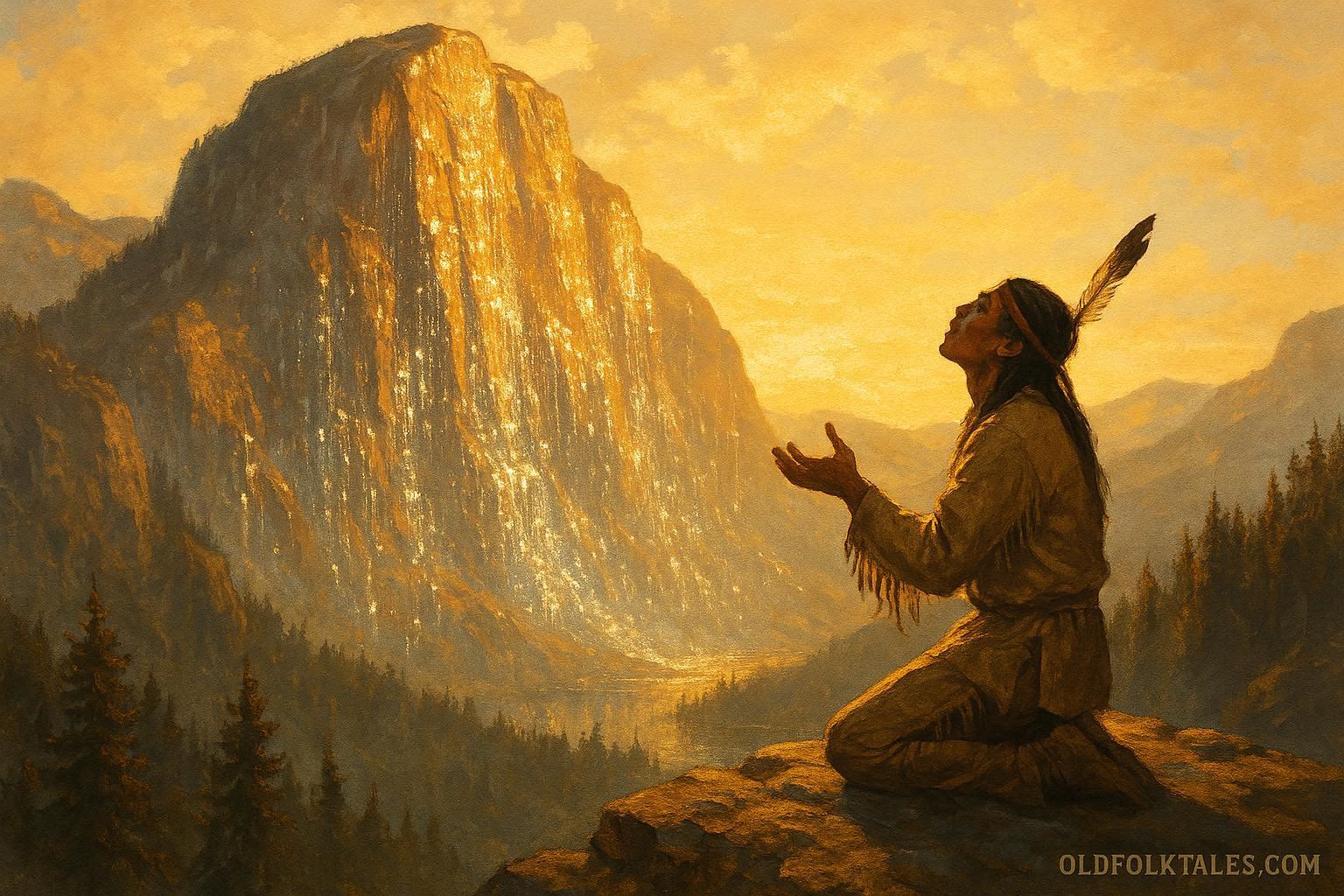
In the heart of British Columbia, where mist curls around pine-covered peaks and rivers carve deep paths through ancient valleys, there stands a mountain that glitters when sunlight touches its face. The people of the Nlaka’pamux Nation say that this mountain is alive with memory, for once long ago, it wept. Its tears turned to crystal, and the cliffs still gleam with sorrow and love. This is the story of The Mountain Who Wept Stone.
Long ago, there lived a warrior named Satsum, proud and strong, known across the valley for his bravery. Yet his greatest strength was not his courage in battle but his love for Amata, a healer whose laughter was as bright as the morning sun. Together they walked the forest trails, offered thanks to the river spirits, and sang songs to the mountains that guarded their people.
When winter came early and fiercely, the snows buried the valley and a sickness swept through the lodges. Amata tended to the sick with gentleness and hope, but the sickness took many lives. Satsum prayed to the spirits of stone and sky, offering his finest carvings and sacred cedar to save her. But no offering could change fate. On a morning when the mountains were painted with dawn’s red light, Amata’s spirit left her body and joined the ancestors.
Discover the diverse storytelling traditions of Canada — from the icy North to the Maritimes
Satsum’s heart broke. He turned away from his people and began to climb the highest mountain. He carried no food, no water, and spoke no words. He walked through wind and snow until he reached the peak. There, surrounded by silence and sky, he fell to his knees and wept. His tears fell upon the cold rock, and as they touched the stone, they hardened into clear crystals that caught the light. The mountain felt his grief and began to shimmer, its surface glowing with sorrow.
From the village below, the people saw the strange light upon the cliffs and knew that Satsum’s spirit had joined the land. When they climbed the mountain to look for him, they found no trace of his body, only the shining stones that sparkled like frozen tears. The elders said the mountain had taken his sorrow into itself so that love would never fade. They named it The Mountain Who Wept Stone.
Every spring, when the rivers thawed and flowers returned to the valley, the people brought offerings of cedar and sweetgrass to the mountain. They whispered the names of their loved ones into the wind, believing that Satsum and Amata could hear them. When sunlight struck the cliffs, the stones glittered, and the people said the mountain was remembering those who had once loved deeply.
Travelers who passed through the valley often spoke of hearing faint singing in the night. The sound rose and fell like wind through stone. The elders taught that it was Satsum’s spirit calling to Amata, a song of eternal love that echoed through the ages. The land had become their bond, unbroken and everlasting.
Generations have passed, but the people still tell the story. They say that when grief is great, it should not be hidden, for even tears can become something beautiful. The mountain stands as a reminder that love never truly dies. It becomes part of the world around us, the land, the air, and the shining stones that remember.
Explore the ancestral legends of Canada, Mesoamerica, and South America’s Indigenous tribes.
Moral Lesson
The story of The Mountain Who Wept Stone teaches that love is eternal and that even sorrow can create beauty. It reminds us that the earth remembers our deepest emotions and that grief, when expressed, becomes a source of strength and transformation.
Knowledge Check
-
Who were Satsum and Amata, and what made their bond special?
They were a warrior and a healer who shared a deep love that connected them to their people and the natural world. -
What caused Satsum’s great sorrow?
He grieved the death of his beloved Amata after a sickness swept through their village. -
What happened when Satsum’s tears touched the mountain?
His tears turned into shining crystals, and the mountain began to glow with sorrow and love. -
How did the Nlaka’pamux people honor the warrior’s memory?
They brought offerings of cedar and sweetgrass to the mountain each spring and whispered prayers to the spirits. -
What do the glittering stones on the cliffs represent?
They symbolize everlasting love, remembrance, and the beauty that can arise from sorrow. -
What is the main message of this folktale?
That love and grief are sacred, and through expressing pain, people find peace and connection with the world around them.
Source
Adapted from Tales of the Interior Salish by James Teit, 1917.
Cultural Origin
Nlaka’pamux First Nations, British Columbia, Canada.