In the time before time was measured, when the world was still learning its rhythms, the Moon was not the distant, pale wanderer we know today. She was radiant and brilliant, shining with a light nearly as fierce as her brother, the Sun. Every night, she would traverse the heavens in her silver chariot, illuminating the mountains and valleys below with a warm, steady glow that rivaled the day itself.
But the Moon was lonely in her celestial kingdom. Night after night, she looked down upon the earth and watched the lives of mortals unfold beneath her light. She saw lovers meeting in moonlit gardens, families gathering around fires, and children dancing in her silvery beams. Yet she remained apart, untouchable and alone in the vast darkness of the sky.
Click to read all South American Folktales — timeless stories from the Andes to the Amazon.
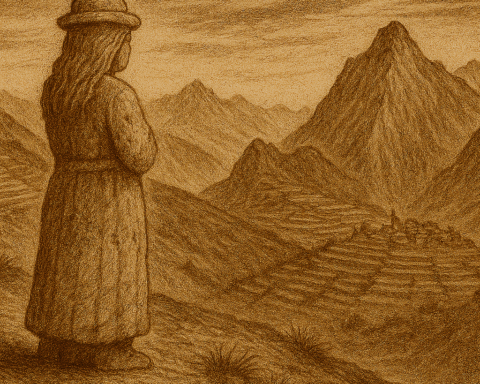
One evening, as the Moon cast her gaze across the Andean highlands, her eyes fell upon a young shepherd tending his flock on a remote mountainside. His name was Chasqui, and he was unlike any mortal she had ever seen. He played a simple wooden flute, and the melody that drifted up to the heavens was so beautiful that even the stars seemed to pause in their eternal dance to listen. His face was kind, weathered by wind and sun, and his eyes held a gentleness that moved the Moon’s immortal heart.
Night after night, the Moon found herself drawn to this lonely shepherd. She would linger longer over his mountain, bathing him in her softest, most tender light. Chasqui, for his part, began to sense a presence in the moonlight something warm and watchful that seemed to care for him in his solitude.
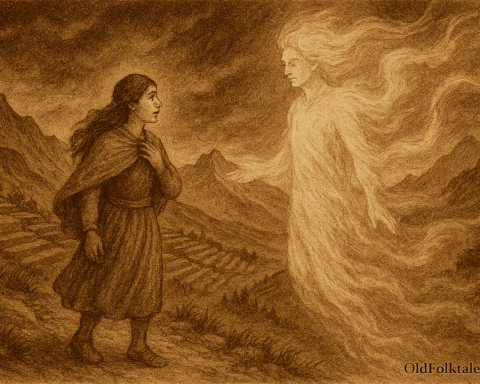
Unable to bear the distance any longer, the Moon made a decision that would change the heavens forever. She waited until the Sun had fully retreated beyond the western peaks, then she descended from her celestial path. Wrapping herself in mortal form, she appeared before the astonished shepherd as a beautiful woman dressed in robes that shimmered like water under starlight.
“Do not be afraid,” she whispered, her voice like wind through mountain grass. “I have watched you from above, and your music has called to my heart.”
Chasqui, though amazed, was not frightened. He had always felt a special connection to the night sky, and now he understood why. The Moon visited him every night thereafter, arriving after sunset and leaving before the first hint of dawn. Together, they would sit beneath the stars, sharing stories and dreams. She told him of the loneliness of eternity, and he spoke of the simple beauty of earthly life the smell of rain on stone, the warmth of his llamas’ wool, the taste of quinoa porridge.
Their love grew with each passing night, pure and profound. Chasqui would play his flute, and the Moon would sing ancient songs from before the world began. For the first time in her endless existence, she knew happiness.
But secrets kept in the heavens do not remain hidden forever.
The Sun, traversing his daily path across the sky, began to notice his sister’s absence from her proper celestial course. Her light grew dimmer as she spent her energy descending to earth each night. Suspicious, he rose earlier than usual one morning and discovered the truth: the Moon, wrapped in mortal form, asleep in the shepherd’s arms on the mountainside.
The Sun’s rage was terrible to behold. How dare his sister, a celestial being of divine origin, lower herself to consort with a mere mortal! In his fury, he unleashed the full force of his fire upon the sleeping shepherd. The flames consumed Chasqui in an instant, reducing him to nothing but ash that scattered across the mountain peaks.
The Moon awoke to find her beloved gone, only a dark stain upon the earth marking where he had lain. Her anguished cry echoed across the mountains and valleys, a sound so sorrowful that even the condors fell silent in the sky.
Heartbroken beyond measure, the Moon retreated to the heavens. But she was forever changed. Her brilliant light had dimmed to a pale, ghostly glow a reflection of her sorrow. And she could no longer bear to shine fully upon the world that had taken her love from her. Instead, she began to hide herself away, showing only a sliver of her face, then slowly emerging, then hiding once more in an endless cycle of grief and remembrance.
To this day, the Moon waxes and wanes, never maintaining her full brightness for long. When she is full and round, she remembers the brief time of her happiness. When she disappears into darkness, she mourns the loss of her shepherd. And on certain nights, when the wind whistles through the Andean peaks, the people say you can still hear the shepherd’s flute playing in the moonlight and see the Moon’s tears falling as mountain mist upon the highlands where Chasqui once tended his flock.
Click to read all Andean Highland Folktales — echoing from the mountain peaks of Peru, Bolivia, and Ecuador.
The Moral Lesson
This ancient Andean tale teaches us about the painful consequences of love that crosses forbidden boundaries, and the sorrow that comes from defying natural order. Yet it also speaks to the universal nature of love itself how it can touch even the most distant hearts and leave permanent marks upon the world. The Moon’s eternal grief reminds us that true love, once experienced, changes us forever, and that some losses can never be fully overcome, only endured through the cycles of time.
Knowledge Check
Q1: Who was Chasqui in the Andean legend of the Moon? Chasqui was a humble shepherd who tended his flock in the Andean highlands. He played a wooden flute whose beautiful melodies attracted the Moon’s attention, leading her to fall in love with him and descend from the heavens to be with him.
Q2: Why did the Moon descend from the sky in this Peruvian folktale? The Moon descended from the sky because she was lonely in her celestial realm and fell deeply in love with the shepherd Chasqui. She was moved by his gentle nature and the beautiful music he played on his flute, and she could no longer bear to remain distant from him.
Q3: What does the Sun represent in this Andean mythology? The Sun represents divine authority, the enforcer of cosmic order, and the guardian of boundaries between celestial and mortal realms. His fury at discovering the Moon’s relationship with a mortal shepherd reflects the ancient belief in maintaining separation between the divine and human worlds.
Q4: How does this legend explain the lunar cycle and phases of the Moon? The legend explains that the Moon’s waxing and waning is a manifestation of her grief cycle. When full, she remembers her brief happiness with the shepherd; when dark, she mourns his loss. Her inability to maintain her full brightness represents her eternal sorrow and her changed nature after losing her beloved.
Q5: What is the cultural significance of this story in Andean tradition? This tale reflects Andean cosmology, where celestial bodies are living beings with emotions and relationships. It explains natural phenomena through human experiences of love and loss and reinforces cultural values about respecting boundaries between different realms of existence while acknowledging the universal power of love.
Q6: What happened to the shepherd Chasqui in the Moon legend? The Sun discovered the Moon’s secret relationship with Chasqui and, in his rage at this transgression of cosmic order, unleashed his full fire upon the sleeping shepherd. Chasqui was instantly consumed by flames and reduced to ash, which scattered across the Andean mountain peaks.
Source: Adapted from Andean oral poetry collections and Leyendas de la Sierra Peruana (Legends of the Peruvian Highlands)
Cultural Origin: Andean Indigenous Peoples, Peruvian Highlands and Sierra Region