In the time when the stars still spoke to those who listened and the heavens felt close enough to touch, there lived a young maiden in a village high in the mountains near Cusco. She was known throughout her community for her gentle nature and her unusual habit every evening, as the sun descended behind the western peaks and shadows lengthened across the terraced fields, she would walk alone to the sacred lake that lay like a mirror of obsidian at the edge of the village.
The girl was beautiful in the way of mountain flowers, delicate yet resilient, with long dark hair that fell past her waist like a river of night and eyes that reflected the depth of mountain pools. But it was not vanity that drew her to the water’s edge each evening. She went there to pray, to contemplate, and most of all, to gaze upon the reflection of the moon.
Click to read all Andean Highland Folktales — echoing from the mountain peaks of Peru, Bolivia, and Ecuador.
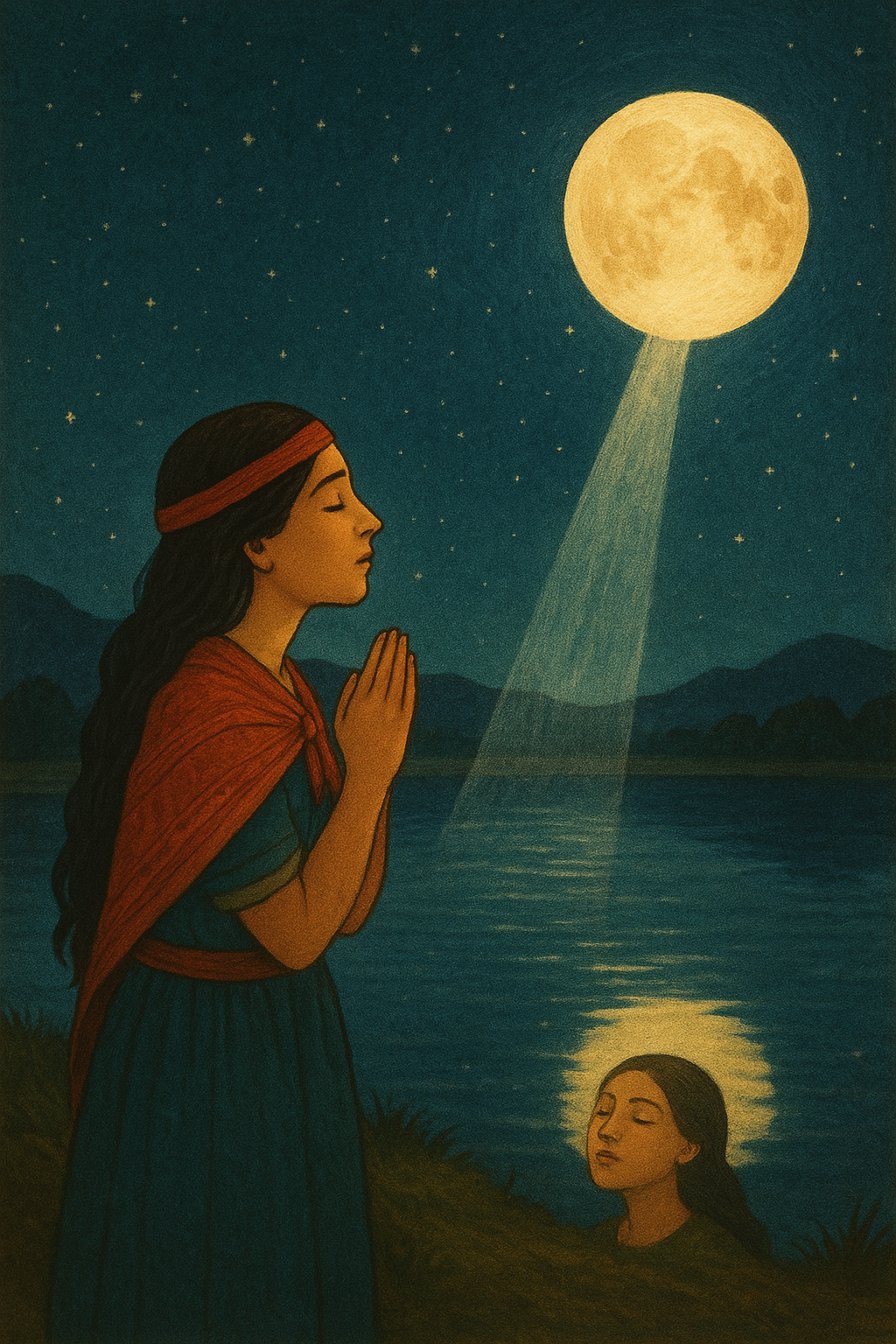
The lake was perfectly still in the evening hours, sheltered by surrounding hills from the winds that swept across the puna grasslands. Its surface became a perfect mirror when darkness fell, and on clear nights, it captured the image of Mama Killa the Moon Goddess in exquisite detail. The maiden would kneel at the water’s edge on the smooth stones worn by centuries of pilgrims and devotees, and she would look not up at the sky but down into the water, where her own reflection appeared beside the glowing orb of the moon.
At first, she simply marveled at the beauty of Mama Killa’s light so pure and silver, so gentle compared to the fierce brilliance of her brother Inti, the sun. The moonlight seemed to speak of mysteries and quiet wisdom, of the feminine divine that ruled the night and guided travelers through darkness. The maiden felt drawn to this celestial presence in a way she could not explain to her family or friends.
“Why do you spend your evenings alone by the lake?” her mother would ask, concerned. “You should be with the other young people, dancing and singing, preparing for the festivals.”
“I am happy where I am, Mother,” the girl would reply softly. “The moon’s beauty fills my heart with peace.”
As the seasons turned and the constellations wheeled overhead, the maiden’s nightly vigils continued. Her devotion deepened from mere admiration into something more profound a spiritual longing that consumed her thoughts during the day and filled her dreams at night. She began to see her reflection in the water beside the moon’s image not as two separate things but as a pairing, a connection between earth and heaven.
She would speak to Mama Killa as if the goddess could hear her prayers. “Great Mother of the Night,” she would whisper, her voice barely audible above the gentle lapping of water against stone, “how beautiful you are. How I wish I could be near you, to dwell in your silver light and share in your celestial peace. Take me to your realm, away from this heavy earth. Let me be part of your radiance.”
Night after night, month after month, the maiden offered these prayers. Her family grew worried as she became more withdrawn, eating little, speaking less, as if already half-departed from the mortal world. Her skin grew pale and luminous, and her eyes seemed to reflect moonlight even during the day. The other villagers whispered that she was becoming like a ghost, a spirit caught between worlds.
But the maiden paid no attention to their concerns. She was focused entirely on her devotion, on the growing certainty that Mama Killa heard her prayers and would, in time, respond.
Then came the night of the full moon during the feast of the harvest a night when Mama Killa’s power was at its zenith and her light shone bright enough to cast shadows as sharp as those made by the sun. The maiden walked to the lake as always, but this night felt different. The air itself seemed to shimmer with potential, and the stars burned with unusual intensity.
She knelt at the water’s edge and gazed down at her reflection beside the moon’s perfect circle. As she began her evening prayer, something extraordinary happened.
The reflection of the moon in the water began to glow brighter, more intensely, until the maiden had to shield her eyes from its radiance. Then, from the center of that glowing orb, a beam of pure silver light emerged not reflecting from the sky above but rising from the water itself, as if the lake had become a gateway between worlds.
The beam of moonlight rose vertically, a column of liquid silver that extended upward into the night sky, connecting the earth to the heavens. And in that moment, the maiden heard a voice soft as silk, ancient as the mountains, filled with otherworldly warmth.
“Daughter of earth,” spoke Mama Killa, “your prayers have reached me across the vast distances of the sky. Your devotion is pure, your heart is sincere, and your longing is true. I grant your wish. Come, and be part of my light forever.”
The maiden’s heart soared with joy and wonder. Without hesitation, without even a thought for the family and life she was leaving behind, she reached out and touched the beam of silver light. It was solid beneath her fingers, yet soft, like touching water that had been transformed into something between liquid and air.
She began to climb.
Step by step, the maiden ascended the column of moonlight, leaving the earth behind. The stones at the water’s edge grew distant below her, then the lake itself became small, then the entire valley with its terraced fields and stone houses. She climbed through clouds that felt like cool mist against her skin, through layers of atmosphere where the air grew thin and the stars grew near.
As she climbed higher, her earthly body began to transform. Her heavy flesh became light, her solid form became luminous, her mortal nature gave way to something eternal. By the time she reached the realm of Mama Killa, she was no longer entirely human but had become something in between a being of light and spirit, pure devotion made visible.
Mama Killa welcomed her into the silver court of the moon, where she would dwell forever, a companion to the goddess and a servant of the night.
Back in the village, when the morning came, the maiden’s family discovered she was missing. They searched everywhere in the fields, along the mountain paths, through the forests. But it was at the lake that they found the only clue: her woven shawl, left neatly folded on the stones where she always knelt, and beside it, footprints that led to the water’s edge and then simply… stopped.
That night, when darkness fell and Mama Killa rose again, the villagers gathered at the lake to mourn and search for answers. As they gazed up at the moon, they noticed something new in the sky a bright star that had not been there before, shining close beside the moon’s silver face, as if keeping it company.
The elders recognized it immediately. “Look,” they said, pointing skyward, “the maiden has been transformed. She has become Ñawi Killa the Eye of the Moon. See how she stays close to Mama Killa, forever devoted, forever watching.”
And so the star came to be known by that name among the Quechua people of Cusco and beyond. Parents would point it out to their children and tell the story of the maiden whose pure heart and devoted prayers earned her a place in the heavens. They would say that Ñawi Killa watches over those who pray with sincere hearts, and that it reminds all people that devotion, purity of spirit, and spiritual longing can lift the soul beyond the confines of earthly existence.
To this day, when people see that bright star near the moon, they remember the young maiden who loved Mama Killa so deeply that she was transformed from flesh into light, from mortal into eternal, from daughter of earth into the Eye of the Moon.
Discover the sacred tales of llamas, condors, and gods who guard the Andes
The Moral of the Story
This ethereal tale teaches us about the transformative power of pure devotion and spiritual aspiration. The young maiden’s unwavering focus on the divine symbolized by Mama Killa demonstrates that sincere spiritual longing can transcend the limitations of earthly existence. However, the story also carries a subtle warning about balance: the maiden’s single-minded devotion came at the cost of her earthly relationships and human life. The Quechua interpretation emphasizes the positive that purity of heart and devotion can elevate the soul to heavenly realms but the story also reminds us those spiritual pursuits, while noble, can sometimes lead us away from the human connections and responsibilities that ground us. The maiden’s transformation into Ñawi Killa represents the eternal reward for those who seek the divine with a pure heart, yet her family’s loss reminds us that every spiritual journey involves sacrifice and that the path to transcendence is one-way, leaving behind all that is mortal and earthly.
Knowledge Check
Q1: Who is Mama Killa in Quechua mythology, and what does she represent?
A: Mama Killa is the Moon Goddess in Quechua/Inca cosmology, the feminine divine counterpart to Inti the Sun. She represents the gentle, mysterious aspects of divinity, rules over the night, and guides travelers through darkness. She embodies feminine spiritual power and celestial wisdom.
Q2: Why did the young maiden visit the lake every evening?
A: The maiden went to the lake each evening to pray and gaze upon the reflection of Mama Killa (the moon) in the still water. She was drawn by spiritual devotion and longing to be near the moon’s beauty and divine presence, preferring this contemplation to earthly pleasures.
Q3: What physical changes occurred in the maiden as her devotion deepened?
A: As her spiritual focus intensified, the maiden became withdrawn, ate little, and her skin grew pale and luminous. Her eyes seemed to reflect moonlight even during the day, and villagers noticed she was becoming ghost-like, as if already half-departed from the mortal world.
Q4: How did Mama Killa respond to the maiden’s prayers?
A: On the night of the full moon during harvest time, Mama Killa sent down a beam of pure silver light from the water itself, creating a column connecting earth to heaven. She invited the maiden to climb this moonbeam and join her in the celestial realm forever.
Q5: What is Ñawi Killa, and how did it come to exist?
A: Ñawi Killa means “The Eye of the Moon” in Quechua. It is a bright star that appears close to the moon, believed to be the transformed maiden who ascended to the heavens. She became a celestial companion to Mama Killa, forever devoted and watching from beside the moon.
Q6: What lesson do Quechua parents teach children through this story?
A: Parents teach that Ñawi Killa reminds us that devotion, purity of spirit, and sincere prayers can lift the soul to heavenly realms. The star watches over those who pray with sincere hearts and shows that spiritual longing can transcend earthly existence and lead to divine transformation.
Source: Adapted from Quechua oral traditions documented in Tradiciones Quechuas del Cusco (Quechua Traditions of Cusco), Instituto Nacional de Cultura, Peru (1975), and M. Arguedas, Mitos, Leyendas y Cuentos del Perú (1949).
Cultural Origin: Quechua peoples, Cusco region, Andean Highlands of Peru