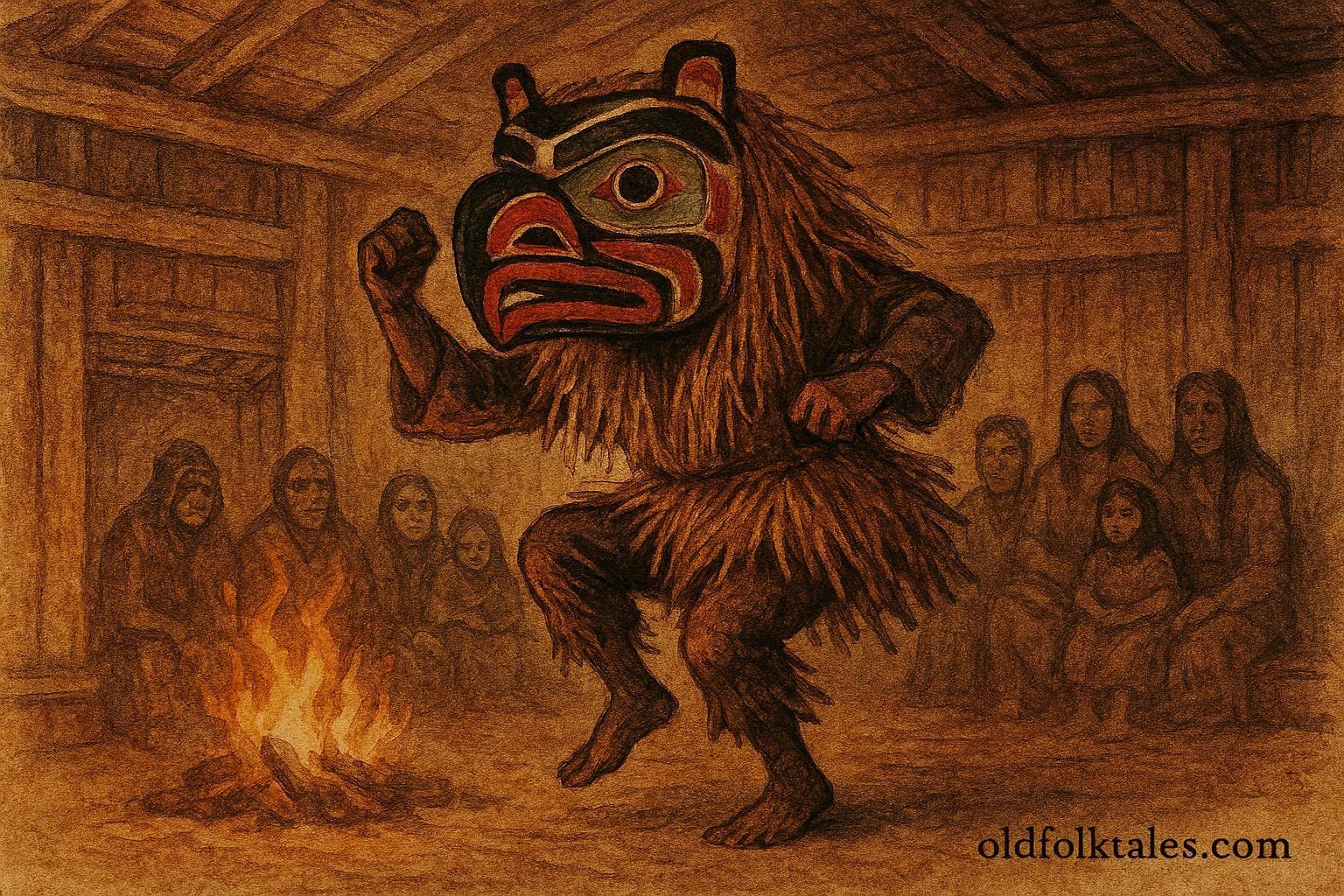
In a coastal village along the rugged shores of what is now British Columbia, the people lived according to the rhythms of tide, forest, and ceremony. Cedar trees stood tall behind the longhouses, their bark and wood shaping canoes, tools, and masks that carried stories older than memory. Among these masks was one unlike any other, known quietly as the Mask That Could Not Be Worn Twice.
The mask was carved generations earlier by a master carver whose name was no longer spoken aloud. It was not forgotten, but protected. The elders said his hands moved with guidance, not ambition, and that the mask was created not to impress, but to serve. Its face was neither fierce nor gentle, neither smiling nor angry. It reflected only what the wearer brought into it.
The mask was kept wrapped in woven cedar bark and placed high within the longhouse. It was not displayed. It was not admired casually. It was brought down only during moments when the community needed balance restored, when disputes threatened harmony, or when a ceremony required humility rather than authority.
Journey into the rhythm, wit, and wonder of Caribbean storytelling — from Haiti to Jamaica
When worn for its true purpose, the mask carried power. Songs deepened. Words spoken through it carried weight. Those who witnessed such ceremonies felt calm settle over them like evening mist. But the elders warned that the mask listened as much as it spoke.
One winter, after many seasons of peace, a man named Gwa’na grew restless. He was a skilled speaker, confident in ceremony, and admired for his strong voice. Over time, admiration began to harden into pride. He believed the people listened because of him, not because of the teachings he carried.
When a minor disagreement arose between families, the elders prepared for a reconciliation ceremony. They chose Gwa’na to assist, trusting his experience. That night, as the longhouse filled with firelight and quiet anticipation, the mask was brought down and placed before him.
As Gwa’na lifted it, he felt its weight settle heavily in his hands. Instead of grounding him, the sensation thrilled him. He thought of how the people would watch him, how his voice would command the space.
When he placed the mask over his face, something shifted.
The songs continued, but they felt thinner. The fire cracked loudly. Gwa’na spoke words meant to guide reconciliation, yet they rang hollow. The families listened politely, but the tension did not lift. When the ceremony ended, the elders exchanged quiet glances.
Later that night, the mask was returned to its place without comment.
Weeks passed. Gwa’na felt unsettled. The respect he once felt during ceremony now felt distant. When another gathering was planned, he asked to wear the mask again, insisting he could correct what had gone wrong.
The elders refused.
“The mask is not worn for desire,” one elder said. “It is worn for need.”
Offended, Gwa’na waited until night. Believing the power belonged to the object itself, he climbed quietly into the longhouse and took the mask.
He wore it alone.
At first, nothing happened. Then the mask grew unbearably heavy. His breath echoed strangely within it. The carved face seemed to tighten, pressing against him. When he tried to remove it, his hands trembled. The room felt empty, yet crowded with unseen presence.
By morning, the mask lay on the floor. Gwa’na was found nearby, shaken and silent.
When the elders examined the mask, they knew. The cedar surface had dulled. The presence that once lingered around it was gone. The mask had turned away.
From that day on, the mask was never worn again.
Yet its lesson endured.
The elders taught that sacred authority does not repeat itself for pride. Power offered without humility withdraws. Ceremony is not performance, and tradition is not possession.
The mask had not failed. It had fulfilled its final teaching.
Explore the ancestral legends of Canada, Mesoamerica, and South America’s Indigenous tribes.
Moral Lesson
Sacred traditions are not tools for personal recognition. When ceremony is approached with humility and responsibility, it strengthens the community. When approached with pride, it loses its power. True authority is earned through service, not display.
Knowledge Check
1. Why was the mask created?
The mask was created to serve the community during moments of imbalance, not for personal recognition or display.
2. Why did the mask lose its power?
It lost its power because it was worn for pride rather than purpose, violating its sacred responsibility.
3. What mistake did Gwa’na make?
He believed the power came from the mask itself rather than from humility and intention.
4. Why did the elders refuse to let the mask be worn again?
They understood that sacred authority does not repeat itself once misused.
5. What does the mask symbolize?
It symbolizes ceremonial authority, responsibility, and the limits placed on power by tradition.
6. What lesson does the community learn?
That tradition must be approached with humility, or it will withdraw its meaning and strength.
Source
Adapted from Royal BC Museum Indigenous collections and documented ceremonial ethics studies.
Cultural Origin
Kwakwaka’wakw First Peoples, British Columbia, Canada.