In a remote Highland glen, where the mountains stood like silent sentinels and the heather stretched purple across the moorland, there lived a community of families who scratched their living from the harsh but beautiful land. The soil was thin, the winters long, and survival depended on cooperation and mutual support. Among these humble crofters, there was one man who owned a piece of land blessed with something precious beyond measure the only fresh spring for miles around.
The spring bubbled up from deep within the earth, cold and clear as crystal, flowing year-round from a cleft in the rocks. In wet seasons, it was merely a convenience. But when the rains failed and the summer sun beat down mercilessly upon the glen, turning the streams to dust and the earth to cracked clay, this spring became the difference between life and death. Every living creature in the glen human and animal alike depended upon its waters.
Click to read all Andean Highland Folktales — echoing from the mountain peaks of Peru, Bolivia, and Ecuador.
The man who owned the land where the spring emerged was neither the poorest nor the richest in the community, but he possessed something that made him powerful: control over what everyone needed. In the beginning, neighbors had come freely to fill their vessels, offering thanks and perhaps a small token of appreciation, a loaf of bread, a handful of eggs, a blessing spoken in the old Gaelic tongue. But as the years passed, the man’s heart grew harder than the granite beneath his feet.
He began to see the spring not as a gift from the earth to be shared, but as his personal property, a resource to be exploited. He built a fence around it, installed a locked gate, and announced that from that day forward, anyone who wanted water would have to pay. The price he set was not modest, it was calculated to extract the maximum that desperate people could afford.
When drought came to the glen, as it inevitably did, the man’s neighbors found themselves at his mercy. Mothers carrying infants appeared at his gate, offering what little coin they had saved. Old men who had worked the land for decades came with trembling hands, begging for water to keep their livestock alive. Children were sent with precious belongings, a silver brooch, a treasured book, anything that might convince the spring’s keeper to unlock his gate.
The man accepted their payments with cold indifference, measuring out water as miserly as a banker counting coins. To those who had nothing left to give, he turned a deaf ear. “I did not make the drought,” he would say, his voice devoid of compassion. “Why should I suffer for it? The spring is mine, on my land. If you wanted water, you should have dug your own well or saved your money more carefully.”
When elderly neighbors, too weak to carry heavy buckets up the hillside, asked if they might send their grandchildren to fetch water on their behalf, he refused unless payment doubled, one price for the water, another for the inconvenience of dealing with children. When a widow whose husband had died the previous winter came pleading for water to keep her small garden alive so she might feed her children, he quoted her a price he knew she could never afford, then sent her away with a shrug.
The community watched with growing disgust and helplessness. In Highland tradition, certain things were understood to be communal, the grazing land, the peat for fuel, and most especially water. Springs and wells were considered gifts from the earth itself, not commodities to be hoarded and sold. What the man was doing violated every unspoken law of the glen, every principle of mutual aid that had allowed their ancestors to survive in this unforgiving landscape for generations.
But then something strange began to happen. The spring, which had flowed reliably for as long as anyone could remember, began to diminish. At first, the change was subtle, the water seemed slightly less abundant, the flow a bit slower. But as weeks passed, the decline became undeniable. The once-vigorous stream that had gushed from the rocks dwindled to a trickle, then to barely more than a seep.
Even more peculiar, animals began to refuse the water. Cattle that had always drunk eagerly from the spring now turned their heads away, snorting with displeasure. Sheep would approach, lower their muzzles to the surface, then back away as if repelled by something invisible. Birds that had once gathered at the spring to bathe and drink now avoided it entirely, choosing instead to fly miles away in search of other sources.
The man himself, who had always drunk from his precious spring, began to suffer mysterious ailments. His stomach cramped and churned. His head ached with a persistent, throbbing pain that no remedy could ease. His skin took on a grayish pallor, and his eyes became dull and sunken. He grew thin despite eating, and his strength ebbed away like water draining into dry ground.
Desperate, he consulted what healers remained in the glen, those who hadn’t already left in search of more hospitable lands or more generous neighbors. They examined him, prepared their remedies of herbs and whispered prayers, but nothing helped. Some whispered among themselves that the land itself had turned against him, that he had violated something so fundamental that nature itself rebelled.
The man’s condition worsened steadily. As autumn gave way to winter, he became bedridden, his body wasting away as surely as his spring had diminished. He died alone in his house, with his precious gate still locked and his strongbox still full of the coins he had extracted from his desperate neighbors. No one mourned him. The funeral was attended out of duty, not affection, and the prayers spoken over his grave were perfunctory.
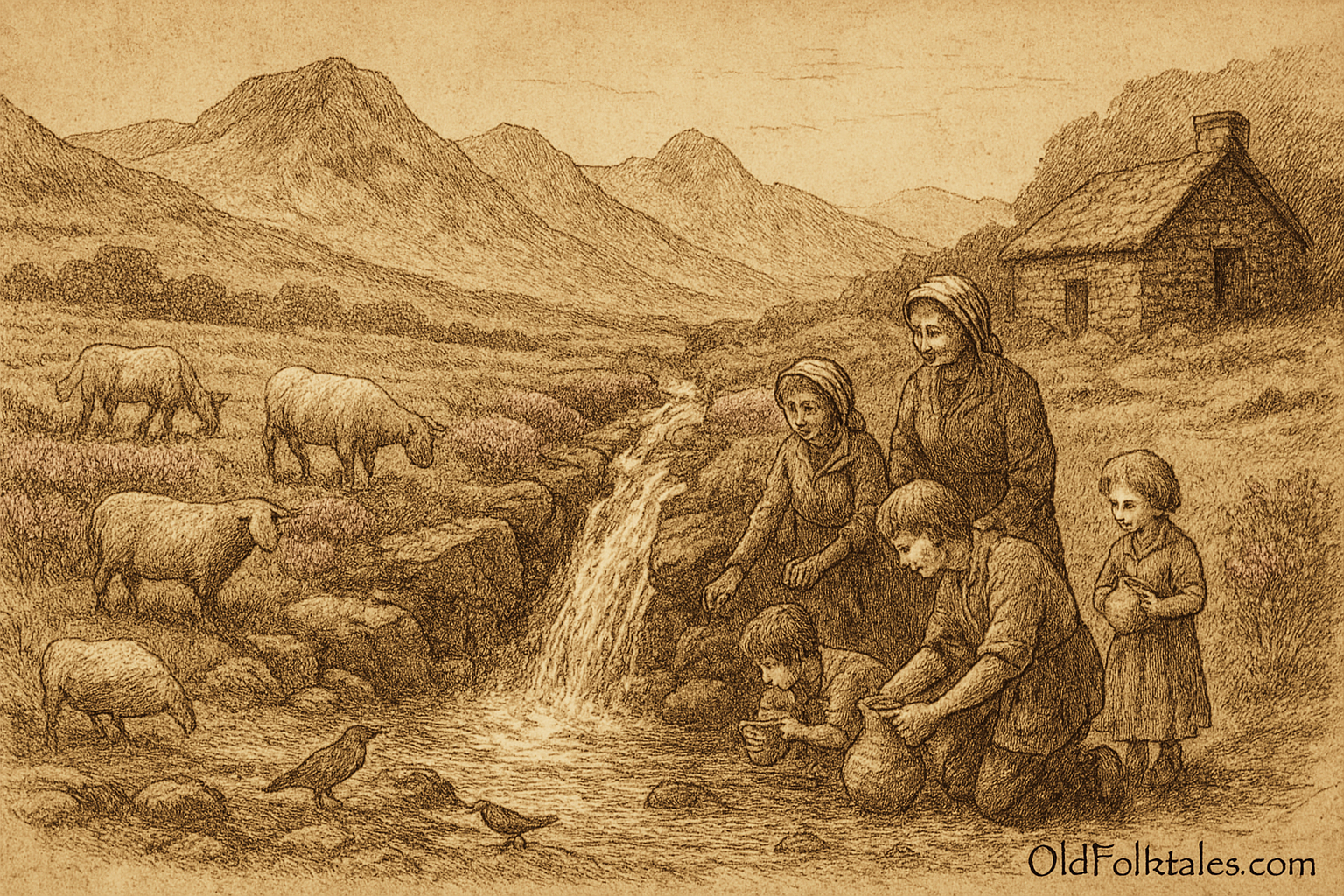
But a remarkable thing happened after his death. Within days of his burial, the spring began to flow again. At first, just a trickle, then a stream, and finally a vigorous gush as strong as it had ever been. The water ran clear and cold and sweet once more. Animals returned to drink from it without hesitation. The man’s distant relatives, who inherited the property, immediately tore down the fence and gate, and the spring returned to what it had always been meant to be a communal resource, a gift shared freely among all who needed it.
The glen prospered once more. Families who had considered leaving decided to stay. Gardens bloomed, livestock thrived, and life returned to its ancient rhythm of mutual dependence and shared fortune. The man who had tried to own the spring was quickly forgotten, his name rarely spoken, his deeds remembered only as a cautionary tale told around winter fires.
Click to read all South American Folktales — timeless stories from the Andes to the Amazon.
The Moral Lesson
This Highland parable teaches a profound truth about the nature of essential resources and human responsibility. Water, like air and sunlight, is a fundamental necessity that sustains all life, it cannot be rightfully claimed as exclusive property without moral and often literal consequences. The spring’s decline and the man’s illness symbolize how greed and the hoarding of communal resources disrupts the natural order and ultimately destroys the hoarder himself. In traditional Highland society, survival depended on recognizing that certain gifts of nature belong to the community, not to individuals. The story reminds us that when we treat life’s essentials as commodities to exploit rather than blessings to share, we sever ourselves from both human community and the natural world that sustains us, inviting ruin upon ourselves.
Knowledge Check
Q1: What made the spring so valuable in this Scottish Highland tale?
A1: The spring was the only source of fresh water for miles in a remote Highland glen. During droughts, when streams dried up and the earth cracked under the summer sun, this spring became essential for survival providing drinking water for families and livestock alike. Its year-round flow from deep within the earth made it precious beyond measure in the harsh Highland environment.
Q2: How did the landowner violate Highland communal traditions?
A2: The landowner violated fundamental Highland traditions by claiming exclusive ownership of the spring and charging money for access to its water. In traditional Gaelic Highland culture, essential natural resources like water, grazing land, and peat were considered communal gifts to be shared, not commodities for individual profit. By fencing the spring, installing a locked gate, and extracting payment from desperate neighbors, he broke the unspoken laws of mutual aid that had sustained Highland communities for generations.
Q3: What supernatural signs appeared after the man began exploiting the spring?
A3: Several mysterious signs suggested nature itself was rebelling against the man’s greed. The spring, which had flowed reliably for generations, began to diminish and shrink for no apparent reason. Animals, cattle, sheep, and birds, refused to drink from the water despite their thirst, as if they sensed something wrong. The man himself developed inexplicable illnesses, including stomach cramps, persistent headaches, and a wasting condition that no healer could cure, suggesting the land had turned against him.
Q4: What happened to the spring after the greedy man’s death?
A4: Remarkably, within days of the man’s death, the spring returned to full vigor. The water began flowing strongly again, running clear, cold, and sweet as it had in earlier times. Animals immediately returned to drink from it without hesitation. His relatives tore down the fence and gate, restoring the spring to its traditional role as a freely shared communal resource, and the glen prospered once more.
Q5: What does the spring symbolize in Highland Scottish folklore?
A5: In this Highland tale, the spring symbolizes essential natural resources that are meant to be shared communally rather than hoarded individually. It represents the life-sustaining gifts of the earth that no person has the right to monopolize. The spring’s response to the man’s greed, diminishing when hoarded, thriving when shared embodies the Highland belief that nature itself enforces justice and that attempting to own what should be communal disrupts both social and natural order.
Q6: What cultural values about resources does this Scottish story teach?
A6: The story embodies core Highland values about communal responsibility and the proper relationship between humans and natural resources. It teaches that essential resources like water are gifts from the earth that must be shared equitably, that survival in harsh environments requires mutual aid rather than individual greed, and that violating these principles brings consequences from both the community and nature itself. The tale reflects the Gaelic understanding that humans are stewards, not owners, of the land and its bounty.
Source: Adapted from Gaelic oral tradition as recorded by John Francis Campbell in Popular Tales of the West Highlands.
Cultural Origin: Scottish Highlands, Gaelic Scotland