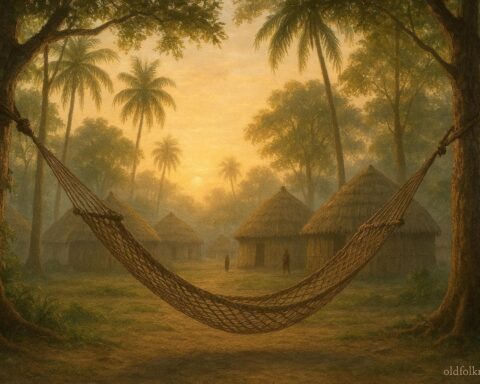
In the early days, when the forests of Hispaniola and Puerto Rico were thick with flowering trees and the air carried the scent of cassava bread and salt from the sea, there lived a man named Arawin. He was known in his village for speaking often of freedom, though few understood what he truly meant by it.
Arawin worked the fields like everyone else. He planted cassava, cleared brush, carried water, and helped mend canoes. Yet each task felt heavy to him. He watched the birds dart freely between blossoms, unburdened by tools or schedules, and his heart filled with longing.
“Why must people work endlessly,” he complained, “while creatures of the air live without effort?”
The elders warned him that labor was not a punishment but a bond, tying people to land and community. Arawin did not listen. He believed freedom meant movement without obligation.
One afternoon, while resting beneath a flowering tree, he watched a hummingbird hover effortlessly, wings beating so fast they blurred into light. The bird drank nectar and vanished in an instant, returning moments later as if distance meant nothing.
“If only I could live as you do,” Arawin whispered.
The forest heard him.
That night, as the moon climbed high, Arawin dreamed of the spirits who dwell between roots and clouds. They did not speak at first. Instead, they showed him images: birds feeding, birds fleeing storms, birds starving when flowers faded.
Still, Arawin’s desire remained unchanged.
When he awoke, his body felt light. His arms trembled. His breath came quickly. As he stood, the world shifted. His feet no longer touched the ground.
Arawin had become a hummingbird.
At first, joy filled him. He flew faster than thought, weaving through branches, skimming water, hovering in perfect balance. The world was vast and open. He laughed, though the sound came out as a soft chirr.
He no longer carried tools. He no longer bent beneath the sun. He felt free.
But freedom revealed its other face quickly.
Hunger came often. He had to feed constantly, darting from flower to flower. When blossoms were scarce, his strength faded rapidly. Storms terrified him. Winds tossed his tiny body like a leaf. He slept lightly, always alert, always vulnerable.
Worst of all, he could no longer speak.
When he flew near the village, he saw his people working together, sharing food, laughing, resting when the sun set. He tried to tell them who he was, but his voice could only hum.
Days passed. Then weeks.
Arawin learned that freedom without support was fragile. Each day required relentless effort simply to survive. There was no rest without danger. No shelter without vigilance.
One evening, exhausted, he perched near the cassava fields where he once complained of labor. He watched children helping elders, saw food shared, and felt a deep ache.
He understood then.
Work had never been the enemy. Isolation was.
That night, the spirits returned.
“You wished to escape effort,” they said, their voices like wind through leaves. “Instead, you learned its true shape.”
They gave him a choice. He could remain a hummingbird forever, light and fast, but always alone and at risk. Or he could return as a man, carrying the memory of what freedom truly means.
Arawin chose to return.
At dawn, he awoke beneath the flowering tree, human once more. His body felt heavy again, but his heart felt steady.
From that day on, Arawin worked willingly. He no longer envied the birds. When hummingbirds hovered nearby, he greeted them with respect, knowing their beauty was balanced by constant struggle.
The elders noticed his change. They asked what had taught him humility.
Arawin only smiled and said, “Even the lightest wings must work without rest.”
And so the hummingbird remained a symbol not of escape, but of balance between freedom and responsibility.
Explore the ancestral legends of Canada, Mesoamerica, and South America’s Indigenous tribes.
Moral Lesson
True freedom is not the absence of effort, but the understanding of responsibility. Those who flee obligation may gain movement, but they lose stability, connection, and rest. Wisdom lies in balance, not escape.
Knowledge Check
1. Why did Arawin wish to become a hummingbird?
Because he believed birds lived freely without labor or responsibility.
2. What did Arawin enjoy at first about being a hummingbird?
Speed, movement, and freedom from human work.
3. What difficulties did he face after transforming?
Constant hunger, danger from storms, exhaustion, and isolation.
4. What realization changed his perspective?
He learned that effort exists in all forms of life and that community provides strength.
5. Why did Arawin choose to return to human form?
He understood that shared responsibility offers stability and meaning.
6. What does the hummingbird symbolize in the story?
The balance between beauty, effort, freedom, and vulnerability.
Source
Adapted from Caribbean Folklife Project and Taíno oral tradition materials preserved in Puerto Rico and Hispaniola collections.
Cultural Origin
Taíno peoples, Puerto Rico and Hispaniola.