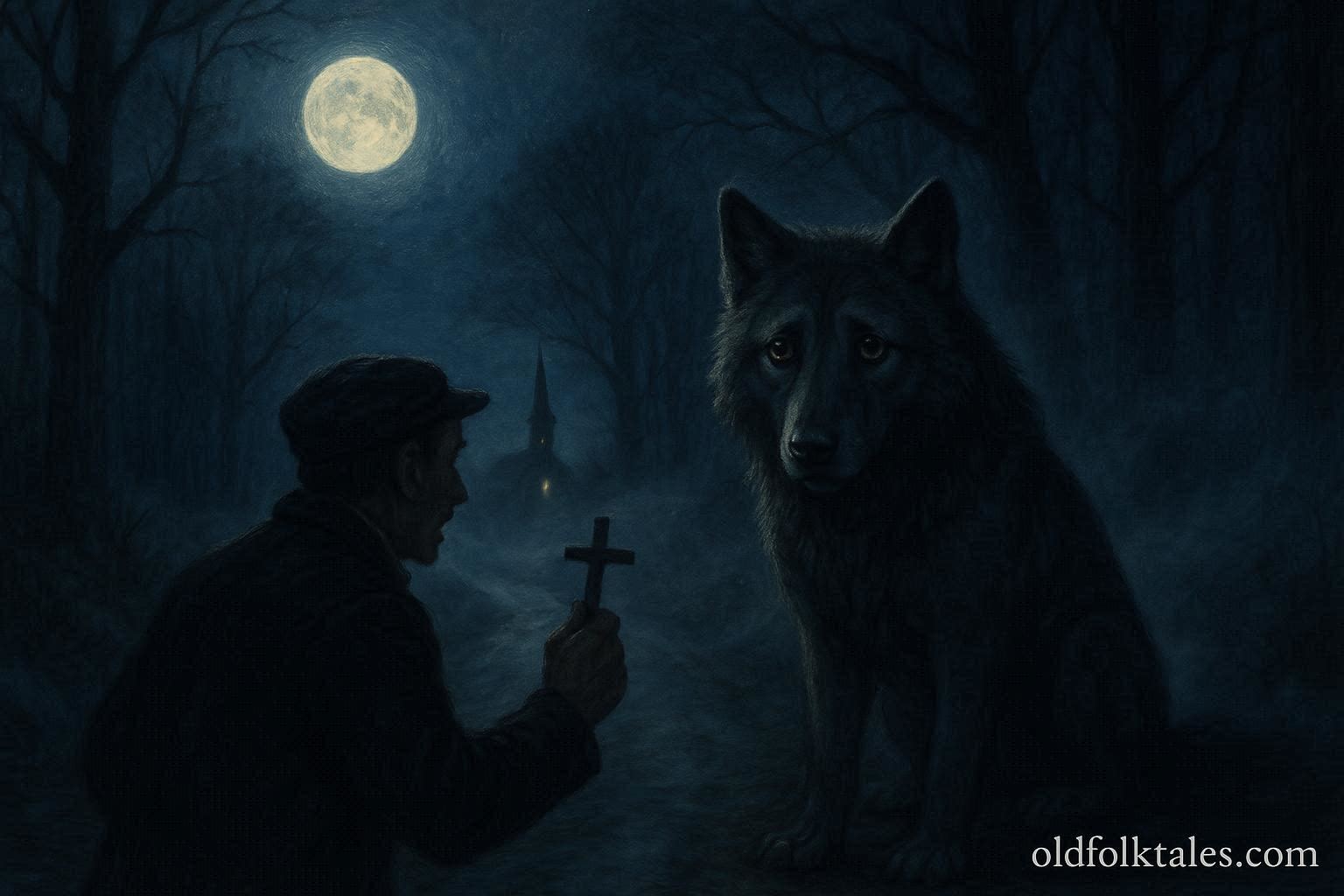
In the old countryside of Quebec, where the church bells echoed across the frozen fields and the scent of pine lingered in the evening air, there was one story that never faded from the fireside. It was the tale of the Loup Garou, the man cursed to walk as a beast because he turned away from his faith.
They said that anyone who failed to attend Mass for seven years, or who broke the sacred fast of Lent, risked falling under this dark enchantment. When the full moon rose, the curse would take hold. Skin would stretch and ripple like water, fur would grow thick and black, and the cursed one would roam the night, trapped between man and beast.
In a small village near Trois Rivieres lived a man named Etienne. He was known for his laughter, his strength, and his skill as a woodcutter. For many years he was a faithful man, always present at Mass, always bowing his head at prayer. But as time passed, he grew careless. The forest demanded his strength, and the work left him weary. Sunday mornings came, and he would tell himself that the Lord would understand if he stayed in bed a little longer.
Explore the land of La Llorona, trickster coyotes, and magical realism in Mexican folklore
Father Benoit, the priest of the parish, spoke to him one day after Mass. “Etienne, my son,” he said gently, “a man who forgets his prayers forgets his soul. The Lord forgives much, but not pride.”
Etienne smiled, half in shame, half in pride. “Do not worry, Father,” he said. “I have a strong heart. God will not abandon me.”
But he did not return the next Sunday, nor the one after. As years went by, the whispers began. The old women of the village shook their heads and muttered that a man who forgets the church invites the darkness to his door. Etienne laughed when he heard them. He was not a man who feared stories.
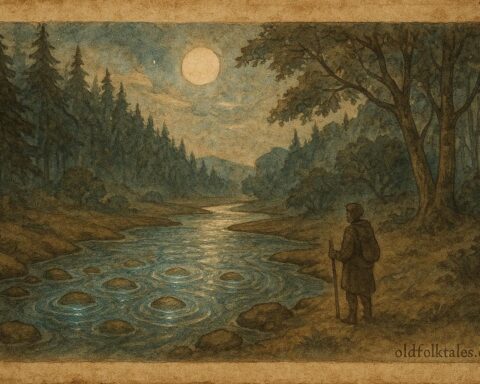
One autumn night, when the air was sharp and the moon shone bright over the fields, Etienne was returning home from a neighboring village. The road wound through thick woods where the branches formed long shadows across the path. He walked with a steady stride, his axe slung over his shoulder, the sound of his boots crunching the gravel.
Then he heard it, a low growl that rose from somewhere in the trees. He stopped. The night fell silent. He turned slowly, searching the dark. Nothing moved but the mist rising from the ground. Then the growl came again, closer this time.
Etienne’s heart began to pound. From the shadows, two glowing eyes appeared. They gleamed gold in the moonlight, and a shape stepped forward a wolf, but larger than any he had ever seen. Its fur was as dark as soot, and its breath rose in steaming clouds. Etienne lifted his axe.
The creature stopped a few paces away. For a moment, it looked at him not with hunger, but with sorrow. Its head tilted as though it recognized him. Then it howled a long, mournful sound that chilled the blood. Etienne stumbled back and made the sign of the cross. The beast shuddered and turned, disappearing into the trees.
He reached home shaken and pale. For days afterward, he spoke to no one of what he had seen. But the image of those eyes haunted his sleep.
Weeks passed. One night, as Etienne walked again near the edge of the forest, he saw movement on the road ahead. The same creature appeared, limping, its fur streaked with silver light. Though fear gripped him, Etienne could not turn away. The old stories of the Loup Garou returned to his mind, the belief that the curse could be broken if one drew blood from the creature without killing it.
Summoning his courage, he stepped forward. “If you are cursed, I will help you,” he whispered. The beast growled softly, as though it understood.
Etienne raised his small knife. When the creature lunged, he struck swiftly, grazing its shoulder. The beast cried out, its body trembling as light surrounded it. The fur began to melt away, and the monstrous form shrank and twisted until, before Etienne’s astonished eyes, a man lay on the ground.
He was pale and weak, his face lined with sorrow. Tears fell as he looked at Etienne. “Bless you,” the man whispered. “For seven years I have wandered beneath the moon, trapped in this form. I broke my faith and forgot the church. My sin made me a beast. You have freed me by your courage and compassion.”
Etienne helped him rise and led him toward the parish. When Father Benoit saw them enter, he was filled with wonder. The stranger confessed his sins, and the priest anointed him with holy water. The curse was lifted, and peace returned to the man’s eyes.
From that day on, Etienne never missed a single Mass. He gave food to the hungry and prayed morning and night. When people asked about the strange scar on his arm, he smiled and said it was a gift from the Lord, a reminder that faith must never sleep.
The villagers spoke of that night for generations. They said that sometimes, when the moon was full, a lonely howl could be heard from the woods. But it was not the cry of a monster. It was the echo of repentance, a song of sorrow turned to grace.
Moral Lesson
The story of the Loup Garou teaches that when faith is forgotten, the soul becomes lost. Yet forgiveness and redemption are always possible for those who seek them. The tale reminds people that discipline, prayer, and moral strength protect the heart from darkness.
Knowledge Check
1. What is the Loup Garou in French Canadian folklore?
The Loup Garou is a cursed man who transforms into a wolf-like creature as punishment for neglecting his faith.
2. What causes a person to become a Loup Garou?
The curse falls on anyone who fails to attend Mass for seven years or who breaks the fast of Lent.
3. Who warned Etienne about neglecting his faith?
Father Benoit, the village priest, warned him to keep his soul strong through prayer and devotion.
4. How was the curse broken?
The curse was lifted when Etienne drew blood from the creature without killing it, breaking the spell.
5. What lesson did Etienne learn from his encounter?
He learned that true strength lies in faith and repentance, not pride or fear.
6. What does the howl in the forest represent at the end of the story?
It symbolizes the sorrow of past sin and the hope of redemption that never dies.
Source
Adapted from Canadian Fairy Tales by Cyrus Macmillan (1922) and traditional French Canadian oral legends.
Cultural Origin
Quebec and Acadian French Canadian Folklore