In the old days, when the world was young and animals spoke as freely as people, all creatures lived together under the watchful eyes of Olufi, the supreme being who ruled heaven and earth. It was a time when order and duty bound every being, some to serve, some to command, and others to wander between both worlds.
Among them was Dog, a loyal, humble creature devoted to humankind. He lived in the houses of men, guarded their doors, followed them to hunt, and slept by their fires. He loved them deeply and obeyed without question, his eyes full of devotion and trust. Yet, despite this love, Dog was not free. He labored from dawn to dusk, chained by duty and custom, always answering to his human masters.
One afternoon, as the tropical sun poured gold through the leaves of the ceiba tree, Dog overheard a curious conversation between his neighbors, Cat and Mouse. The two sat whispering beneath a guava bush, discussing the state of things in the world.
Cat, stretching lazily, said, “Mouse, don’t you see? Freedom is the sweetest milk of life. Without it, even the fattest bowl of cream tastes bitter.”
Mouse, his whiskers twitching thoughtfully, replied, “True, Cat. I may live in fear of you, but I still come and go as I please. That’s freedom enough for me.”
Dog pricked up his ears. “Freedom?” he thought. “What is this freedom they speak of?” The word struck him like a spark in dry grass. He realized that, though he served humans faithfully, he had never chosen his place in life. He worked, guarded, fetched, and waited, but never rested without permission. Was this the natural order, or had something been taken from him?
That night, Dog could not sleep. The question gnawed at his heart. At dawn, he decided to seek answers from Olufi himself, for only the divine could resolve such matters of justice and fate.
Dog journeyed for many days, crossing dusty roads and lush cane fields, until he reached the great gates of Olufi’s heavenly court. Trembling, he bowed his head low and spoke with humble courage.
“Olufi, great father of all beings,” he said, “I have come to ask for my freedom. I love humankind, yet I serve them as a slave. I wish to love without chains, to live by my own will, and to walk as an equal among your creatures.”
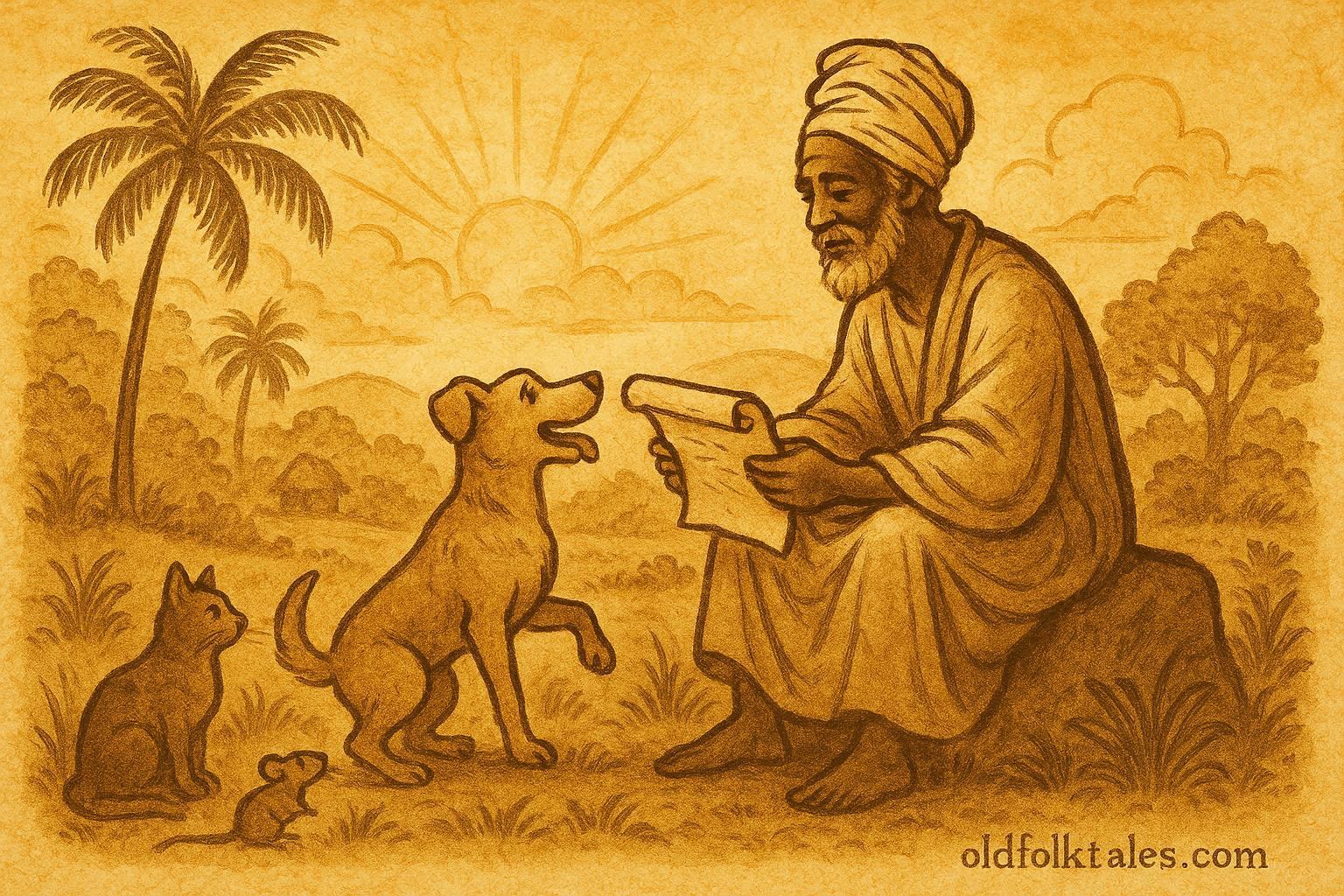
Olufi regarded him kindly, for the Dog’s faithfulness had long been known in heaven. After a moment of thought, Olufi nodded. “Dog,” he said, “your request is just. From this day forth, you shall be free. Take this Letter of Emancipation, proof that you are no one’s servant but your own master. Guard it well, for it will speak for you when words fail.”
Dog bowed in gratitude, his heart bursting with joy. But as Olufi handed him the precious document, a small problem arose, Dog had no pockets, no satchel, no hands to hold it. He tried carrying it in his mouth, but the wind tugged at the paper and made walking awkward. He tucked it under his collar, but it slipped out whenever he wagged his tail in happiness.
Ashamed and frustrated, Dog turned to Cat for help. “Dear Cat,” he pleaded, “Olufi has granted me freedom, but I have no safe place for the letter. Could you keep it for me until I need it?”
Cat, always clever and elegant, agreed with a purr. “Of course, my friend. You may rely on me. Your secret is safe in my keeping.”
Days passed, and Dog went about his duties feeling lighter, proud that he was now free, at least in spirit. But one day, Cat grew tired of the burden. “Why should I hold this paper for Dog?” she grumbled. “It means nothing to me.”
She called to Mouse, who was scurrying nearby. “Mouse,” she said sweetly, “could you keep this for me? It’s only a little scrap of paper, and you’re so good at hiding things.”
Mouse agreed, tucking the rolled letter into his tiny home in the wall. But his wife, Busia Mouse, found it later while preparing their nest. Seeing the soft parchment, she thought it perfect for lining their babies’ bed. She shredded it carefully and mixed it with dry leaves until it was unrecognizable.
Meanwhile, Dog’s master, a proud man with sharp eyes, noticed that Dog seemed to act differently. “You’re walking with too much pride these days,” the man said. “Remember, you’re my servant.”
Dog stood tall and replied, “No longer, master. Olufi himself has freed me. I hold a Letter of Emancipation that proves it.”
The man laughed bitterly. “Then show me this letter, and I’ll believe you.”
Dog raced to Cat, his heart pounding. “The letter, Cat! I need my Letter of Emancipation!”
Cat flicked her tail nervously. “Oh dear, Dog, I passed it to Mouse.”
Dog ran to Mouse. “Where is it? My freedom depends on that paper!”
Mouse looked terrified. “My wife… she may have used it for the nest.”
Dog’s eyes widened in horror. He followed Mouse into the hole, where bits of the sacred parchment now lined a cozy bed of tiny pink pups. His freedom was gone, torn, chewed, and lost forever.
When Dog returned to his master without the letter, the man only shook his head. “See? You’re still mine.” And he tied the leash tighter.
That day, the world changed again. From then on, Dog chased Mouse wherever he saw him, furious at the loss of his liberty. Cat, caught in the middle, remained sly and distant, pretending innocence. And though Dog still lived beside humans, loyal as ever, there was always a sadness in his eyes, the memory of a freedom once granted but forever lost.
Immerse yourself in Latin America’s stories of passion, transformation, and spirit.
Moral Lesson
The story reminds us that freedom is not only a gift but a responsibility. It warns that liberty, once misplaced or entrusted carelessly, can vanish, leaving even the faithful bound again. True freedom must be protected, respected, and carried within the heart, not merely written on paper.
Knowledge Check
- Who granted the Dog his Letter of Emancipation?
Olufi, the supreme being, granted the letter as proof of the Dog’s freedom. - Why couldn’t the Dog keep the letter himself?
He had no pockets or hands, so he couldn’t carry the document safely. - How did the Letter of Emancipation get lost?
Cat passed it to Mouse, whose wife used it to line their nest, destroying it. - What lesson does the Dog’s loss teach about freedom?
That freedom must be guarded carefully, once lost, it is hard to reclaim. - Why does Dog chase Mouse even today, according to the tale?
Because Mouse’s family destroyed the Letter of Emancipation, costing Dog his liberty. - What cultural theme does this Afro-Cuban tale explore?
It reflects on slavery, justice, and the enduring human (and spiritual) desire for freedom.
Source: Adapted faithfully from “The Letter of Emancipation” in Afro-Cuban Tales (Cuentos Negros de Cuba) by Lydia Cabrera, translated by Alberto Hernández-Chiroldes & Lauren Yoder, University of Nebraska Press, 2004.
Cultural Origin: Cuba (Afro-Cuban oral tradition)