Long ago, in the coastal forests of what is now British Columbia, there lived a people who depended deeply on the land around them. Towering cedar trees shaded their villages, rivers carried salmon through the seasons, and mist often drifted through the forest at dawn and dusk. These forests were places of life and nourishment, but they were also places of danger. Among the many stories told to explain those dangers, none was more feared than the legend of Ts’onoqua, the Wild Woman of the Woods.
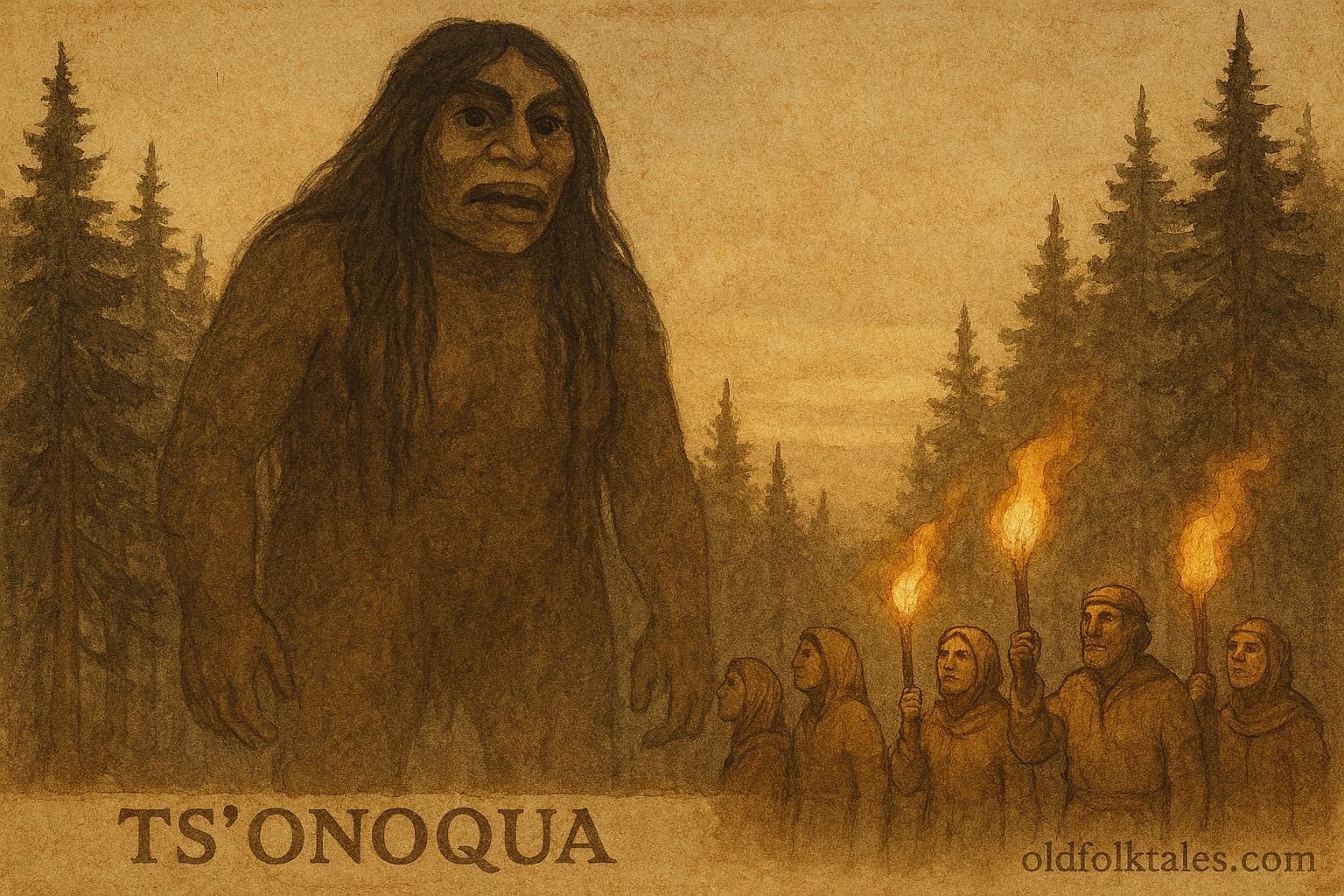
Ts’onoqua lived far from the villages, deep within the forest where the trees grew thick and the paths disappeared. She was said to be enormous, much larger than any human. Her long, tangled hair covered most of her body, and her face was marked by deep-set eyes and a wide, hollow mouth. When she walked, her steps shook the ground. When she spoke, her voice carried through the forest, echoing in ways that made it difficult to know where she truly stood.
The people believed Ts’onoqua watched the villages from afar. She was especially drawn to children who wandered alone or ignored the warnings of their elders. Parents taught their children to listen carefully, to stay close to home, and never to follow strange voices into the woods. They said Ts’onoqua could imitate the voices of loved ones, calling softly to trick the unwary.
Discover ancient tales passed down by the Indigenous peoples of the Americas.
For many years, Ts’onoqua remained only a warning spoken beside the fire at night. Then, one season, signs of her presence began to appear. Food went missing from storage places. Heavy footprints were found near the edges of the village. Dogs whined at night and refused to leave the safety of the firelight. Fear slowly settled among the people.
One afternoon, a brother and sister were sent to gather firewood near the forest edge. Their parents warned them not to stray far, but the wood close to the village was scarce. As they worked, the boy heard his name spoken softly. The voice sounded kind and familiar, like that of a relative calling him home.
Before his sister could stop him, the boy followed the sound deeper into the trees.
The forest grew darker and quieter with each step. The air felt heavy, and the sounds of the village faded away. Suddenly, Ts’onoqua emerged from behind the trees. She towered over the boy, her great shadow falling across the ground. Before he could cry out, she lifted him with ease and carried him toward her dwelling.
When the sister realized her brother was gone, she ran back to the village in tears. The people gathered quickly, knowing exactly what had happened. Fear spread, but the elders urged calm. They reminded everyone that Ts’onoqua fed on fear and confusion. Courage and clever thinking, they said, were the only way to defeat her.
The elders spoke of Ts’onoqua’s weakness. Though powerful, she was greedy and easily distracted by food. Using this knowledge, the villagers formed a plan. They prepared large baskets filled with heavy stones and covered them with dried fish and berries. These baskets were made to look tempting but would be impossible to carry.
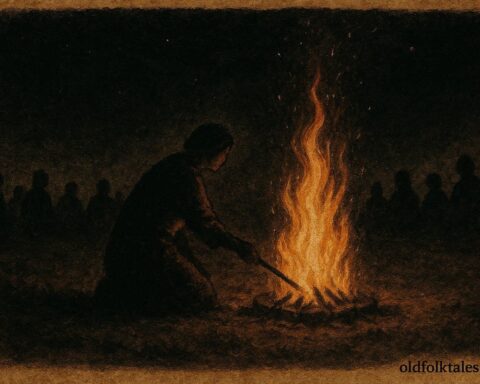
As night fell, a group of brave men and women followed Ts’onoqua’s tracks deep into the forest. They moved quietly, guided by the light of the moon and the wisdom of their elders. At last, they reached Ts’onoqua’s dwelling. She sat beside a fire, humming to herself, while the captured boy sat nearby, frightened but unharmed.
The villagers stepped forward and called out to Ts’onoqua. They pretended to offer her a great feast. Curious and hungry, she approached and lifted one of the baskets. Its weight threw her off balance. She stumbled and fell, roaring in anger and confusion.
In that moment, the villagers surrounded her, shouting together with strong voices. Their unity and courage startled Ts’onoqua. For the first time, she felt fear. She fled into the deepest part of the forest, never again daring to come so close to the village.
The boy was returned safely to his family. The people celebrated, not only because he was home, but because they had faced their fear together. From that day on, the story of Ts’onoqua was told with purpose. Children learned that the forest must be respected, that elders must be listened to, and that community protection depended on cooperation and bravery.
Ts’onoqua did not disappear from the stories. She remained a warning and a lesson, reminding everyone that danger exists, but fear can be overcome through wisdom and unity.
Moral Lesson
Courage and cleverness are stronger than fear. When a community works together and listens to its elders, it can protect its children and overcome great dangers.
Knowledge Check
- Who is Ts’onoqua?
Ts’onoqua is a powerful forest being known as the Wild Woman of the Woods. - Why was Ts’onoqua feared by the people?
She was feared because she lured and stole children who wandered alone. - How did Ts’onoqua trick her victims?
She imitated familiar human voices to deceive them. - What weakness did Ts’onoqua have?
Her greed and distraction made her vulnerable. - How did the villagers defeat Ts’onoqua?
They used clever planning, unity, and courage. - What lesson does the story teach children?
It teaches children to listen to elders and stay close to their community.
Source: Royal BC Museum Indigenous Collections, Native-Languages.org.
Cultural Origin: Kwakwaka’wakw people, British Columbia, Canada.