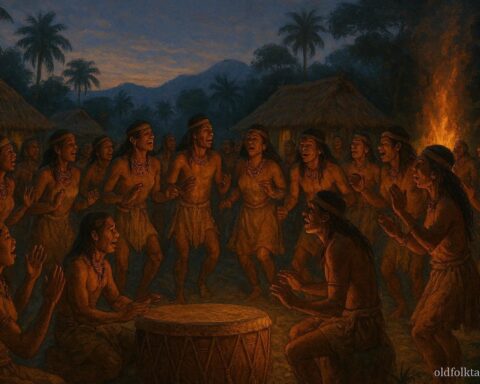
In the heart of ancient Tenochtitlán, when temples still smoked with copal and kings walked beneath the eyes of the gods, the people spoke in awe and fear of Tezcatlipoca, He Whose Mirror Smokes.
He was the god of the night sky and invisible winds, of fate, destiny, and the hidden thoughts of mortals. Where others saw only darkness, Tezcatlipoca saw truth. He ruled not by light, but by reflection, for his power dwelled in the obsidian mirror, black as a moonless lake, through which he watched the hearts of humankind.
Immerse yourself in Latin America’s stories of passion, transformation, and spirit.
The priests said that Tezcatlipoca’s mirror could reveal the future, but only to those brave, or foolish, enough to gaze into it. For what it showed was not always glory; often, it showed the decay of power, the fall of kings, and the fragility of pride.
The God Who Walked as a Jaguar
Once, when the world was still young and kings had grown vain in their palaces, Tezcatlipoca looked down upon the valley of Anáhuac and saw arrogance rising like smoke. The rulers of the Mexica and their neighbors had begun to believe themselves invincible, builders of temples taller than mountains, takers of tribute as if they were gods themselves.
Tezcatlipoca’s eyes burned with both pity and anger. “They forget that I am the night that swallows their stars,” he said. “They feast as if eternity is theirs. Let them learn what lies beyond their reflection.”
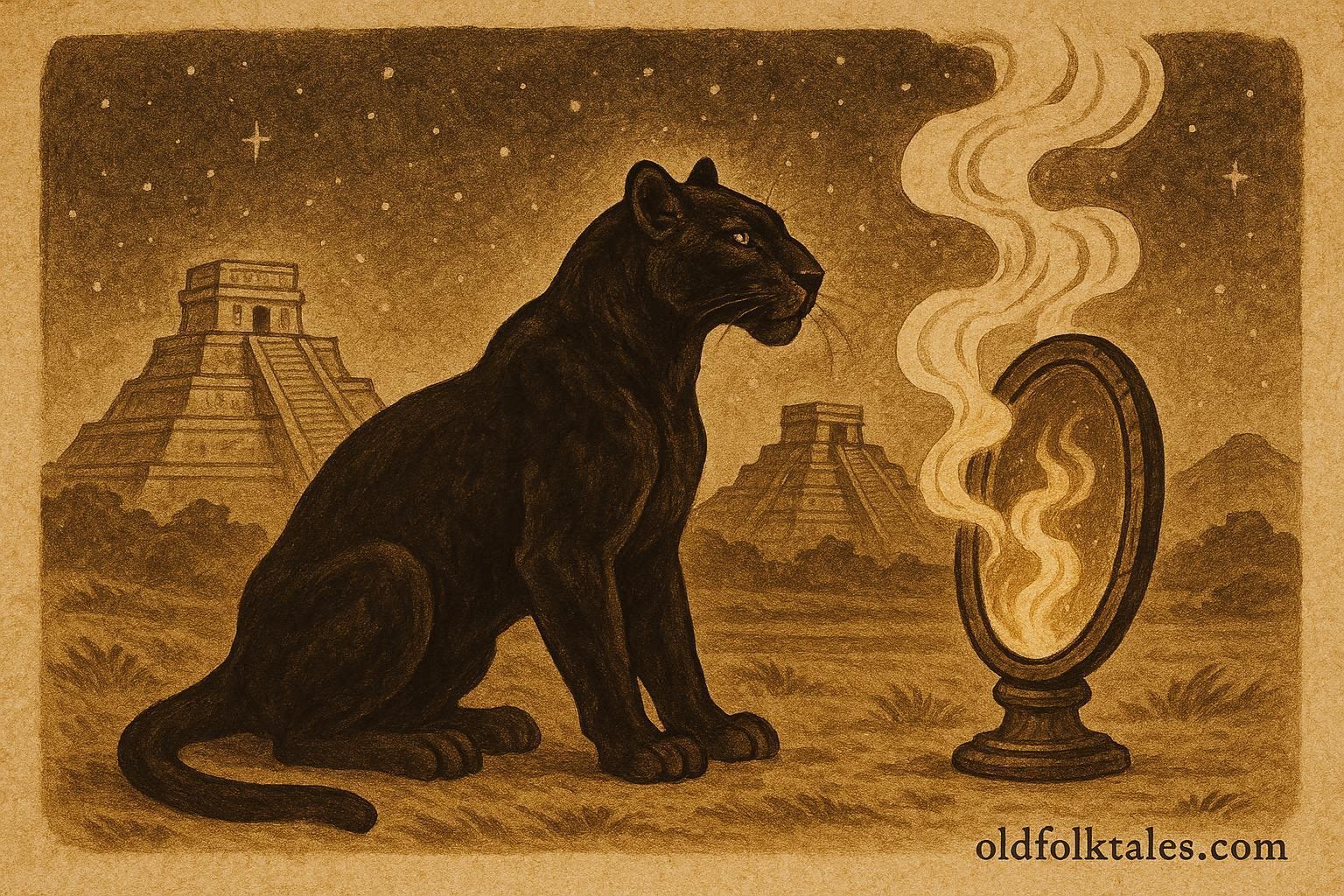
He took up his obsidian mirror, polished until it gleamed like still water, and breathed upon it. The smoke coiled and deepened, becoming a portal between worlds. From within its dark surface, the god stepped forth, transformed into a great black jaguar, his fur rippling like shadow, his eyes two glowing embers.
Thus, Tezcatlipoca walked among mortals once more, silent and watchful.
The First Vision: The King of Texcoco
In the city of Texcoco ruled a noble king, wise in law but swollen with pride in his own wisdom. When the black jaguar appeared on the steps of his palace, the people trembled, for no ordinary beast bore such a gaze.
“Do not harm it,” the king ordered. “It is a sign from the gods.”
That night, the jaguar appeared again, this time in the king’s dreams. It spoke in a voice deep as thunder:
“Look into my mirror, O ruler of men. See what the night conceals.”
The king, fearless, peered into the shining surface that hung in the air before him. At first he saw himself seated on a golden throne. Then, the image shimmered, his face grew older, his crown tarnished, his people scattered, and his name forgotten.
He awoke in terror, sweat upon his brow. But pride whispered, “It was only a dream.”
Ignoring the omen, the king ordered new tributes, harsher taxes, and more monuments to his glory. Within months, famine struck the land, and his people turned against him. He was overthrown, his name indeed forgotten, save as a warning.
The Second Vision: The Lord of Tlacopan
Farther west, in Tlacopan, a ruler known for his cruelty delighted in conquest. He enslaved his enemies and mocked the priests, saying, “Let the gods prove their power, I see none mightier than I.”
Tezcatlipoca came to him as a noble youth cloaked in black feathers, carrying the mirror of obsidian bound with jaguar skin.
“Would you see the measure of your might?” asked the youth.
The king laughed. “Show me, then!”
He looked, and saw himself standing on a field of skulls, his army fallen, his palace aflame. The mirror cracked, and from the split rose black smoke that took the shape of claws and teeth.
When the vision cleared, Tezcatlipoca’s true form stood before him, the Jaguar God, vast and gleaming.
“Power that devours without gratitude devours itself,” said the god.
The next day, war came unexpectedly. The king’s own captains betrayed him, and Tlacopan fell. His final sight before death was a shadow shaped like a jaguar disappearing into the smoke.
The Third Vision: The Humble Priest
In Tenochtitlán, the high priest heard these stories and trembled. When he prayed to Tezcatlipoca, the mirror appeared before him in the temple’s darkness.
“Will you look, servant of men?” whispered the god.
The priest bowed. “Only if it pleases you, Lord of the Night Wind.”
He looked, and saw not gold or ruin, but himself walking barefoot among the people, teaching children, comforting the dying, and giving away his food. Around him shone a faint silver light.
Tezcatlipoca’s voice echoed:
“Those who see their reflection and turn their hearts toward humility shall walk safely in the shadow of my night.”
The priest awoke with tears of gratitude. From that day, he taught that all things, life, strength, power, are borrowed from the gods, and must be returned with reverence.
The Eternal Mirror
When Tezcatlipoca returned to the heavens, he set the mirror in the sky so that all might see their fate reflected in its shimmer. Some say this became the black surface of the night, where the stars gleam like sparks upon obsidian. Others say it is hidden deep in the jungle, guarded by the Jaguar God himself, who waits for another age of arrogance to come.
The old storytellers end by saying that whenever a ruler grows too proud, a black jaguar is seen walking the outskirts of cities, silent as the shadow of a conscience, the sign that Tezcatlipoca still watches, still weighing hearts against the truth within his smoking mirror.
Discover Mexico’s timeless tales blending Indigenous roots and Spanish tradition
Moral Lesson
The tale of Tezcatlipoca and the Jaguar reminds us that power without humility leads to downfall. No mirror lies to its owner, and the divine reflection shows that all glory fades. Only those who live with gratitude and self-awareness endure beyond time’s shadow.
Knowledge Check
- Who is Tezcatlipoca in Aztec mythology?
Tezcatlipoca is the Aztec god of night, fate, and divine reflection, known as “He Whose Mirror Smokes.” - What is the meaning of Tezcatlipoca’s obsidian mirror?
It symbolizes truth and self-revelation,showing mortals the reality of their souls, power, and destiny. - Why did Tezcatlipoca take the form of a jaguar?
The jaguar represents divine strength, night power, and the bridge between the mortal and spiritual worlds. - What happened to the kings who ignored his warnings?
They met ruin and death, punished for their arrogance and failure to respect divine balance. - What lesson did the humble priest learn?
That true wisdom lies in service and humility, not wealth or control,the way to divine protection. - What moral does the Smoking Mirror teach modern readers?
That self-reflection and humility preserve inner strength, while unchecked pride leads to destruction.
Source: Florentine Codex, Book VII, “The Sun, Moon, and Stars,” by Fray Bernardino de Sahagún (1577).
Cultural Origin: Aztec (Mexica) — Central Mexico.