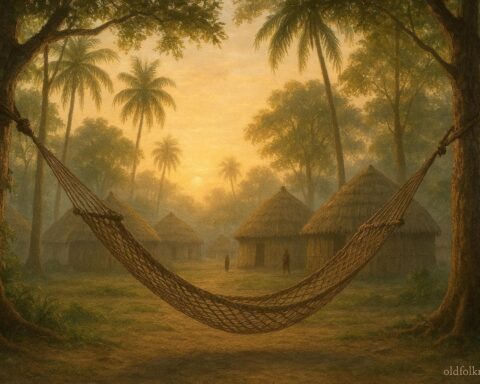
In the age when the gods still walked upon the earth, before the lakes of the Valley of Mexico were divided by stone and city walls, there was a quiet village resting on the shore of calm, blue waters. The people lived simply, tending their canoes and reed huts, their days measured by the rhythm of the lake and the hum of the wind.
Among these villagers lived a young couple whose hearts were pure and steadfast. The man rose with the dawn each day, casting nets and tending what little maize they could grow in the dry soil near the shore. His wife sang as she worked beside him, her voice carrying softly across the lake. But no matter how carefully they planted or how often they prayed, their fields remained barren. The earth, cracked and dry, refused to yield fruit or flower.
Click to read all Andean Highland Folktales — echoing from the mountain peaks of Peru, Bolivia, and Ecuador.
Still, the couple did not lose hope. Each evening, they would sit by the water’s edge, watching the sunset dye the sky in strokes of red, orange, and violet. “If only the earth could bloom with such colors,” the woman whispered. Her husband took her hand and said, “Perhaps the gods have not forgotten us. Perhaps they are waiting to see if our hearts will endure.”
Seasons passed, and their patience became a quiet prayer that never ceased. One moonlit night, as the lake mirrored the silver light of the heavens, they made a decision born of desperation and faith. They would climb to the sacred hill where offerings were made to Xochiquetzal, the goddess of beauty, love, and flowers.
The climb was long and steep. They carried only the simplest gifts: a small bowl of honey from wild bees, a woven garland of reeds, and a few grains of maize wrapped in palm leaves. When they reached the summit, the night was still, and the stars shone like blossoms scattered across the dark sky.
Kneeling before the small stone shrine of Xochiquetzal, they bowed their heads. The woman’s voice trembled as she spoke: “O radiant goddess, whose laughter brings color to the earth, we ask not for gold or power. Bless our land so that life may return to it, and may beauty once more dwell among your people.”
Their words rose like incense to the heavens. For a moment, all was silent, then the wind stirred, carrying the fragrance of unseen flowers. A soft light began to glow around the shrine. The couple lifted their eyes, and there stood Xochiquetzal herself, her hair woven with blossoms, her robes shimmering with the hues of sunrise. Wherever her bare feet touched the earth, new petals unfurled.
“My children,” she said, her voice like wind through petals, “your love and faith have reached me across the ages. You have asked for life, not for yourselves, but for the land. Such purity must be rewarded.”
She reached out and touched their cheeks, where tears had begun to fall. “These tears,” she whispered, “are the seeds of renewal.”
As her hands brushed the ground, the soil glowed with light. From it sprang the first flowers ever known to humankind, red like fire, yellow like sunlight, blue like the lake itself. Their scent filled the air, and the whole hillside shimmered as though dawn had returned in the middle of the night.
“From this day,” said the goddess, “you shall tend the earth and water together. Build gardens upon the lake, and let the flowers of your hearts take root there. So long as you live in balance and care, the waters shall feed the soil, and the soil shall feed your people.”
Then she rose upward in a whirl of petals and vanished into the sky, leaving only her perfume and the sound of rustling reeds behind.
The couple fell to their knees in gratitude. They gathered mud from the lake and reeds from the shore and began weaving small floating plots, just as the goddess had shown them in a vision. They filled them with soil and planted the sacred seeds she had blessed. Within days, tiny shoots broke through the mud, and soon their floating gardens, chinampas, blazed with color.
Word of the miracle spread swiftly. Villagers from near and far came to see the blooming waters. They helped the couple tend the chinampas, learning how to weave the rafts, anchor them with reeds, and plant the earth with care. Together, they transformed the once-barren lake into a vast field of floating flowers and crops.
As the seasons turned, the lake shone like a woven tapestry, golden marigolds, scarlet dahlias, and purple lilies dancing upon the water. The people named their home Xochimilco, meaning “place of the flower field.” They called themselves the Flower People, keepers of the goddess’s gift.
Every year, during the season of blossoms, they offered garlands to Xochiquetzal, thanking her for her compassion and remembering the tears that had once watered the first flowers. And even today, when the wind drifts across the chinampas and the petals ripple like waves, the people say it is the goddess walking once more among her children, blessing them with beauty and balance.
Moral Lesson
True abundance springs not from desire but from devotion. When humans live in harmony with the divine and the natural world, even the smallest prayer can transform the barren into the beautiful.
Knowledge Check
1. Who was Xochiquetzal, and what did she represent?
Xochiquetzal was the Aztec goddess of beauty, love, and flowers, symbolizing fertility and the sacred harmony of life.
2. Why did the couple pray to her?
They sought her blessing to revive their barren land so it might sustain life once more.
3. What miracle did Xochiquetzal perform?
She transformed their tears into the first flowers and taught them how to build floating gardens.
4. What are chinampas, and what do they symbolize?
Chinampas are floating gardens made from reeds and mud; they represent the balance between earth and water, labor and love.
5. How did Xochimilco get its name?
It was named “Xochimilco,” meaning “place of the flower field,” after the lake bloomed with divine blossoms.
6. What is the main moral of this folktale?
That devotion, humility, and respect for nature bring lasting beauty and abundance.
Source: Adapted from oral tradition recorded in Anales de Cuauhtitlán (16th century), compiled in Codex Chimalpopoca (1558).
Cultural Origin: Aztec (Mexica) – Valley of Mexico (Xochimilco).