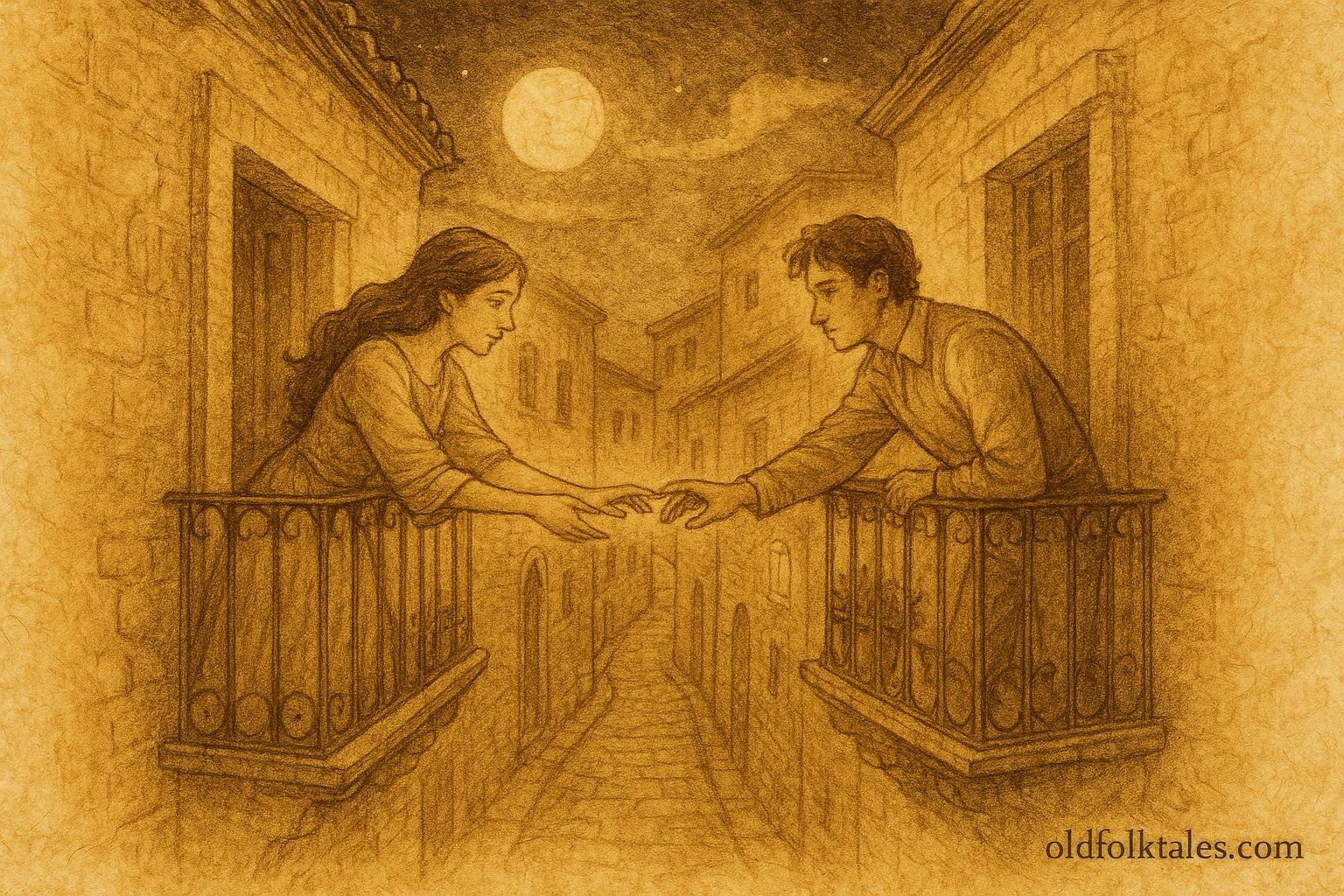
In the heart of Guanajuato, Mexico, where narrow streets twist like golden ribbons through the old mining town, there is one alleyway that has captured the world’s sorrow and its hope, the Callejón del Beso, the Alley of the Kiss. The passage is so narrow that two balconies nearly touch across the chasm of air between them, a hand’s breadth apart, a whisper away.
Long ago, in the 18th century, when Spain still ruled New Spain and the air smelled of silver dust and incense, a young woman named Ana lived in one of those tall, stone houses overlooking the alley. She was the only daughter of Don Tomás, a stern and wealthy Spanish official. To him, family honor was as rigid as the iron gates that barred his windows.
Ana’s beauty was famed throughout Guanajuato. Her skin was pale as candlelight, her eyes soft as the midnight sky, and her laughter could melt the solemn stillness of her father’s mansion. But her heart did not belong to one of her father’s noble friends or suitors. It belonged to Carlos, a young miner who worked deep in the silver veins beneath the city.
Carlos was brave, hardworking, and honest, but to Don Tomás, he was nothing more than a laborer, unworthy of even looking at his daughter. Yet fate, ever mischievous, had given them the gift of proximity. Carlos lived in a house across the same narrow alley, and from his wooden balcony he could see directly into Ana’s room.
Each evening, when the moonlight turned the alley to silver, Ana would step quietly onto her balcony. Carlos would appear across from her, hands rough from labor, heart trembling with longing. And there, leaning across the narrow gap, they would whisper, dream, and finally, kiss, a kiss stretched across the forbidden space of class, power, and fear.
For weeks, their secret meetings continued, guarded by shadows and the hush of midnight. But love, like light, cannot be hidden forever.
One evening, the door to Ana’s room creaked open while she leaned toward Carlos. Her father’s furious voice shattered the fragile silence.
“Ana!” he thundered, his footsteps echoing against the stone walls. “Shame upon this house! Shame upon my name!”
Ana turned, pale and trembling. Carlos froze, unable to reach her, just a hand’s width apart, yet worlds away.
Don Tomás’s rage was not the fire of a father betrayed; it was the cold fury of pride wounded. Without mercy, he drew his dagger, its blade glinting like moonlight. “You have dishonored me,” he said.
Ana’s cry pierced the night as her father’s dagger struck. Carlos reached out across the balcony, catching her falling hand, her warm blood dripping between their clasped fingers.
For a moment, time stood still. The walls seemed to breathe their grief; the moon turned pale with sorrow. Carlos could not speak, his voice was stolen by despair. He pressed his lips to her hand one last time, a final kiss that sealed their love beyond death.
By dawn, both balconies were empty. Carlos vanished from the town, some say into the mines, others say into the grave beside her. But the townsfolk began to whisper, that on moonlit nights, soft voices still murmur across the narrow gap, and shadows lean forward for a kiss that never ends.
Today, lovers from across the world climb the steep steps of the Callejón del Beso. It is said that if a couple kisses on the third step, their love will endure forever. But woe to those who pass without a kiss, seven years of misfortune shall follow, for love neglected is love cursed.
Explore the land of La Llorona, trickster coyotes, and magical realism in Mexican folklore
Moral Lesson
This Mexican folktale teaches that true love cannot be confined by walls, wealth, or pride. Yet it also warns that pride and social arrogance destroy what love alone can make pure. Compassion and humility preserve the soul, but blind honor can bring eternal sorrow.
Knowledge Check
1. Who are the main characters in “The Legend of the Callejón del Beso”?
The story centers on Ana, a nobleman’s daughter, and Carlos, a humble miner, whose forbidden love leads to tragedy in colonial Mexico.
2. Where does the Callejón del Beso folktale take place?
It takes place in Guanajuato, a historic mining town in colonial Mexico, famous for its narrow alleyways and legends.
3. What moral lesson does the Callejón del Beso teach?
It teaches that true love transcends class and pride, but arrogance and obsession with honor can destroy happiness and life itself.
4. Why did Ana’s father kill her in the legend?
He killed her out of wounded pride and obsession with family honor, believing she had shamed their noble name by loving a miner.
5. What modern tradition arose from this folktale?
Couples who visit the Callejón del Beso kiss on the third step of the alley to ensure everlasting love — avoiding seven years of bad luck.
6. What cultural values are reflected in this Mexican folktale?
The tale blends Spanish colonial notions of honor and class with local beliefs in eternal love and spiritual consequence.
Cultural Origin: Colonial Mexican Folklore, Guanajuato, 18th century.
Source: Mexican Colonial Folklore and Legends — MexicoHistorico.com; field variants in Folktales of Mexico by Américo Paredes (Smithsonian Institution).