In the heart of ancient Anáhuac, the Valley of Mexico, where the lakes shimmered beneath a wide blue sky and the temples of Tenochtitlán rose toward the heavens, there lived a princess whose beauty was said to rival that of the dawn. Her name was Iztaccíhuatl, “the White Woman,” daughter of a mighty Aztec ruler.
Among the warriors who served her father was Popocatépetl, a brave and noble man whose courage in battle was matched only by the gentleness in his heart. From the moment their eyes met in the palace gardens, their souls were bound by a love as pure as it was forbidden by rank. Yet, their hearts paid no heed to power or status.
Click to read all Central American Folktales — where ancient Maya spirits meet the voices of the rainforest and volcano.
The Promise of Love
When Popocatépetl came before the emperor, he did not bow as a soldier but knelt as a man in love.
“Great lord,” he said, his voice steady despite the silence that filled the hall, “I ask for your daughter’s hand. I will prove my worth by conquering your enemies and returning with victory for your throne.”
The emperor, proud and calculating, looked upon the warrior and saw both promise and peril. To win the heart of a royal daughter was no small matter. Yet the king thought, if this man could truly secure triumph in battle, it would bring great glory to his name.
He nodded slowly. “Go, Popocatépetl. If you return victorious, Iztaccíhuatl shall be yours.”
Hope flared in both their hearts. That night, beneath the soft glow of the moon, the lovers met for what might be the last time.
“Wait for me,” whispered Popocatépetl, pressing her hands between his own. “I will return to you, and nothing will keep us apart.”
“I will wait,” Iztaccíhuatl promised, her tears glistening like dew. “My heart will remain yours until the gods themselves call me home.”
The Cruel Deception
Popocatépetl led his army into the highlands, his spear gleaming in the sun, his thoughts always returning to Iztaccíhuatl. Battle after battle, he proved his valor. But while he was away, envy and deceit festered in the court.
A rival suitor, jealous of the warrior’s courage and the princess’s devotion, spread a terrible lie, that Popocatépetl had fallen in battle.
The false news spread like wildfire through the palace. When it reached Iztaccíhuatl, her world shattered. She wept until her body grew frail, her spirit dimming like the last ember of a dying fire.
Day by day, her strength faded. She no longer sang to the birds or walked in the gardens they once shared. One morning, she lay upon her bed, pale as the morning mist, and whispered his name one final time:
“Popocatépetl…”
Then, her breath stilled, and her soul drifted to the land of the ancestors.
The Return of the Warrior
Weeks later, the skies darkened as Popocatépetl’s army returned in triumph. He bore the enemy’s banners, proof of victory, and came to claim his beloved. But when he entered the palace, joy turned to horror.
“She is gone,” the servants whispered.
Disbelieving, he rushed to her chambers and found only the flowers that had once adorned her hair, now withered and scentless. His heart broke. The warrior who had faced death without fear now fell to his knees before love’s cruelest blow.
He stayed by her side for days, refusing food, refusing counsel. Then, one morning, he lifted her body gently in his arms.
“I made you a promise,” he said softly. “And though the gods themselves may part us, I will keep it still.”
The Birth of the Mountains
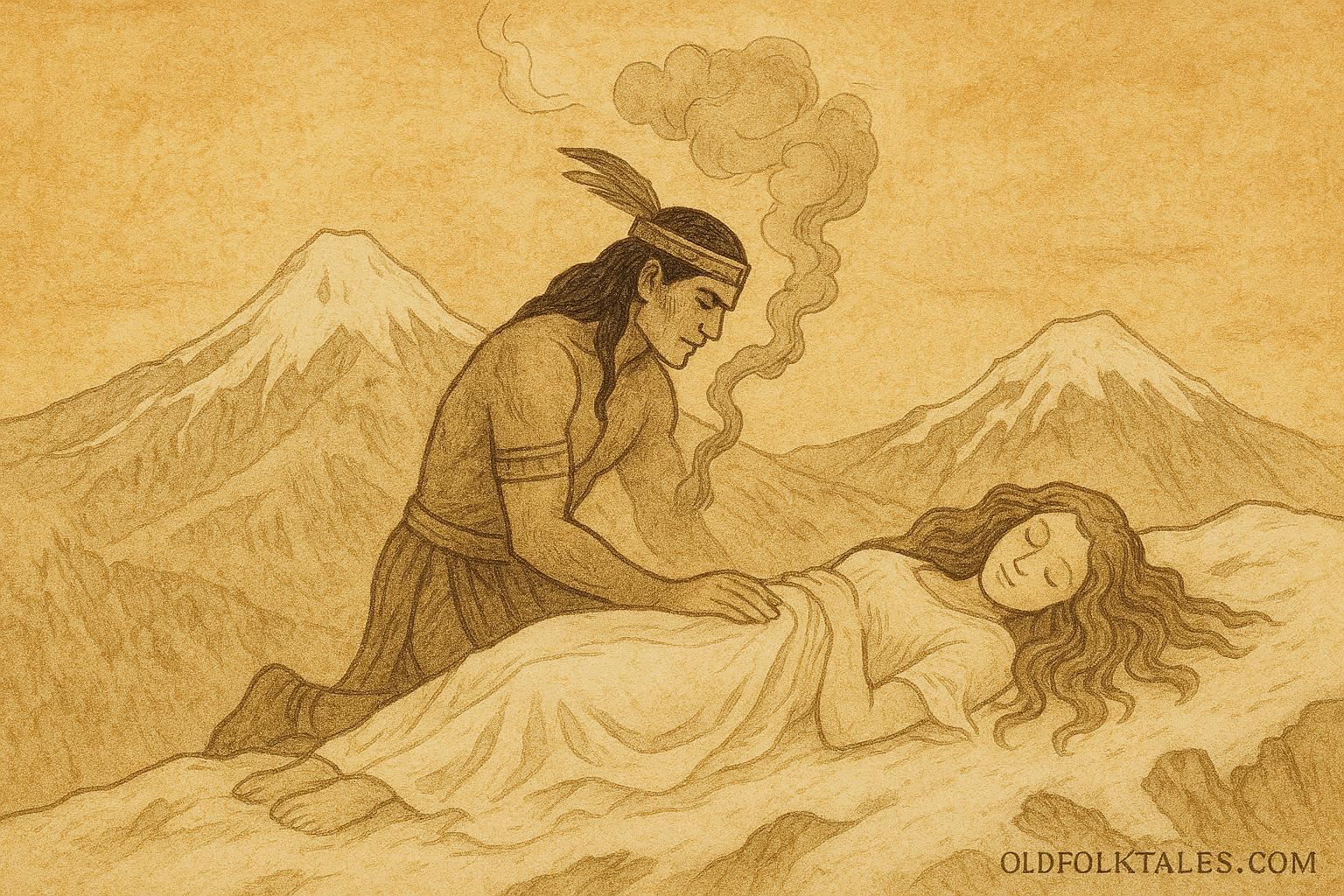
Popocatépetl journeyed to the mountains that touched the clouds, where the earth meets the heavens. There, upon a high plateau blanketed by snow, he built a great funeral pyre and laid Iztaccíhuatl’s body upon it.
He kissed her forehead one last time and whispered, “Sleep, my white flower. I will guard you forever.”
Then, with the strength that had once conquered nations, he gathered stones and built her a tomb so vast it reached toward the sky. Exhausted and grief-stricken, he knelt beside her and never rose again.
The gods, moved by their devotion, transformed them both.
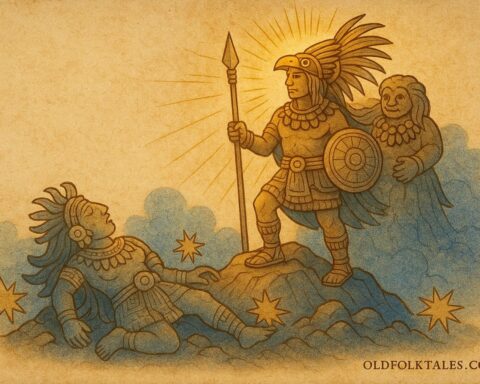
Where Iztaccíhuatl’s body lay, her form became a great mountain, her snowy peaks resembling the gentle curves of a sleeping woman. And where Popocatépetl knelt beside her, his heart still burning with love, the gods made another mountain. His name would mean “Smoking Mountain,” for his fiery heart still smolders, sending smoke and ash into the sky as he watches over her eternal rest.
Even now, when the clouds swirl over the Valley of Mexico, the people look to the horizon and see them, Iztaccíhuatl, the Sleeping Woman, and Popocatépetl, the vigilant warrior. Together, they remind the world that true love endures beyond time, beyond death, and even beyond the will of the gods.
Moral Lesson
Love that is pure and selfless can transcend all boundaries, even those between life and death. Popocatépetl’s devotion shows that the heart’s truest vow is eternal, living on in nature’s beauty and strength. The mountains stand not as monuments to tragedy, but as testaments to the enduring power of love.
Knowledge Check
1. Who were the main characters in the legend?
Iztaccíhuatl, an Aztec princess, and Popocatépetl, a brave warrior.
2. What promise did the emperor make to Popocatépetl?
He would grant Iztaccíhuatl’s hand in marriage if Popocatépetl returned victorious from war.
3. What caused Iztaccíhuatl’s death?
False news of Popocatépetl’s death broke her heart, and she died of grief.
4. How did Popocatépetl honor Iztaccíhuatl after her death?
He carried her body to the mountains, built a tomb for her, and stayed beside her until the gods turned them into volcanoes.
5. What do the volcanoes Popocatépetl and Iztaccíhuatl symbolize?
They symbolize eternal love, devotion, and the transformation of sorrow into beauty.
6. What lesson does the legend teach?
That love’s endurance can outlast life itself, transforming pain into everlasting remembrance.
Source: Leyendas del Anáhuac by Carlos Rivera Aguirre (drawn from Aztec oral traditions), 1862.
Cultural Origin: Aztec (Mexica), Valley of Mexico