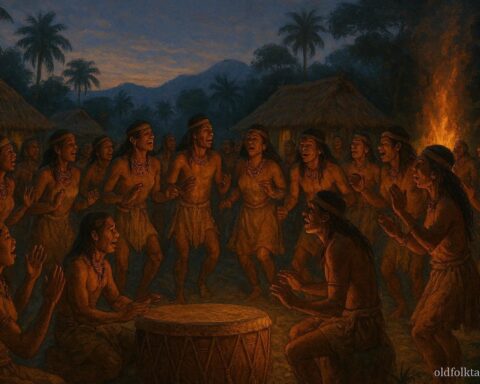
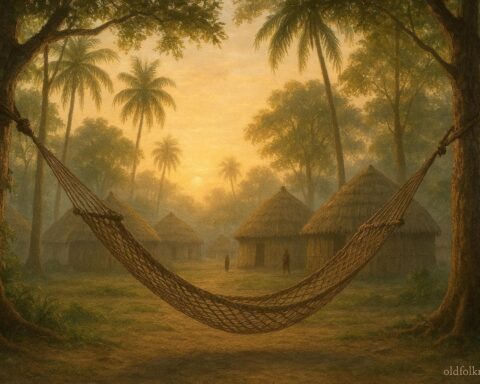
In the time before memory, when the gods still walked visibly among the people and the boundary between earth and sky remained thin as morning mist, the Guaraní nation faced its darkest hour. War had swept across the land like wildfire, consuming villages, scattering families, and leaving behind trails of ash and sorrow.
Among the warriors who fought to defend their people was a young man named Ybaté. His name meant “high place” or “elevated,” and he had earned it through his courage and nobility of spirit. He was not the strongest warrior, nor the most skilled with bow and spear, but he possessed something perhaps more valuable a heart that beat not for glory or conquest, but for the survival and wellbeing of his people.
Click to read all South American Folktales — timeless stories from the Andes to the Amazon.
For weeks, Ybaté and his fellow warriors had fought against an enemy that seemed endless, a tide that kept crashing against their defenses no matter how bravely they stood. One by one, his companions fell. The forests that had once echoed with birdsong now rang with the clash of weapons and the cries of the dying.
On a day when the sun hung red and swollen in a smoke-stained sky, Ybaté found himself alone on a battlefield strewn with the broken and the lost. He had been wounded not once, but many times. Blood seeped from a deep gash across his chest, another along his thigh. His breathing came in ragged gasps, each one a struggle, each one perhaps his last.
The battle was lost. The enemy had withdrawn temporarily, but they would return. His people, those who still survived, had scattered into the forests, fleeing toward whatever safety they might find. Ybaté knew he could not follow them. His legs would no longer carry him. His strength was bleeding away into the thirsty earth.
He stumbled forward, each step an agony, searching not for escape but for a place to rest, a place to die with whatever dignity remained to him. His vision blurred, the world around him swimming in and out of focus. The sounds of the forest seemed to fade, replaced by a strange, hollow silence.
Then he saw it a tree standing alone in a small clearing.
It was an ancient tree, gnarled and twisted, its bark scarred by lightning and time. But what struck Ybaté most profoundly was that the tree itself appeared to be dying. Its leaves had turned brown and brittle, many already fallen to carpet the ground beneath it. Its branches reached toward the sky like skeletal arms, as though pleading with the heavens for mercy that would not come.
Ybaté recognized in this tree a kindred spirit something beautiful and strong, brought low by forces beyond its control, facing its end alone.
With the last of his strength, he dragged himself to the tree’s base. The rough bark pressed against his wounded back as he slid down to sit at its roots, his legs finally giving way completely. Blood continued to flow from his wounds, pooling in the dusty earth, mixing with the fallen leaves.
The warrior looked up through the dying branches at the patch of sky visible above. Tears traced clean paths down his dirt-and-blood-stained face. But these were not tears of self-pity or fear. They were tears for his people—for the children who might never grow old, for the mothers who had lost sons, for the elders whose wisdom would be forgotten, for a way of life that seemed destined to vanish like smoke on the wind.
With trembling lips, Ybaté began to pray.
“Great spirits who watch over us,” he whispered, his voice barely audible even in the silent clearing. “I do not ask for my life it is already leaving me, and I accept this fate. I do not ask for victory in battle that opportunity has passed. I ask only this: do not let my people be forgotten. Do not let their struggle, their courage, their love for this land fade into nothing.”
He paused, gathering the strength to continue, each word now an effort that seemed to draw from depths beyond his physical body.
“Let something beautiful remain,” he prayed. “Let something rise from this death and sorrow. Let there be a sign that even in the darkest times, even when all seems lost, hope can bloom again. Let there be a reminder that suffering is not the end, that from sacrifice can come renewal.”
As the final words left his lips, Ybaté felt a strange warmth spreading through his body. It did not hurt. Rather, it was comforting, like being embraced by his mother when he was a child. His eyes grew heavy, the pain fading into a peaceful numbness.
The gods had heard his prayer.
In that moment, as Ybaté’s life force slipped away, something miraculous occurred. His blood, which had pooled at the tree’s roots, began to glow with an otherworldly light. The dying tree shuddered, and the light traveled up through its roots, into its trunk, along its withered branches like liquid fire transforming everything it touched.
The warrior’s body began to merge with the tree, his spirit flowing into the wood and bark, his courage becoming sap, his love for his people becoming the very essence of the tree itself. Where moments before there had been two dying things man and tree now there was something new, something transformed.
The brittle brown leaves burst into flames of color brilliant pink, radiant magenta, deep rose. But these were not leaves. They were flowers, thousands upon thousands of flowers, covering every branch in a cascade of breathtaking beauty. The dying tree had become vibrant with life, more magnificent than it had ever been before.
This was the first Lapacho tree.
As if responding to a silent command, other trees throughout the forest began to transform as well. The gods, moved by Ybaté’s selfless prayer, spread this gift across the land. Wherever a Lapacho tree would grow, it would remember the warrior’s sacrifice. It would bloom not in the easy times of spring prosperity, but in the harsh season when other plants struggled a reminder that beauty and hope can emerge even in hardship.
The Guaraní people, those who had survived the war, eventually returned to their lands. When they saw the Lapacho trees blooming in magnificent displays of pink and magenta, covering entire hillsides in color, they knew that their prayers had been answered. They knew that Ybaté lived on, his spirit transformed but not extinguished, his message clear: resilience, hope, and beauty can flourish even in the most difficult circumstances.
The story of Ybaté and the Lapacho spread throughout the land. Parents told it to children, who told it to their children in turn. The tree became sacred to the Guaraní people, a living symbol of sacrifice and transformation.
To this day, the Lapacho blooms when the world seems harsh and unforgiving. During the dry season, when other trees stand bare and the land appears lifeless, the Lapacho explodes in a symphony of pink flowers. The blooms come before new leaves appear, covering the entire tree in color so intense it seems to glow against the pale winter sky.
People say that when you stand beneath a Lapacho in full bloom, you can feel Ybaté’s presence his courage, his hope, his unwavering love for his people. The flowers fall like pink snow, carpeting the ground in soft petals, each one a reminder of the warrior’s prayer and the gods’ answer.
The Lapacho has become more than just a tree. It is a promise that sacrifice is never forgotten, that prayers uttered in desperation can transform the world, and that from death and suffering, extraordinary beauty can emerge. It teaches that the darkest moments can give birth to the brightest hope, and that one person’s courage, offered freely for others, can bloom eternally.
Discover the sacred tales of llamas, condors, and gods who guard the Andes
The Moral Lesson
The legend of the Lapacho tree teaches that selfless sacrifice and prayers for the greater good have the power to transform tragedy into lasting beauty. Ybaté’s willingness to think of his people even in his final moments, rather than focusing on his own suffering, resulted in a gift that would inspire generations. The story reminds us that hope and beauty can emerge from the darkest circumstances, that resilience is possible even in hardship, and that one person’s courage and selflessness can create something that endures far beyond their own lifetime. The Lapacho blooms in difficult seasons to show that strength and beauty are not found only in easy times, but especially in moments of struggle.
Knowledge Check
Q1: Who was Ybaté in the Lapacho tree legend and what made him special? A: Ybaté was a Guaraní warrior whose name meant “high place” or “elevated.” What made him special was not his physical strength but his selfless heart even as he lay dying from battle wounds, he prayed not for himself but for his people’s survival and for something beautiful to remain as a symbol of hope.
Q2: What was the condition of the tree that Ybaté leaned against before the transformation? A: The tree was ancient and dying, with brown and brittle leaves, scarred bark from lightning strikes, and skeletal branches reaching skyward. It was as wounded and near death as Ybaté himself, making them kindred spirits facing their end together before their miraculous transformation.
Q3: What did Ybaté pray for as he died beneath the tree? A: Ybaté did not pray for his own life or for victory in battle. Instead, he prayed that his people would not be forgotten, that something beautiful would rise from death and sorrow, and that there would be a lasting sign showing that hope can bloom even in the darkest times.
Q4: How did the gods respond to Ybaté’s selfless prayer? A: The gods merged Ybaté’s dying body and spirit with the dying tree, transforming both into the first Lapacho tree. His blood glowed with otherworldly light, traveled through the tree’s roots and branches, and caused thousands of brilliant pink and magenta flowers to bloom where dead leaves had been.
Q5: Why is it significant that the Lapacho blooms during the dry season? A: The Lapacho’s dry-season blooming is deeply symbolic—it flowers when conditions are harsh and other trees are bare, demonstrating that beauty and hope can emerge especially during difficult times. This reflects Ybaté’s message that resilience and courage are most meaningful when facing hardship, not during easy times.
Q6: What is the cultural meaning of the Lapacho tree to the Guaraní people of Paraguay? A: For the Guaraní people, the Lapacho is a sacred tree symbolizing sacrifice, transformation, and enduring hope. It represents how selfless courage can create lasting beauty, how prayers for the greater good are answered, and how the spirit of those who sacrifice for others lives on eternally in nature, inspiring future generations.
Source: Adapted from Paraguayan folklore as compiled by Feliciano Acosta et al. in Mitos y Leyendas del Paraguay Mestizo
Cultural Origin: Guaraní people, Paraguay, South America