Before the Inca kings walked the earth, before the first fires burned in the valleys, before even the condor spread its wings across the sky, the world was swallowed by darkness. No light shone upon the mountains. No warmth touched the waters. The earth lay cold and empty, wrapped in an eternal night so absolute that nothing could grow, nothing could live, and nothing could be.
In this void of nothingness, there was only one place where power still dwelt the deep, sacred waters of Lake Titicaca, cradled high in the Andes between what would one day be called Peru and Bolivia. The lake was ancient beyond measure, its waters dark and still, holding within them the seeds of all creation.
Click to read all Andean Highland Folktales — echoing from the mountain peaks of Peru, Bolivia, and Ecuador.
Then, from those unfathomable depths, a being began to rise.
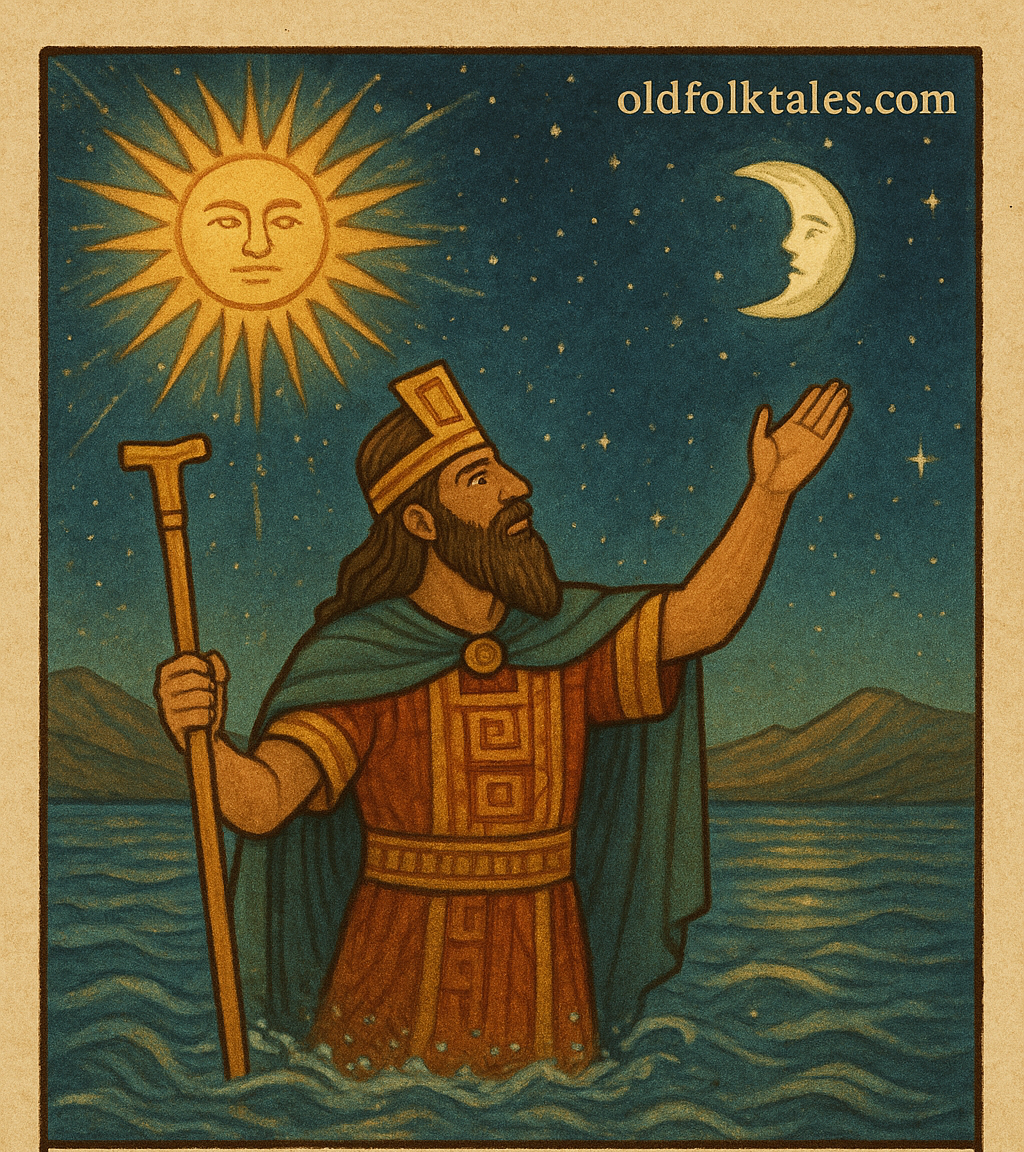
The waters stirred and rippled. Waves rolled across the surface where no wind blew. And suddenly, breaking through with a brilliance that shattered the darkness like a stone through obsidian, came Viracocha the great creator god, radiant and tall, clothed in light that seemed to emanate from his very being. His face was stern but noble, his presence so overwhelming that the mountains themselves seemed to bow before him.
Viracocha stood upon the surface of the sacred lake and surveyed the darkness that surrounded him. His eyes, ancient and knowing, saw the emptiness of the void, the potential waiting to be born, the world that could be if only someone had the power and vision to shape it.
He raised his arms toward the heavens and spoke with a voice that resonated through every corner of creation: “Let there be light!”
And in that instant, the Sun was born.
It burst forth from the waters beside him a sphere of blazing gold, fierce and magnificent, radiating heat and brilliance that drove back the darkness like a retreating shadow. The Sun rose slowly, majestically, climbing into the empty sky and taking its place among the heavens. As it ascended, its rays touched the snow-capped peaks of the Andes, turning them to crowns of fire. They swept across the valleys, illuminating stones and grass and water that had never before known the gift of light. The world, for the first time, could see itself.
But Viracocha was not finished.
“The day is strong,” he said, “but the night must also have its guardian.”
With another gesture, he drew forth the Moon pale and gentle, silver where the Sun was gold, cool where its companion was hot. The Moon rose more slowly, more gracefully, casting a softer light that would comfort rather than command, that would guide travelers through darkness rather than banish it entirely. The Sun and Moon looked upon each other like siblings different in nature but equal in purpose and Viracocha sent them both to dwell in the sky, to watch over all beings and mark the passage of time with their eternal dance.
Now that light had come to the world, Viracocha could begin his greatest work: the creation of life itself.
He walked across the highlands, his feet touching the earth and bringing fertility wherever he trod. From the stones scattered across the mountains, he began to shape men and women. His hands moved over the cold rock, and it softened, warmed, transformed. Arms emerged, then legs, then faces with eyes that could see and mouths that could speak. One by one, Viracocha breathed life into these stone figures, and they became the first peoples of the earth.
To each group, he gave different gifts. He taught them languages so they could communicate, songs so they could celebrate, and stories so they could remember. He showed them how to plant crops in the terraced fields, how to weave cloth from the wool of llamas and alpacas, how to build homes that could shelter them from the mountain cold. He gave them laws for living in harmony rules about respect, about sharing, about honoring the earth and sky that sustained them.
“Live by these laws,” Viracocha commanded, his voice carrying across the valleys, “and you shall prosper. The Sun will warm your fields, the Moon will guide your nights, and the earth will give you all that you need.”
For a time, the people obeyed. They built their communities, raised their children, and offered thanks to Viracocha and the celestial beings he had created. The world flourished under the light of the Sun and Moon, and it seemed that peace would last forever.
But as generations passed, some among the people grew proud. They looked at the great civilizations they had built the temples, the terraced farms, the woven textiles and worked gold and began to believe that these accomplishments were their own doing, that they owed nothing to the creator who had shaped them from stone and given them the gift of life.
They forgot Viracocha’s laws. They quarreled and fought among themselves. They took more than they needed and gave nothing back to the earth. They looked at the Sun and Moon and saw only natural phenomena, not sacred gifts. Their hearts grew hard, their spirits grew selfish, and chaos began to spread across the land.
Viracocha saw all of this, and his heart filled with sorrow and anger. He had given these beings everything light, life, knowledge, beauty and they had repaid him with arrogance and ingratitude.
He returned to the world he had created, walking among the people with his terrible radiance blazing around him. Those who saw him fell to their knees in terror, for they knew they had betrayed their creator. But it was too late for repentance.
“You were made from stone,” Viracocha said, his voice like thunder rolling across the mountains, “and to stone you shall return.”
With a gesture, he transformed the prideful ones back into rock statues frozen in their moment of recognition, eternal reminders of the price of forgetting gratitude and humility. They stand even now, scattered across the Andes, worn by wind and rain but never fully erased.
His work of judgment complete, Viracocha turned and walked toward the western sea. The people who had remained faithful watched him go, calling out for him to stay, to give them another chance, to continue guiding them through the challenges of existence.
At the edge of the great ocean, Viracocha turned back one final time. “I will return,” he promised, his voice carrying across the distance, “when the world again loses its way and needs to be remade. Until then, remember you came from the sacred lake, from darkness into light, from stone into life. Honor that gift always.”
And with those words, he walked across the surface of the sea and vanished beyond the horizon, leaving behind only his promise and his creation.
The people of the highlands never forgot. They built magnificent temples on Isla del Sol and Isla de la Luna the Island of the Sun and the Island of the Moon the two sacred islands in Lake Titicaca where the celestial lights had first been born. Pilgrims traveled from across the empire to stand on those holy shores, to offer sacrifices, and to remember the moment when creation began.
Even now, thousands of years later, when the morning light touches Lake Titicaca, the ripples shine like liquid gold and silver, as if the Sun and Moon were still being born from those depths. The Aymara and Quechua peoples who live around the lake continue to honor it as the womb of creation, the place where light conquered darkness and where Viracocha first shaped humanity from stone.
And sometimes, on especially clear nights when the Moon hangs full above the water and the mountains stand silent as sentinels, the old people say you can still feel his presence the great creator who came from the depths, who gave the world its light, and who promised to return when he was needed most.
Discover the sacred tales of llamas, condors, and gods who guard the Andes
The Moral of the Story
This profound creation myth teaches us the importance of gratitude, humility, and remembering our origins. The people who were turned back to stone forgot that everything they had their abilities, their civilization, their very lives was a gift from their creator. Their pride and ingratitude led to their downfall. The story reminds us that no matter how much we achieve or how far we progress, we must never forget where we came from and who gave us the opportunity to thrive. It also teaches that all good things light, knowledge, community come with responsibility: to honor the source of these gifts, to live according to just laws, and to treat the earth and each other with respect. When we forget these lessons, we risk losing everything and becoming as lifeless as stone.
Knowledge Check
Q1: Who was Viracocha and where did he come from?
A: Viracocha was the great creator god in Incan mythology. He rose from the depths of Lake Titicaca, the sacred lake high in the Andes, bringing light and life to a world that had been swallowed in darkness.
Q2: What did Viracocha create first when he emerged from Lake Titicaca?
A: Viracocha first created light by commanding the Sun to emerge, blazing across the heavens. Then he created the Moon to guide the night with its gentler, silver light. Both celestial bodies rose from the lake and were sent to dwell in the sky.
Q3: How did Viracocha create the first humans?
A: Viracocha shaped the first men and women from stone scattered across the highlands. He breathed life into these stone figures, transforming them into living people, and then taught them languages, skills, and laws for living.
Q4: Why did Viracocha turn some people back into stone?
A: Some people grew proud and forgot Viracocha’s laws. They believed their accomplishments were their own doing and showed ingratitude for the creator’s gifts. In anger at their arrogance and disobedience, Viracocha transformed them back into stone as punishment.
Q5: What promise did Viracocha make before disappearing?
A: Before walking across the sea and vanishing beyond the horizon, Viracocha promised to return when the world again lost its way and needed to be remade. This gave hope that the creator would come back in times of great need.
Q6: Why are Isla del Sol and Isla de la Luna sacred to Andean peoples?
A: These islands in Lake Titicaca are sacred because they are believed to be the exact locations where the Sun and Moon first rose from the waters when Viracocha created them. Temples were built there to honor the moment of creation, and they remain important pilgrimage sites.
Source: Adapted from traditional Incan creation mythology recorded by Spanish chroniclers Juan de Betanzos in Narrative of the Incas (1551) and Pedro Sarmiento de Gamboa in History of the Incas (1572).
Cultural Origin: Inca Empire, Aymara and Quechua peoples, Lake Titicaca region of Peru and Bolivia