In the countryside of old Quebec, where rolling hills met thick forests and maple trees stood like silent witnesses to generations of life, there was a grove unlike any other. The villagers spoke of it with respect and caution, calling it the Maple Grove. It was not the largest stand of trees, nor the oldest, but it was said to be watched over by a spirit known as the Lady of the Grove.
Maple trees were central to village life. They provided sweetness after long winters, wood for warmth, and shade during summer days. Because of this, the elders taught that maple trees were not to be treated carelessly. One might harvest sap or fallen branches, but cutting or harming the trees without reason was forbidden. The Lady of the Grove, they said, ensured this balance was kept.
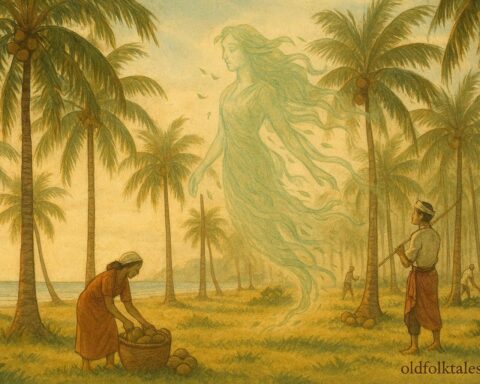
Some villagers claimed to have seen her. She appeared as a tall woman clothed in pale green and gold, her hair the color of autumn leaves. Others said she was only a whisper in the wind or a shimmer of light between trunks at dawn. Whether seen or unseen, her presence was felt most strongly by those who disrespected the trees.
Explore the ancestral legends of Canada, Mesoamerica, and South America’s Indigenous tribes.
One spring, a woodcutter named Mathieu arrived from another region. He was skilled and strong, accustomed to taking what he needed from forests wherever he traveled. When he heard of the Maple Grove, he scoffed at the warnings. Trees were trees, he believed, and stories were meant to frighten children.
Mathieu entered the grove early one morning. The air was still, and sunlight filtered gently through budding branches. He chose a healthy maple and raised his axe without hesitation. The first strike echoed unnaturally loud, sending birds scattering. As the blade bit into the trunk, a sharp wind rose, though the sky remained clear.
Ignoring the sudden chill, Mathieu continued. Sap flowed thick and red gold down the bark, pooling at the roots. The wind strengthened, carrying a faint sound like a sigh. Mathieu paused briefly, unsettled, but greed urged him onward.
By midday, his work was done. He left the grove with timber strapped to his cart, convinced the warnings were meaningless. That night, however, strange things began to happen. His axe handle cracked cleanly in two. The wheels of his cart loosened and collapsed. When he tried to sleep, he dreamed of a woman standing among maple trees, her eyes filled not with anger, but disappointment.
The next day, Mathieu returned to the grove to retrieve more wood, determined to prove his courage. This time, the forest felt different. The path seemed longer, twisting where it had once been straight. The air smelled sharply of sap, and shadows stretched unnaturally along the ground.
As he raised his axe again, a voice spoke. It was calm and clear, yet carried the weight of centuries. It asked why he harmed what gave life. Startled, Mathieu dropped his axe and turned. Before him stood the Lady of the Grove. Her presence was both gentle and unyielding, like the trees themselves.
She did not shout or threaten. She simply explained that the grove existed to sustain life, not to be stripped for profit. Those who took without care broke the balance, and balance, once broken, demanded correction.
Terrified, Mathieu begged forgiveness. He promised never to harm the grove again. The Lady listened but said that words alone could not undo harm already done. She placed her hand on the wounded tree, and the sap slowed. Then she turned back to Mathieu and vanished among the trunks.
From that day on, Mathieu’s strength faded. Tasks that once came easily now left him exhausted. Tools slipped from his hands. The more he tried to work, the weaker he became. Finally, humbled and frightened, he returned to the village elders and confessed everything.
The elders instructed him to return what he had taken and make amends. Mathieu carried the timber back to the grove and laid it carefully at the roots of the damaged tree. He spent days tending the forest floor, clearing debris, and repairing what he could. Slowly, his strength returned, though never fully. The lesson had left its mark.
After that, no villager doubted the Lady of the Grove. Children were taught to greet the maple trees in spring. Woodcutters harvested only what was needed and offered thanks. Those who respected the grove found abundance and peace. Those who did not found their efforts mysteriously thwarted.
Even now, people say the Lady still walks among the maples at dawn, ensuring balance is kept. She is not cruel, nor is she merciful without reason. She is the embodiment of the forest’s memory, reminding humans that nature watches, remembers, and responds.
Moral Lesson
Nature is not merely a resource, but a living system sustained by balance and respect. When humans take without care or justification, they invite consequences that no strength or skill can overcome. True guardianship lies in restraint, gratitude, and understanding that what sustains life must be protected, not exploited.
Knowledge Check
- Who is the Lady of the Maple Grove?
A forest spirit who protects maple trees and maintains balance. - Why were maple trees considered sacred?
They sustained village life through food, shelter, and tradition. - What mistake did Mathieu make?
He cut down a maple tree without respect or permission. - How did the Lady punish wrongdoing?
By weakening those who disrupted the balance. - How did Mathieu seek redemption?
He returned the wood and cared for the grove. - What lesson did the villagers learn?
Nature must be respected to maintain harmony.
Source: Canadian Museum of History; Folklore du Québec.
Cultural Origin: French Canadian folklore, Quebec.