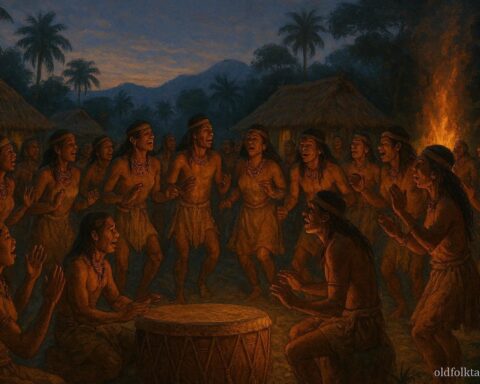
In the time when the Guaraní people lived along the great rivers of Paraguay, when the forest was deep and the connection between humans and the spirits of nature was still strong, there lived a young woman named Irupé. She was the daughter of a powerful chief, a man respected throughout the region for his wisdom and leadership. Irupé had everything a young woman of her status could desire: a loving family, a secure position in her community, and the promise of a good marriage to unite families and strengthen alliances.
But Irupé’s heart belonged to someone she could never have, someone who existed in the celestial realm far beyond the reach of mortal hands. She was in love with the Moon.
Her fascination with the Moon had begun when she was a child, looking up at the night sky and marveling at the silver disc that moved through the darkness, changing shape from crescent to full and back again. As she grew older, her childish wonder deepened into something more profound, more consuming. She saw in the Moon a being of perfect beauty and mystery, distant and unreachable, yet somehow present in her life every night.
Click to read all South American Folktales — timeless stories from the Andes to the Amazon.
While other young women her age spoke of the young men in their village and neighboring communities, weighing the merits of potential husbands, Irupé had no interest in earthly suitors. How could any human man compare to the luminous perfection of the Moon? How could she give her heart to someone who walked on the ground when her soul yearned for the being who sailed through the heavens?
Each night, as darkness fell over the forest and the river, Irupé would slip away from her family’s dwelling and make her way to the water’s edge. She had a special place she would go, a quiet spot where the river widened and the current slowed, creating a smooth surface like polished obsidian. There she would sit for hours, gazing at the Moon’s reflection in the dark water.
The reflection was almost as beautiful as the Moon himself, she thought. In the still water, she could see his face clearly, seemingly close enough to touch. The silvery light would shimmer and dance on the gentle ripples, and Irupé would imagine that the Moon was speaking to her, that the play of light and shadow was his way of communicating across the vast distance that separated them.
She would talk to the reflection, pouring out her heart. “I love you,” she would whisper to the image floating on the water. “I know you are far above me, beyond my reach, but I cannot help how I feel. You are the most beautiful thing I have ever seen, and my heart belongs to you alone.”
Night after night, this ritual continued. Her family grew concerned. Her mother would find her missing from her bed and would have to send someone to bring her back from the river. Her father, the chief, tried to reason with her, explaining that she needed to think about practical matters, about marriage and her future role in the community. But Irupé seemed unable to hear their concerns. Her mind was always on the Moon, her thoughts always returning to those precious hours spent gazing at his reflection.
The other young women thought her strange, perhaps touched by spirits. The young men who had once hoped to court her gave up, understanding that her heart was not available to any of them. Even the wisest elders of the tribe were troubled by her obsession, sensing that such intense longing for the unreachable could only lead to tragedy.
As the months passed, Irupé’s devotion to the Moon grew even stronger. She began to spend entire nights by the river, not returning home until dawn forced her to leave. She would sit so still, staring at the reflection, that birds would sometimes land near her, mistaking her for a stone. Her family worried that she was forgetting to eat, that she was becoming more spirit than flesh, slowly fading from the world of the living.
One night, when the Moon was at its fullest and most brilliant, shining with a light that turned the river into a path of silver, Irupé sat at her usual spot and gazed at the reflection with an intensity that bordered on madness. The Moon’s image on the water was so clear, so perfect, so achingly beautiful that something inside her finally broke.
“I cannot bear this separation any longer,” she said aloud, her voice trembling with emotion. “I must go to you. I must reach you, even if it costs me everything.”
She stood up, her eyes fixed on the Moon’s reflection floating on the dark water. In her fevered mind, clouded by months of obsessive longing, she convinced herself that if she could just reach that reflection, she could somehow reach the Moon himself. The boundary between reflection and reality had blurred for her. She no longer saw water; she saw a pathway to her beloved.
Without hesitation, Irupé walked into the river. The water was cold around her ankles, then her knees, then her waist, but she did not stop. She moved forward, her arms outstretched toward the Moon’s reflection, her eyes never wavering from the silvery image that seemed to dance just beyond her grasp.
“I am coming to you,” she called out. “Wait for me, my love. I am coming.”
The water reached her chest, then her shoulders. Still she walked forward, deeper and deeper into the river. The current began to tug at her, trying to pull her downstream, but she pushed against it, determined to reach the reflection that floated always just ahead of her.
The Moon, looking down from his celestial realm, saw the young woman walking into the river with her arms outstretched toward his image. He was moved by her devotion, but also saddened by the tragedy unfolding below. He could not come down to her, could not save her from her own desperate love. The laws of the cosmos did not permit such intervention.
But he was not the only one watching. The great spirits of the forest and river, the ancient powers that governed the Guaraní world, also observed Irupé’s final moments. They saw her determination, her absolute devotion, the purity of her love even if it was tragically misdirected. And they decided that such love, even love for the impossible, deserved to be honored rather than simply allowed to end in meaningless death.
As the water closed over Irupé’s head, as she sank beneath the surface still reaching for the Moon’s reflection, the spirits enacted their transformation. They would not save her life in its current form, for that life had already been surrendered. But they would give her a new existence, one that would allow her to remain forever connected to the object of her devotion.
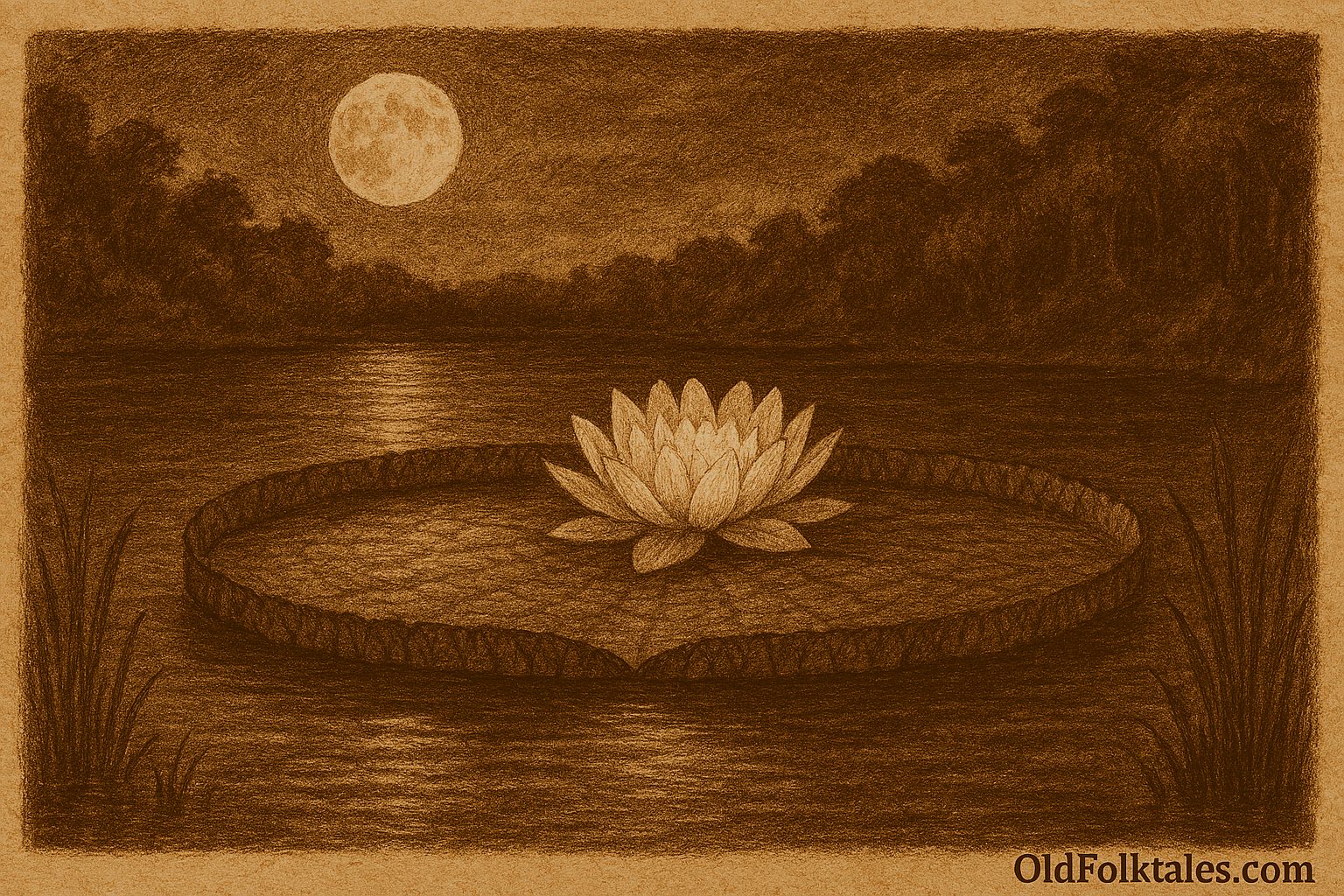
When the sun rose the next morning and Irupé’s family came searching for her at the river, they found something extraordinary. Where she had disappeared into the water, there now floated an enormous flower unlike anything they had ever seen. It was a water lily, but of impossible size, with leaves that spread across the surface of the river like great green platters, and a massive white bloom in the center.
The flower was the irupé, the giant water lily. Irupé herself had become the plant, her body transformed into leaves and roots and petals. But the most remarkable thing about this new creation was its relationship with the Moon. The giant leaves floated on the water’s surface, creating perfect mirrors. Each night, when the Moon rose, his reflection would appear on the water lily’s leaves and petals, clear and bright and beautiful.
Irupé had gotten her wish, in a way. She could not join the Moon in the sky, but she had become something that would forever reflect his light, that would hold his image on her surface every night for all eternity. The Moon would shine down, and there she would be, catching his light, cradling his reflection on her leaves and petals, finally united with him in the only way the cosmos would allow.
The irupé lily still grows in the rivers and waterways of Paraguay and throughout the region. It is one of the largest water lilies in the world, with leaves that can grow to more than two meters across, strong enough to support the weight of a small child. The flowers bloom white and fragrant, opening in the evening as the Moon rises and closing again with the dawn.
The Guaraní people remember Irupé’s story when they see these magnificent plants floating on the water. They understand that the lily is not merely a plant but the embodiment of a young woman’s impossible love, transformed by the spirits into something that could endure forever. And on nights when the Moon is full and its reflection shimmers on the giant leaves of the irupé, they say that the chief’s daughter has finally found peace, united at last with the celestial being she loved, holding his image close in the only way she ever could.
The story is both beautiful and sad, a reminder that some loves are not meant to be fulfilled in the ways we imagine, but that devotion itself, even when directed toward the impossible, has a kind of nobility that the universe itself might honor and preserve.
Discover the sacred tales of llamas, condors, and gods who guard the Andes
The Moral Lesson
This poignant Guaraní legend teaches about the transformative power of devotion and the consequences of loving the unattainable. Irupé’s story illustrates how obsessive love for something impossible can consume a person entirely, blinding them to the real world and the people who care for them. Yet the tale also honors the purity and intensity of her feelings by showing how the spirits transformed her tragedy into something beautiful and enduring. The legend reminds us that while some desires can never be fulfilled in the ways we imagine, genuine devotion is never entirely wasted and may be honored in unexpected forms. It also teaches that the natural world around us carries within it the stories of transformation, love, and sacrifice, and that what we see as simple plants or natural features may embody profound human emotions given permanent form.
Knowledge Check
Q1: Who was Irupé in this Guaraní legend from Paraguay? Irupé was the daughter of a powerful Guaraní chief who fell deeply in love with the Moon. Despite having a secure position in her community and the prospect of good marriage alliances, she became obsessed with the celestial being and spent her nights by the river gazing at the Moon’s reflection in the water, eventually leading to her tragic transformation.
Q2: Why did Irupé reject earthly suitors and marriage proposals? Irupé rejected all earthly suitors because she had fallen completely in love with the Moon, whom she saw as a being of perfect beauty and mystery that no human man could match. Her fascination that began in childhood deepened into an all consuming obsession that made her unable to consider any mortal relationship, as her heart belonged entirely to the unreachable celestial being.
Q3: What ritual did Irupé perform every night by the river? Every night, Irupé would slip away to a quiet spot where the river widened and the water was smooth, creating a perfect mirror. There she would sit for hours gazing at the Moon’s reflection in the water, talking to it, pouring out her heart, and imagining that the Moon was communicating with her through the play of light and shadow on the water’s surface.
Q4: How did Irupé die in this Paraguayan folktale? On a night when the Moon was at its fullest, Irupé became so consumed by her longing that she walked into the river attempting to reach the Moon’s reflection on the water. In her obsessed state, the boundary between reflection and reality had blurred, and she believed she could reach her beloved by walking into his image. She walked deeper and deeper into the river until the water closed over her head and she drowned.
Q5: How did the spirits honor Irupé’s devotion after her death? The spirits of the forest and river, moved by the purity of Irupé’s devotion even though it was tragically misdirected, transformed her into the giant water lily known as irupé. This transformation allowed her to remain forever connected to the Moon by creating enormous floating leaves that serve as perfect mirrors, reflecting the Moon’s image on their surface every night for all eternity.
Q6: What is special about the irupé water lily in nature and legend? The irupé is one of the world’s largest water lilies, with leaves that can grow over two meters across and are strong enough to support a small child. In the legend, these giant leaves serve as perfect mirrors for the Moon’s reflection, symbolizing Irupé’s eternal union with her beloved. The flowers bloom white and fragrant in the evening as the Moon rises, embodying the chief’s daughter’s continued devotion to the celestial being she loved.
Source: Adapted from Mitos y Leyendas del Paraguay Mestizo compiled by Feliciano Acosta and others (Paraguayan folklore collection)
Cultural Origin: Guaraní Indigenous Peoples, Paraguay