In the rugged highlands, where the plateau rises dramatically from the valleys below and the ancient mountains stand witness to centuries of life, there lived all manner of creatures noble and humble, strong and cunning, beautiful and plain. Among them was a hyena, a creature known for its scavenging ways, its eerie laugh that echoed through the darkness, and its reputation for opportunism rather than dignity.
This particular hyena had grown tired of his station in life. He was weary of skulking through the night, feeding on what others had killed, lurking at the edges of villages hoping for scraps. More than anything, he was tired of how other animals regarded him. When the lion walked past, creatures stepped aside with respect, even fear. When the leopard moved through the forest, others whispered in admiration of his grace and power. Even the baboons, though loud and chaotic, had their own social standing and were respected for their cleverness and community bonds.
Click to read all South American Folktales — timeless stories from the Andes to the Amazon.
But when the hyena appeared, animals turned away in distaste. Shepherds threw stones to drive him off. Children made up songs mocking his sloping back and his unsettling laugh. He heard the whispers: “Coward. Scavenger. Thief in the night.” The hyena’s heart burned with resentment and ambition. “Why should they receive praise while I receive scorn?” he muttered to himself as he gnawed on old bones in the darkness. “I am intelligent. I am strong enough. I deserve admiration as much as any lion or leopard.”
So the hyena conceived a plan. He would imitate the noble animals adopt their behaviors, their bearing, their habits and thus gain the respect and praise he craved. If he could appear noble, surely, he would be treated as noble. The external trappings of honor, he reasoned, would be enough to earn him the recognition he deserved.
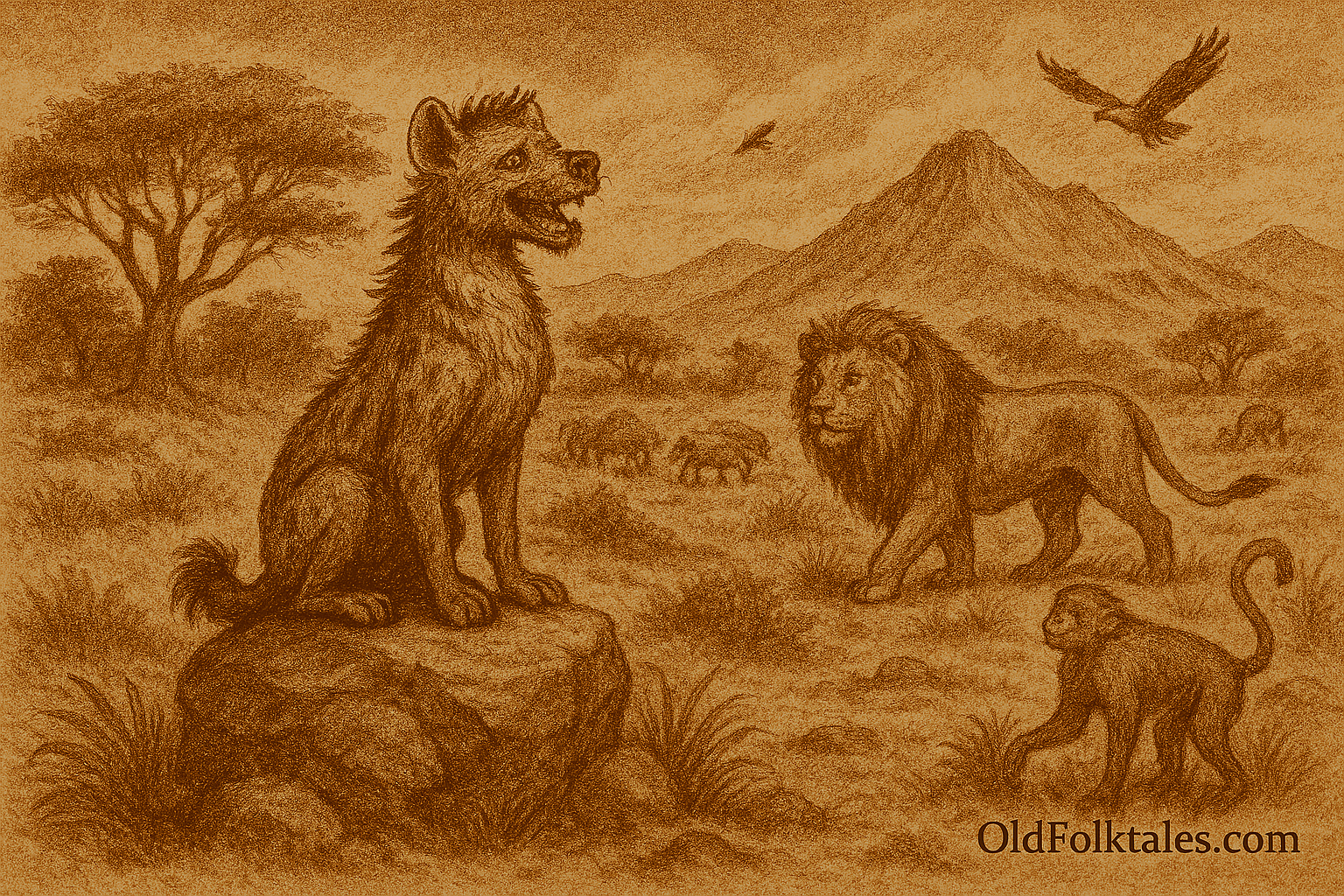
First, he decided to imitate the lion, the undisputed king of beasts. He watched from a distance as the great male lion rested in the sun, his magnificent mane catching the golden light, his powerful body relaxed yet commanding. The hyena noted how the lion sat head held high, gaze steady and calm, exuding an air of absolute confidence and authority.
The hyena tried to copy this posture. He found a prominent rock and climbed atop it, arranging himself as he had seen the lion do. He lifted his head, puffed out his chest, and attempted to project majesty. But his sloping back wouldn’t straighten, his scraggly coat looked mangy rather than magnificent, and when he tried to gaze imperiously at passing animals, they simply laughed at his pretense. A group of young antelope stopped to stare, then broke into giggles. “Look at the hyena playing king!” they called to one another. Humiliated, the hyena slunk away, his tail between his legs.
Undeterred, he decided to try another approach. He would imitate the leopard sleek, mysterious, admired for grace and hunting prowess. He watched as the leopard moved through the grassland with fluid, economical movements, every step purposeful and elegant. The leopard was patient, spending hours stalking prey, learning the patterns of the herds, waiting for precisely the right moment to strike.
The hyena attempted to copy the leopard’s graceful walk, picking his way delicately through the grass. But his gait was awkward, his movements jerky rather than smooth. When he tried to stalk a herd of gazelles as the leopard did, he grew impatient after just minutes. His stomach growled. The careful, disciplined approach required by true hunting frustrated him. “This takes too long,” he grumbled. “Why should I wait hours for a meal when I could find already-dead meat in a fraction of the time?” He abandoned the stalk and returned to his old ways, searching for carcasses left by other predators.
Next, he thought he might gain respect by imitating the eagle, who soared high above the plateau and was praised for his keen vision and independence. But the hyena couldn’t fly, and when he tried to perch on high rocks and scan the horizon as eagles did, he only looked ridiculous. His eyesight was made for night scavenging, not the long-distance clarity of a raptor. After several fruitless hours squinting at the sky, he gave up this attempt as well.
Finally, he tried to join the baboons, thinking perhaps he could earn respect through their kind of social cleverness and community organization. He approached their troop and attempted to participate in their grooming rituals, their coordinated movements, their complex social hierarchies. But the baboons required discipline deference to elders, sharing of food according to rank, protection of the young and vulnerable. When a young baboon found food, the hyena tried to snatch it for himself rather than wait his turn according to social rules. When the troop’s scouts called warnings of danger, the hyena ignored them and thought only of his own safety. The baboons quickly drove him away with sharp barks and threatening gestures. “You want the benefits of our community but refuse its responsibilities,” the old male told him. “That is not how respect is earned.”
Exhausted and hungry, having wasted days in fruitless imitation, the hyena finally returned to his usual haunts. But word of his attempts had spread throughout the animal kingdom. Everywhere he went, creatures mocked him. “There goes the hyena who would be king!” they called. “Watch out the eagle-hyena might try to fly!” “Perhaps he’ll teach the lions how to scavenge today!”
The ridicule was worse than the initial disrespect had been. And worse still, in his days of playacting, he had failed to feed himself properly. His ribs showed through his patchy coat. His strength had diminished. Other hyenas, who had continued their usual scavenging while he pursued his foolish ambitions, were well-fed and healthy. He had gained nothing but humiliation and hunger.
An old jackal, who had watched the hyena’s various attempts with wry amusement, finally took pity on him. “Young fool,” the jackal said, not unkindly, “you can dress in a lion’s manner, but you cannot be a lion. You can mimic a leopard’s walk, but you cannot become a leopard. Each creature has its nature, its role, its own form of dignity.”
The hyena, defeated and ashamed, hung his head. “But how can I gain respect when everyone despises what I am?”
The old jackal regarded him thoughtfully. “Respect comes not from pretending to be what you are not, but from being what you are with skill and integrity. A hyena who scavenges honestly, who survives through genuine cunning rather than deception, who fulfills his role in the natural order without pretense such a hyena has his own dignity. You sought the honor of others while refusing their discipline. You wanted praise without earning it through character and conduct. That path leads only to mockery and emptiness.”
The hyena pondered these words as hunger gnawed at his belly. Around him, the Ethiopian Highlands stretched vast and indifferent, home to creatures of every kind, each with their place in the ancient order of things. He realized that he had wasted precious time and energy pursuing an illusion trying to gain external admiration through imitation rather than building genuine character through his own authentic actions.
He never did gain the kind of praise that lions and leopards received. But he learned, slowly and painfully, that there was a kind of self-respect that came from doing one’s work honestly, from accepting one’s nature without shame, from surviving through legitimate cleverness rather than elaborate pretense. It was not the admiration he had craved, but it was something more solid and more real a dignity that came from within rather than from others’ opinions, earned through conduct rather than stolen through imitation.
Click to read all Andean Highland Folktales — echoing from the mountain peaks of Peru, Bolivia, and Ecuador.
The Moral Lesson
This Highland tale teaches that genuine respect cannot be obtained through mere imitation or pretense, it must be earned through authentic character, discipline, and conduct. The hyena’s fundamental error was believing that appearing noble would make him noble, that copying the external behaviors of admired animals would transfer their honor to him. But he wanted the benefits of their status without accepting the responsibilities, discipline, and character development that created that status. True dignity comes from fulfilling one’s role with integrity and skill, not from pretending to be something else. The story reminds us that trying to gain admiration through false pretense while refusing the hard work of genuine self-improvement leads only to ridicule and emptiness. Respect is earned through consistent, authentic conduct aligned with one’s true nature and capabilities, not through shallow imitation of others’ external qualities.
Knowledge Check
Q1: Why did the hyena want to change how others perceived him in this Highland folklore?
A1: The hyena was deeply dissatisfied with his low social status among the animals and resentful of how he was treated. While noble animals like lions and leopards received respect and admiration, the hyena was scorned as a coward, scavenger, and thief. He was tired of skulking through the night feeding on scraps, being driven away with stones, and hearing mocking songs about him. His desire for praise and recognition drove him to seek a shortcut to respect through imitation rather than genuine self-improvement.
Q2: What animals did the hyena try to imitate and what happened each time?
A2: The hyena attempted to imitate several respected animals: First, he tried copying the lion’s regal posture and commanding presence, but his physical appearance and manner made him look ridiculous rather than majestic, earning only laughter from young antelope. Second, he attempted the leopard’s graceful movements and patient hunting style but grew frustrated with the discipline required and quickly returned to scavenging. Third, he tried joining the baboon troop’s social structure, but refused to follow their rules about sharing, hierarchy, and communal responsibility, leading to his rejection.
Q3: What was the hyena’s fundamental mistake in seeking respect?
A3: The hyena’s core mistake was believing that respect could be gained through external imitation and appearance rather than through genuine character development and earned conduct. He wanted the admiration that came to noble animals without accepting the discipline, patience, responsibility, and consistent behavior that actually created their respected status. He sought shortcuts to honor copying postures and movements while refusing the hard internal work of developing true character, skill, and integrity in his own authentic role.
Q4: What consequences did the hyena face for his pretense and imitation?
A4: The hyena faced multiple negative consequences: He became an object of widespread ridicule throughout the animal kingdom, with creatures mocking his failed attempts at nobility everywhere he went. The mockery was worse than the original disrespect he had endured. Additionally, while wasting time on useless imitation, he neglected to feed himself properly, becoming weak and hungry while other hyenas who continued their normal work remained well-fed and healthy. His pursuit of false honor left him worse off than when he started.
Q5: What wisdom did the old jackal offer to the defeated hyena?
A5: The old jackal taught that each creature has its own nature and role, and that genuine dignity comes from fulfilling that role with skill and integrity rather than pretending to be something else. He explained that respect is earned through being authentically oneself with competence and character, not through imitation. The jackal emphasized that the hyena had sought praise without earning it through actual conduct and wanted honor while refusing the discipline that creates honor. True self-respect, he suggested, comes from honest work within one’s authentic nature.
Q6: What cultural values about character and respect does this Highland story convey?
A6: The story embodies Ethiopian cultural values emphasizing authenticity, earned respect, and the importance of discipline and character over appearance. It teaches that every role in society has its own dignity when performed with integrity, that shortcuts to honor through deception or imitation ultimately fail, and that genuine respect comes from consistent conduct aligned with one’s true capabilities and responsibilities. The tale reflects Ethiopian wisdom about the relationship between inner character and outer recognition, valuing substance over pretense and authentic contribution over false ambition.
Source: Adapted from Highland oral narratives as recorded by Wolf Leslau .
Cultural Origin: Highlands.