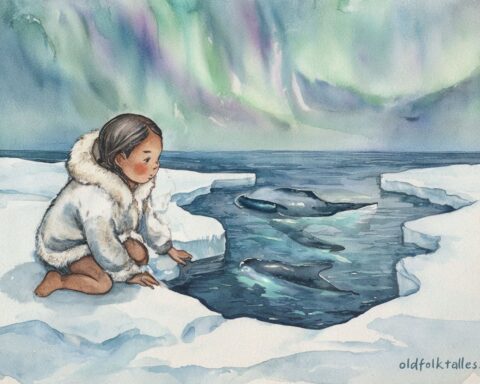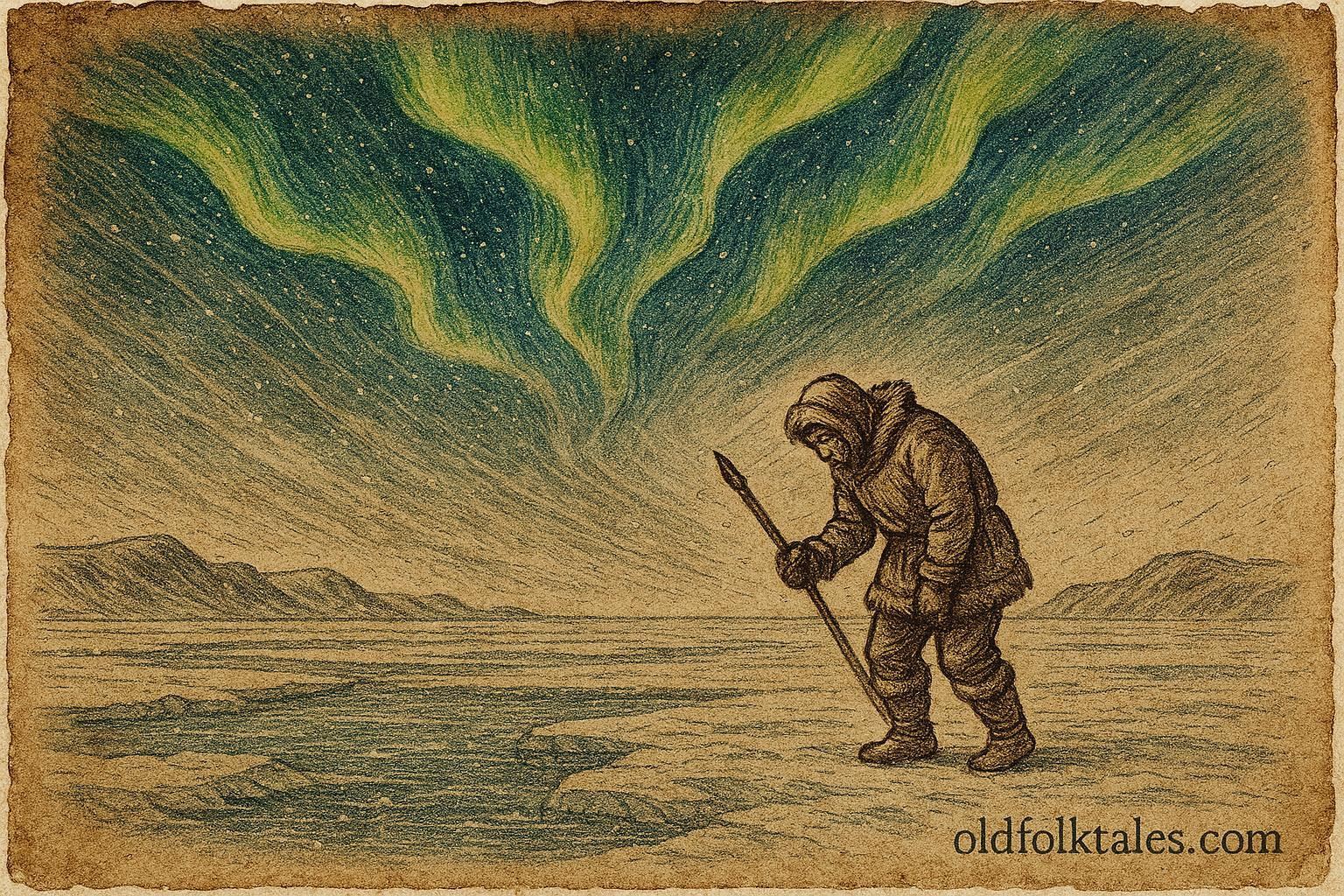
In the far northern reaches of Arctic Canada, where the land lay frozen for much of the year and the sea breathed through cracks in the ice, the Inuit lived by rules older than memory. These rules were not written, yet everyone knew them. They governed how one hunted, how one shared, how one spoke, and how one listened to the world itself.
Among the strongest of these teachings was respect for the aurora, the shifting lights that appeared across the winter sky. The elders taught that the lights were not silent decorations. They were alive with meaning. They were spirits moving, watching, and sometimes warning. When the aurora appeared, people lowered their voices. Children were told not to whistle or mock the lights. Hunters paused, observed, and reflected before continuing their journey.
There lived in one winter camp a hunter named Amaqjuaq. He was strong, skilled, and proud of his success. He had brought back seals when others failed and crossed dangerous ice without fear. Over time, pride hardened in him like ice thickening on the sea. He began to believe that skill alone kept him alive, not the balance between humans, spirits, and the land.
Explore the ancestral legends of Canada, Mesoamerica, and South America’s Indigenous tribes.
One winter night, as Amaqjuaq prepared to leave camp for a long hunt, the aurora flared across the sky in wide bands of green and pale white. The lights shimmered low, brighter than usual, rippling as though stirred by unseen hands. The elders watched quietly, sensing meaning in the movement.
An elder woman approached Amaqjuaq and spoke calmly. She told him the lights were restless and that the spirits were active. She advised him to wait until morning. “The sky is speaking,” she said. “Tonight is not for travel.”
Amaqjuaq laughed softly. He adjusted his gear and replied that the lights were only light, nothing more. He said hunger would not wait for dancing colors in the sky. Without another word, he turned his back on the camp and walked into the frozen darkness.
As he traveled across the ice, the aurora followed him. The lights twisted above, sometimes brightening, sometimes fading. Amaqjuaq ignored them. When the wind rose suddenly, he blamed chance. When the ice beneath his feet groaned, he dismissed it as normal. He pressed forward, refusing to look up.
Soon, the familiar landmarks disappeared. Snow began to fall heavily, blurring the horizon. Amaqjuaq realized he had gone farther than intended, but his confidence kept him moving. He believed turning back would show weakness.
Then the misfortune began.
His dogs slowed, confused by the shifting light and wind. His sled caught on rough ice and cracked. When he tried to repair it, his fingers stiffened with cold more quickly than usual. The aurora flared suddenly, streaking red and green across the sky. This time, Amaqjuaq felt unease, but he still refused to acknowledge it.
Night deepened, and the storm worsened. The ice beneath him cracked loudly, forcing him to retreat to firmer ground. Exhausted, Amaqjuaq attempted to build a shelter, but his hands shook, and the snow refused to pack properly. The wind tore at the walls before they could hold.
At last, fear crept into his heart.
He remembered the elder’s words and the teachings he had ignored. He remembered being told that the aurora could grow angry when mocked or dismissed, that it withdrew protection from those who showed no humility. Looking up for the first time, Amaqjuaq saw the lights pulsing fiercely overhead, moving faster than before, no longer playful but sharp and restless.
He lowered his head and spoke aloud, his voice nearly lost to the wind. He admitted his arrogance. He apologized for his disrespect. He promised to listen again, to teach others what he had forgotten.
Slowly, the storm eased. The aurora softened, its movements slowing, its colors dimming into gentle waves. Amaqjuaq gathered what strength remained and followed the faint glow on the horizon, which now seemed to guide rather than confuse him.
By dawn, he reached the edge of his camp, cold, injured, and empty-handed.
The people listened silently as he told his story. He did not exaggerate or hide his mistakes. He spoke of pride and fear, of how the land had withdrawn its support when he stopped listening. The elders nodded, not in anger, but in recognition.
From that day forward, Amaqjuaq hunted differently. He paused when the aurora appeared. He taught children to respect the sky and reminded other hunters that survival depended on humility as much as skill. He never again laughed at the lights.
The aurora continued to dance above the Arctic, sometimes bright, sometimes faint, always watching. And the people remembered that the sky, like the land, demanded respect.
Moral Lesson
Skill alone cannot protect those who forget humility. When people dismiss spiritual guidance and ignore the signs offered by nature, they place themselves in danger. Respect, listening, and restraint preserve balance, while pride invites loss. True strength lies in recognizing that humans survive not by domination, but by harmony with the world around them.
Knowledge Check
- Why were the Northern Lights important to the community?
They were believed to be spirits offering guidance, warnings, and protection. - What mistake did Amaqjuaq make before leaving camp?
He ignored the elders’ warning and disrespected the aurora. - How did misfortune appear during his journey?
Storms worsened, landmarks vanished, equipment failed, and fear overtook him. - What caused the change in Amaqjuaq’s fate?
He acknowledged his arrogance and showed humility toward the spirits. - What lesson did he bring back to the camp?
That respect and listening are as important as hunting skill. - How does the story explain Inuit values?
It emphasizes balance, spiritual awareness, and responsibility to the natural world.
Source:
Adapted from Native-Languages.org and Arctic sky lore collections.
Cultural Origin:
Inuit folklore, Arctic Canada.