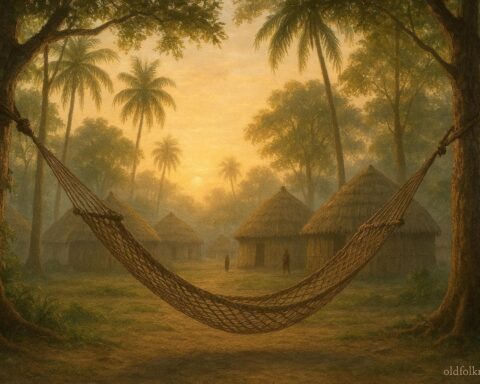
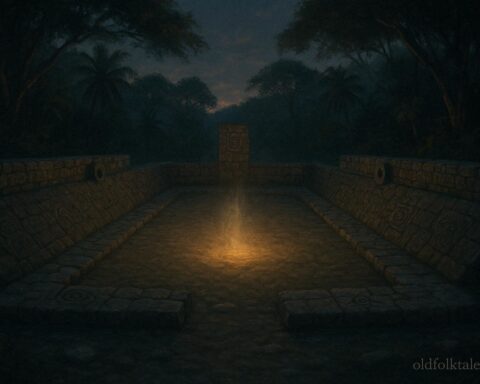
Long ago, when the earth was young and the gods still walked among rivers and hills, there lived a maiden of great beauty and gentleness in the lush valleys of the K’iche’ Maya. Her eyes shone like the surface of sacred cenotes, and her laughter echoed through the forest like music carried on the wind.
She loved a brave young warrior who was the pride of her village. His heart was pure, his courage steady, and his spirit belonged not to conquest but to protection, of his people, his land, and the maiden who had captured his soul. Together they walked among the ceiba trees, whispering prayers to the gods of rain and flowers. The people said that even the birds grew still when they spoke of their love, for it was as radiant as the dawn over the mountains.
Click to read all South American Folktales — timeless stories from the Andes to the Amazon.
But one year, a great war broke out between neighboring villages. The warrior was called to defend his people. Before he left, he placed a single white blossom in the maiden’s hair and said softly, “If I fall, remember me in the flowers. My spirit will find its way back to you.”
The maiden’s heart trembled, yet she smiled and whispered, “Then the flowers shall never close their petals.”
For many moons she waited. Each morning she walked to the hilltop where they had last stood together, watching the sunrise burn through the mist. Each evening she lit a candle and offered it to the gods, praying for his safe return.
But one night, a messenger came bearing the terrible truth, the warrior had fallen in battle. His body lay far beyond the mountains, buried beneath the shadow of the jungle.
Grief overcame her. For days she neither ate nor spoke, and her tears watered the soil beneath her feet. The villagers, moved by her sorrow, brought her offerings of food and flowers, but she turned them away. “I have no hunger for this world,” she said softly. “My heart belongs to the wind that carries his name.”
In her despair, she went to the temple of Ix Chel, goddess of love and transformation, and knelt before her altar. “Great Mother of the Moon,” she cried, “take pity on me! Let me become something that can wait for him beyond the reach of death. Let me not fade into dust, but remain where his spirit might find me again.”
The goddess heard her plea. A warm breeze swept through the temple, carrying the scent of blossoms. The maiden’s body grew light, her hair shimmered like sunlight on petals, and as she fell into sleep, her feet rooted gently into the earth. When the dawn came, where she had knelt there bloomed a single flower of extraordinary beauty, its colors bright as dawn, its fragrance soft as memory. The people wept when they saw it, for they knew their beloved maiden had been changed by divine compassion into the first of her kind.
Seasons passed. The warrior’s spirit wandered the realm of shadows, restless and searching. The gods, seeing his sorrow, summoned him before them. “Why do you linger between worlds?” they asked.
He bowed his head. “My heart remains with the one who prayed for me. She is earth now, and I am wind. How can I find her?”
The gods, moved by his devotion, took pity. They gathered his spirit and shaped it into a small, radiant bird with feathers that caught the light like emerald and sapphire. “You shall be swift as thought and light as breath,” they said. “You shall drink from the heart of every blossom, for there she waits for you still.”
And thus was born the hummingbird, the spirit of the warrior, reborn in motion and music.
When he first took flight, the wind trembled with joy. He soared across mountains and rivers until he came to the valley of his people. There, beneath the ceiba tree, the maiden’s flower swayed gently in the morning sun. The bird hovered above it, his wings beating so fast they shimmered like rain in sunlight. With his long beak, he touched her petals as tenderly as a kiss.
In that moment, the flower stirred, releasing a fragrance so sweet that even the gods smiled from their celestial homes. For an instant, the air glowed, the flower’s spirit and the bird’s spirit recognizing one another beyond death, united in the endless dance of life and renewal.
Every dawn thereafter, the hummingbird returned to the same flower, whispering love through the rhythm of his wings. And when he flew away, she opened her petals wider, basking in the warmth of the sun as if her beloved’s touch had set her heart alight once more.
The people of the valley called her the Flower Maiden, and they said that all blossoms were her daughters, born from her devotion. The hummingbird, they said, carries the souls of warriors and lovers who keep their promises even beyond the grave.
To this day, when a hummingbird pauses to drink from a flower, the Maya say it is a message from the gods, a reminder that true love, once blessed by devotion, never dies. It merely changes its form, fluttering forever between heaven and earth.
Discover Mexico’s timeless tales blending Indigenous roots and Spanish tradition
Moral of the Story
Love endures beyond the limits of time and life itself. Through devotion and faith, even sorrow can bloom into beauty that never fades.
Knowledge Check
- Who was the Flower Maiden?
A young woman whose love for a fallen warrior led her to pray for eternal union, resulting in her transformation into a flower. - What god heard her prayer?
The goddess Ix Chel, deity of love, fertility, and transformation in Maya belief. - How did the warrior return to her?
The gods transformed his spirit into a hummingbird so he could find her again. - What does the hummingbird symbolize in this legend?
It represents the enduring spirit of love and the soul’s return to what it cherishes. - What natural phenomenon does the story explain?
The relationship between flowers and hummingbirds in nature, as spiritual lovers reunited through divine compassion. - What is the central moral lesson?
True devotion transcends death and transforms grief into eternal beauty.
Source: Adapted from Folk Tales of the Maya, collected by Adrián Recinos (1937).
Cultural Origin: K’iche’ Maya (Guatemala and Chiapas, Mexico).