In the dry interior lands of what is now British Columbia, where sagebrush clung to the earth and the rivers cut deep paths through stone, the Nlaka’pamux people lived with an understanding older than memory. The land was not silent. It listened. Hills, valleys, and trails were not empty shapes but living presences that observed how people moved across them and why.
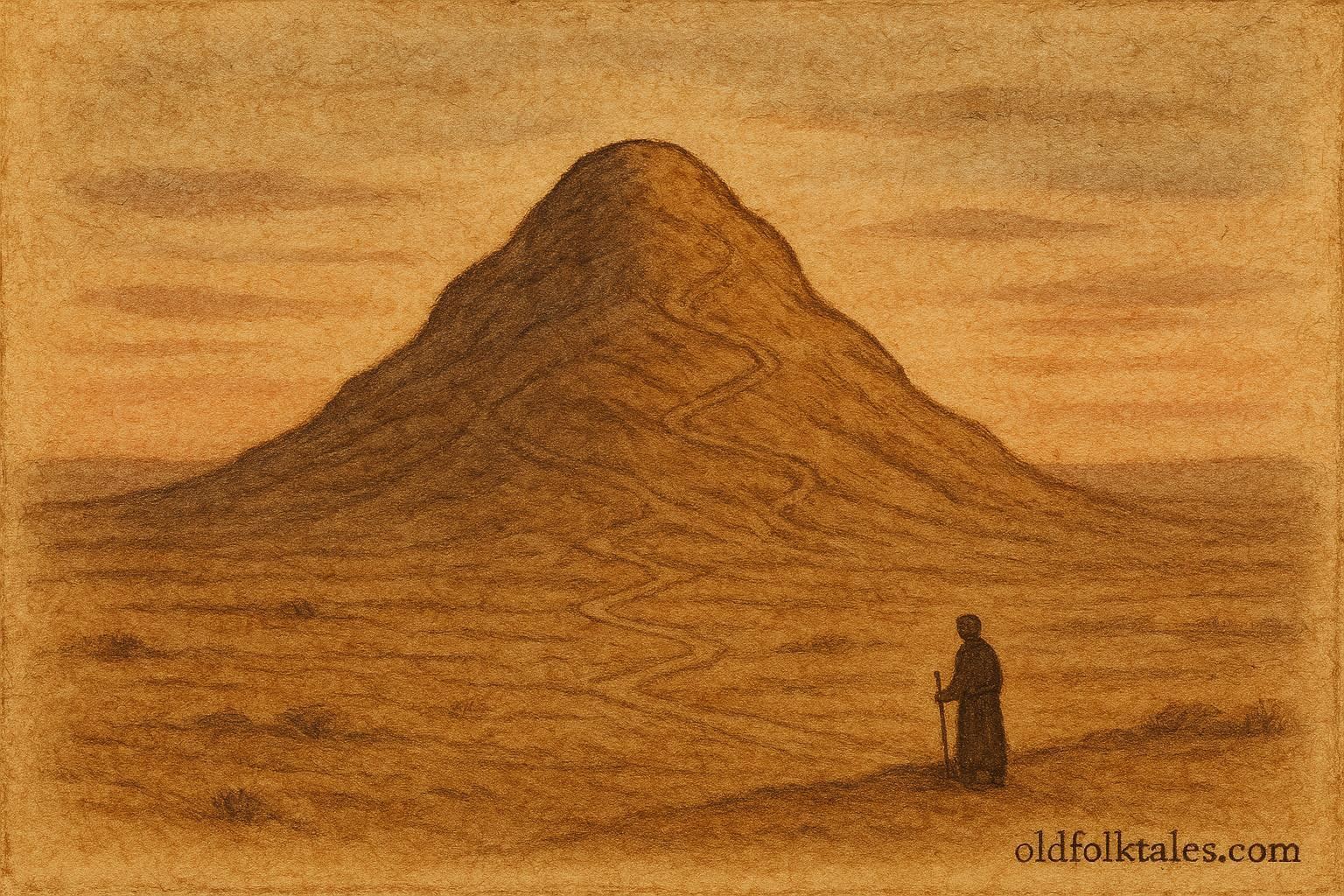
Among these places stood a hill that rose alone from the surrounding plateau. It was not the tallest, nor the steepest, but it drew the eye. From a distance it appeared simple, almost inviting. Its slopes were smooth, marked with faint trails that seemed to promise an easy climb and a wide view of the valley below.
The people called it Spômeten, meaning “the one that watches.”
Elders warned that the hill did not belong to anyone. It allowed passage, but only to those who approached with the right spirit. Hunters crossed its lower slopes carefully. Travelers greeted it aloud before passing nearby. Children were taught never to race up its sides or boast of reaching its top.
Explore French-Canadian legends and First Nations myths in our Canadian Folktales collection
For the hill listened to pride.
Long ago, when the villages were larger and the people still tested themselves against the land, there lived a man named Kélten. He was strong, quick-footed, and known for his confidence. He climbed cliffs without fear and crossed rivers without hesitation. Praise followed him often, and he welcomed it.
When Kélten looked upon Spômeten, he laughed.
“It is only a hill,” he said. “If it watches, it will watch me reach its peak.”
The elders advised him to slow his steps and quiet his voice. They told him the hill was not an obstacle to defeat but a presence to acknowledge. Kélten nodded without listening. He believed warnings were for the weak.
At dawn, he began his climb.
At first, the path was clear. The ground rose gently, and the air was still. Kélten moved quickly, confident in his strength. He called down to those below, boasting of how easy the climb was. His laughter echoed across the slope.
But soon, something shifted.
The trail beneath his feet divided into two, then three. Each path looked equally worn, equally promising. Kélten chose one without pause. It curved sharply, leading him back toward the base without his noticing. When he realized his mistake, irritation flared.
He chose another path. This one narrowed unexpectedly, forcing him to slow. The ground grew uneven, scattered with loose stone. Still, Kélten pushed forward, muttering angrily.
The hill grew warmer beneath the sun, yet a chill crept into the air. The wind shifted direction, carrying dust into his eyes. When Kélten tried to retrace his steps, the path behind him no longer matched the one he remembered.
Hours passed.
From below, the people watched as Kélten appeared and disappeared along the slope, moving sideways, then downward, then upward again. He never reached the summit. His figure grew smaller, slower.
By midday, Kélten was exhausted. His mouth was dry, and his legs trembled. Anger gave way to confusion. Confusion turned to fear.
He shouted, but his voice seemed to sink into the hill rather than carry outward.
As the sun began to lower, Kélten stumbled onto a small clearing. There, he saw an old woman sitting on a stone, her back straight, her gaze calm. She wore no decorations and carried no tools.
“You are lost,” she said, not unkindly.
Kélten demanded to know why the paths would not stay still.
The woman looked at him for a long moment.
“You did not ask where they wished to lead you,” she said. “You only told them where you intended to go.”
She gestured to the slope below. “This hill does not reject strength. It rejects arrogance.”
Kélten felt shame rise in his chest, heavy and unfamiliar.
“What must I do?” he asked quietly.
The woman stood. “Listen.”
She did not explain further. Instead, she turned and walked down a narrow trail that Kélten had not noticed before. She did not hurry. Her steps were slow and deliberate. Kélten followed, matching her pace.
The path did not twist or vanish. It curved naturally, leading them steadily downward. When they reached the base, the woman was gone.
Kélten returned to the village at nightfall, silent and changed.
In the following years, others tested the hill. Some came with pride and were turned away, wandering until hunger or fear taught them humility. Others approached slowly, greeting the land, pausing when the path narrowed, accepting detours without anger. These people reached the summit easily, often without noticing the climb itself.
From the top, they said, the valley looked whole rather than conquered.
The elders continued to teach that Spômeten did not move its paths out of cruelty. It reshaped them as a mirror. Those who climbed to prove themselves found confusion. Those who climbed to understand found clarity.
Even now, the hill stands unchanged. Trails appear and disappear with the seasons. Some say the land itself remembers the footsteps placed upon it.
And it still listens.
Explore the ancestral legends of Canada, Mesoamerica, and South America’s Indigenous tribes.
Moral Lesson
This story teaches that the land responds to intention as much as action. Arrogance blinds people to guidance, while humility opens clear paths forward. True understanding comes not from conquering the world, but from moving through it with respect and awareness.
Knowledge Check
1. What is special about the hill Spômeten?
It is a sentient landscape that responds to human intention.
2. Why does the hill confuse arrogant climbers?
Because pride disrupts balance and awareness.
3. What mistake does Kélten make at the beginning?
He treats the hill as something to conquer rather than respect.
4. Who guides Kélten off the hill?
A mysterious elder who teaches him to listen.
5. How do humble travelers experience the hill?
They find clear paths and reach the summit easily.
6. What does the hill symbolize in Nlaka’pamux belief?
The living land that observes and teaches moral behavior.
Source
Adapted from First Nations land-based teachings; Canadian geographic folklore studies.
Cultural Original
Nlaka’pamux First Peoples, British Columbia.