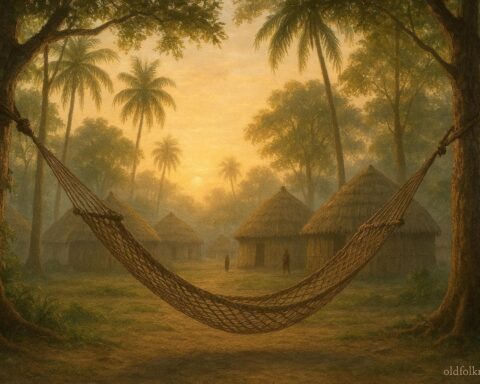
In the earliest days, when the world was young and the stars were still being arranged in the sky, there lived two brothers named Hunahpú and Xbalanqué. They were known throughout the lands for their courage and cleverness, the sons of Hun Hunahpú, a great ballplayer who had once faced the Lords of Death in the dark underworld of Xibalba and perished there.
The people of the earth whispered tales of that place, where rivers of blood and scorpions flowed, and where laughter turned to echoes. The Lords of Death, proud of their dominion, ruled it with cruelty and cunning. They delighted in tricks, puzzles, and challenges that no mortal could escape. Yet the Hero Twins, born of the spirit of their father, carried in their hearts both his courage and his unfinished purpose. They would journey to Xibalba, not only to avenge him but to restore the sacred balance between life and death that the Lords had broken.
The journey began at dawn. The brothers followed a winding path that led downward through thick forests and into the mouth of the earth. The light faded until only the faint glow of fireflies remained to guide them. The air turned cold and heavy, and strange whispers drifted from unseen places.
Discover the diverse storytelling traditions of Canada — from the icy North to the Maritimes
At last, they reached the River of Blood, the first trial of Xibalba. Without hesitation, they wove reeds into small rafts and crossed, untouched by its dark waters. Next came the River of Scorpions, but the brothers called upon the wisdom of the animals. Tiny ants and frogs guided them safely across, whispering that the Lords were watching from beyond.
When Hunahpú and Xbalanqué entered the great hall of Xibalba, twelve shadowy figures awaited them, seated upon thrones carved from bone. At the center sat One Death and Seven Death, the highest of the Lords. Their eyes glowed like cold fire, and their voices carried both amusement and threat.
“Welcome, strangers,” said One Death. “You have been expected. Come, sit upon these benches and rest.”
But the twins had been warned by the owl messengers of the gods that nothing in Xibalba was what it seemed. The benches, they saw, were made not of wood but of burning stones disguised with ash. They bowed respectfully and remained standing. The Lords exchanged dark glances, disappointed that their first trick had failed.
“You are clever,” said Seven Death. “But the tests have only begun.”
The Lords then sent the brothers to the House of Darkness, where even the memory of light could not survive. Yet Hunahpú and Xbalanqué carried a single firefly within a clay lamp, its glow piercing the shadows. When the Lords demanded to see their torches still burning by morning, the twins simply presented the firefly’s light, and the deception worked.
Next came the House of Blades, where knives floated through the air, whispering threats. The brothers spoke softly to them, praising their sharpness and asking them to rest, for the time of battle had not yet come. The knives, flattered, fell still.
Then came the House of Jaguars, filled with hungry beasts whose eyes gleamed like suns. The twins tossed them bones from a hidden bag, and the beasts were satisfied. Every test the Lords devised, the brothers turned into triumph through wit, patience, and unity.
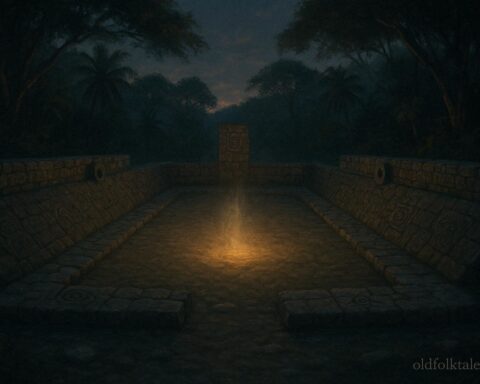
Finally, the Lords challenged them to a sacred ball game, the same game that had cost their father his life. The court was vast and echoing, its walls alive with shadows. The Lords’ ball was made not of rubber but of a living skull, sharp with teeth. When it was hurled toward them, the brothers ducked and laughed, returning it with such skill that it burst into harmless dust.
Game after game, the Lords grew more frustrated. The twins danced, sang, and performed miracles before the dark court. They allowed themselves to be sacrificed, only to rise again, reborn from ashes as radiant youths. Seeing this, the Lords demanded that the twins perform the same magic upon them.
Hunahpú and Xbalanqué pretended to agree. They took One Death and Seven Death, struck them down, and declared that they too would be reborn. But when the time came, no magic stirred. The Lords of Death were gone, and the underworld fell silent.
The twins had triumphed. They brought light to the depths and taught that death is not an end but a passage. Their father’s spirit rose with them, transformed into the sun, while the brothers themselves became the moon and stars. Together, they watched over the world from the heavens, ensuring that day and night, life and death, would remain forever in balance.
And so the people learned that courage alone was not enough. It was wisdom, humility, and faith in one another that allowed even mortals to outwit darkness. The Hero Twins became the guardians of renewal, symbols of hope across the generations.
Explore the ancestral legends of Canada, Mesoamerica, and South America’s Indigenous tribes.
Moral Lesson
The story of the Hero Twins teaches that intelligence and unity can overcome even the darkest challenges. Through courage, humility, and faith, balance is restored, reminding humanity that every ending is also a beginning.
Knowledge Check
-
Who are the main heroes in the story?
Hunahpú and Xbalanqué, the Hero Twins, sons of Hun Hunahpú. -
What is Xibalba?
Xibalba is the Maya underworld ruled by the Lords of Death. -
How did the twins defeat the Lords of Death?
They used wit, strategy, and unity to overcome all challenges and deceived the Lords through clever tricks. -
What happened to the twins after their victory?
They transformed into celestial beings, becoming the moon and stars. -
What moral does the story teach?
That intelligence and courage together bring balance and renewal to life. -
What does the ball game symbolize in the story?
It represents the cosmic struggle between life and death, light and darkness.
Source: Adapted from The Popol Vuh: The Sacred Book of the Maya, translated by Dennis Tedlock (1996), New York: Simon & Schuster.
Cultural Origin: Kiche Maya (Guatemala)