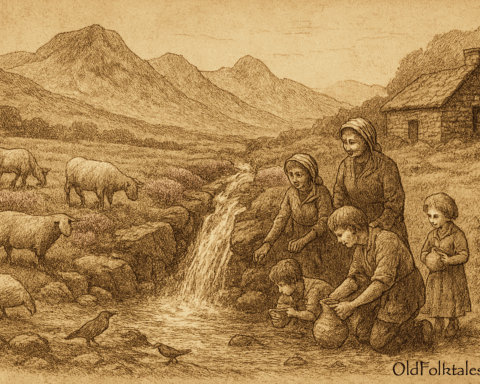
High in the rugged hills overlooking Loch Treig, where the mountains rise like the gnarled backs of sleeping giants and mist clings to the heather like breath on cold mornings, there once lived a herdsman whose name has been long forgotten, though his story remains. His stone cottage sat perched on the hillside, surrounded by fields where cattle grazed in great numbers. The beasts were fat and healthy, their coats glossy in summer sun, their breath steaming in winter cold. By all measures, this man was wealthy. His byre overflowed with livestock, his pastures stretched across the moorland as far as the eye could see, and his barns bulged with hay and grain.
Yet there was something cold about the herdsman’s home, something unwelcoming that even the smoke rising from his chimney could not dispel. Travelers who crossed the treacherous mountain passes learned quickly to avoid his door. Those who didn’t know better and knocked, seeking shelter or a cup of water, were met with harsh words and a slammed door. The herdsman cared for nothing beyond his cattle and his coin. His heart, it was said, was harder than the granite peaks surrounding Loch Treig.
Click to read all Andean Highland Folktales — echoing from the mountain peaks of Peru, Bolivia, and Ecuador.
In the Scottish Highlands of old, hospitality was not merely good manners, it was sacred law, woven into the very soul of Gaelic culture. No matter how poor a family might be, they would share their last crust of bread with a stranger who appeared at their threshold. No matter the hour or the season, a traveler must be offered warmth, shelter, and food before any questions were asked. This was not charity; it was duty, as ancient and unbreakable as the mountains themselves. The land was harsh, the weather merciless, and survival depended on the unspoken covenant that every door might be a haven, every hearth a sanctuary.
But the herdsman scoffed at such traditions. “Hospitality,” he would sneer when the subject arose, “is for fools who enjoy poverty. My cattle didn’t grow fat by feeding every wandering beggar who crosses my path. My wealth came from hard work and good sense not from throwing away what I’ve earned on strangers.”
And so the seasons turned, and the herdsman’s reputation grew colder even as his herds grew larger.
Then came a winter night when the storm arrived with fury. Snow fell in thick, blinding sheets, driven sideways by winds that howled like wounded beasts. The temperature plummeted until the very air seemed to freeze, and ice formed on every surface, glittering and deadly. It was the kind of night when even the hardiest Highlander would bar the door and huddle close to the fire, grateful for solid walls and a warm hearth.
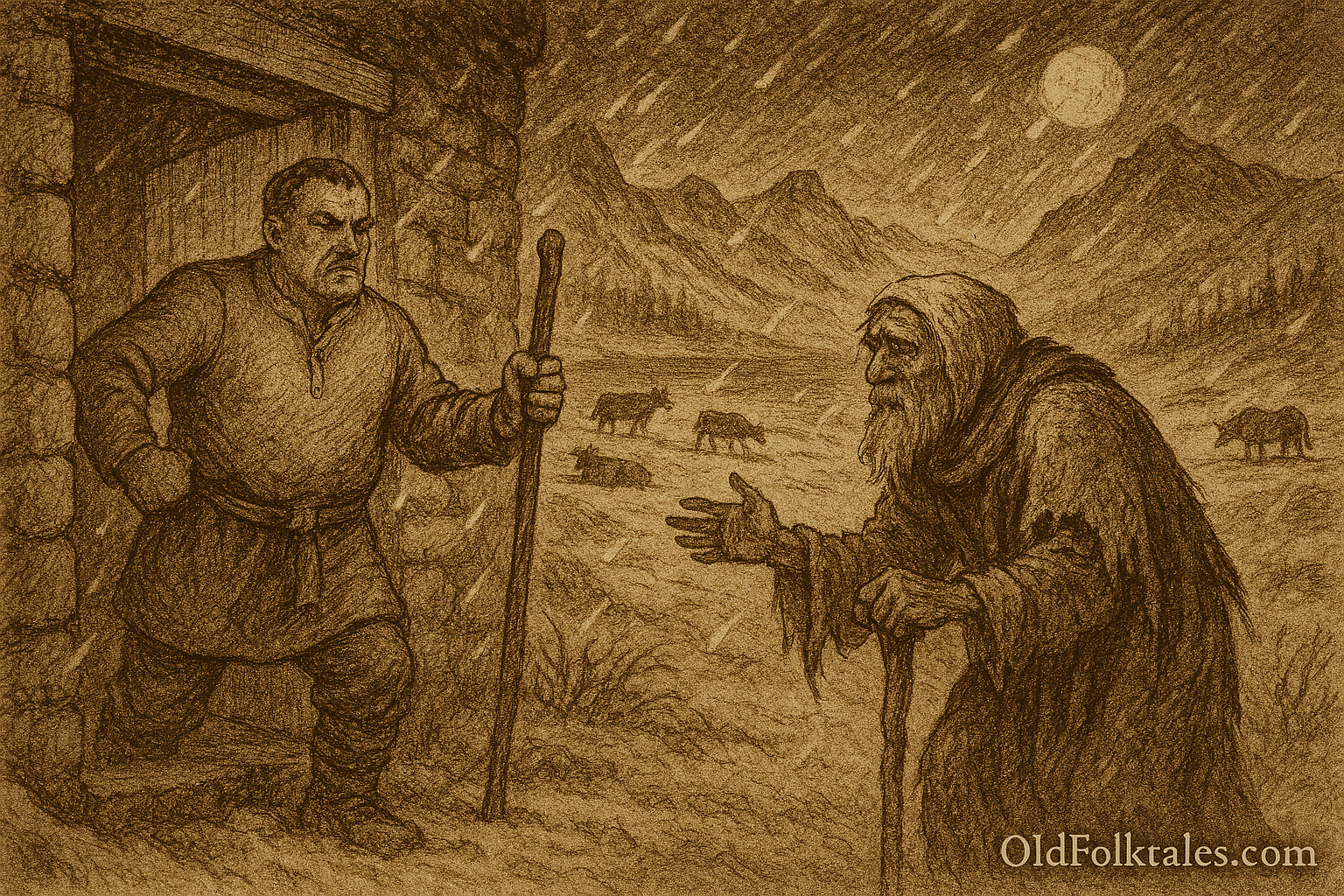
Through this tempest came a figure, an old man, bent and stumbling, his clothes hanging in frozen tatters. Ice clung to his beard like white thorns, and his face was gray with cold and exhaustion. How he had survived the journey through the mountain passes, no one could say, but somehow his legs carried him to the herdsman’s door. With trembling, half-frozen fingers, he knocked.
The herdsman opened the door just a crack, and firelight spilled out into the darkness, along with precious warmth. The old man looked up with eyes that seemed strangely deep, strangely knowing, despite his desperate condition.
“Please,” the stranger said, his voice barely audible over the screaming wind. “I ask for nothing but a place by your fire. Just warmth enough to thaw my bones. I’ve been walking through the storm, and I fear I cannot go much farther.”
The herdsman’s face twisted with contempt. He looked the old man up and down taking in the ragged clothes, the frost-bitten skin, the trembling exhaustion and saw only an inconvenience, a burden, someone who would consume his firewood and perhaps ask for food.
“A beggar!” the herdsman spat. “That’s all you are a worthless beggar who’s too lazy to work and too foolish to prepare for winter. You think you can wander the hills and then demand comfort from those of us who’ve earned what we have?” His voice rose with indignation. “I’ve worked all my life for this prosperity. Why should I share it with the likes of you?”
The old man said nothing, simply stood in the doorway, snow gathering on his shoulders, hope fading from his ancient eyes.
The herdsman’s anger grew. He reached for the stout walking stick that stood beside his door and raised it threateningly. “Get away from here! Go back to wherever you came from. I owe you nothing, nothing! Find your own shelter and leave honest men in peace!”
He advanced with the stick, and the old man stumbled backward into the snow. The door slammed shut with a sound like thunder, cutting off the firelight and warmth. The herdsman returned to his hearth, satisfaction warming him more than the flames. He’d stood firm against the foolish tradition of his neighbors. He’d protected what was his.
Outside, the old man stood in the swirling snow for a long moment. Then, just before the wind swallowed his words, he spoke quietly yet somehow the herdsman heard him clearly through the thick door and stone walls: “You have closed more than a door tonight.”
The herdsman laughed and dismissed the words as the ramblings of a half-frozen fool.
But when dawn broke over Loch Treig, painting the snow-covered hills in shades of pink and gold, something had changed. The herdsman rose and went to check his cattle as he did every morning. What he found turned his blood to ice.
The cattle were gone not all of them, but many. Some lay dead in the fields, their bodies already stiff and cold despite having been healthy and robust the night before. Others had simply vanished, leaving no tracks in the fresh snow, no sign of where they might have fled or been driven. The herdsman called out, his voice echoing across the white landscape, but only silence answered.
The days that followed brought no relief only deepening horror. More cattle sickened and died. Those that survived gave sour milk that curdled in the pail and was unfit even for the pigs. When spring finally came and calves were born, they emerged weak and trembling, barely able to stand on their spindly legs. Many died within hours. The grass in the herdsman’s once-lush pastures grew thin and brown, as if the earth itself had turned against him.
His wealth, so carefully accumulated over decades, began to crumble like a sandcastle before the tide. Desperate and frightened, the herdsman searched far and wide for answers. He consulted his neighbors, though they had little sympathy for him. He walked to distant villages seeking advice. Finally, the village elders agreed to speak with him.
“The old man you turned away,” one elder said, her face grave and lined with wisdom, “was not what he seemed. He was one of the daoine sìth the fairy folk who walk between our world and the Otherworld. They take human form sometimes to test us, to see if we still honor the old ways, the sacred laws that hold our people together.”
Another elder nodded slowly. “Hospitality is not merely tradition. It is covenant with each other, with the land, with forces older than memory. You were tested and found wanting. You broke the most sacred law of our people.”
The herdsman felt his heart sink like a stone into dark water. “What can I do?” he whispered. “How can I make amends?”
The elders shook their heads. “What is done cannot be undone. The blessing has been lifted from your land and your herds. No remedy exists for a heart that refused compassion when it was needed most.”
And so it proved. The herdsman’s fortune continued its downward spiral. His once-great herds dwindled to nothing. His fields lay barren. The prosperity he had guarded so jealously slipped through his fingers like water. In the end, he died alone in his stone cottage, his wealth gone, his name forgotten except as a warning. To this day, when the wind howls around Loch Treig on winter nights, old folk still tell the story not to preserve his memory, but to remind each new generation that some laws are more ancient and more powerful than any man’s pride or greed
Click to read all South American Folktales — timeless stories from the Andes to the Amazon.
The Moral Lesson
The tale of Loch Treig’s herdsman carries a profound warning that resonates across cultures and centuries: material wealth without compassion is hollow and ultimately self-destructive. In the harsh landscape of the Scottish Highlands, where survival often depended on mutual aid and generosity, hospitality represented more than social courtesy, it was a sacred bond that held communities together and connected people to the deeper spiritual forces governing their world. The herdsman’s downfall teaches us that true prosperity flows from an open heart, not a closed fist. When we hoard our resources and turn away from those in need, we sever ourselves from the very sources of blessing and abundance. Wealth built on selfishness is fragile; it can vanish as mysteriously as it came. But generosity and compassion create bonds that sustain us through hardship and connect us to something greater than individual gain. The herdsman lost everything not because he was poor in material goods, but because he was poverty-stricken in spirit.
Knowledge Check
Q1: Who was the herdsman of Loch Treig in Scottish Highland folklore?
A1: The herdsman of Loch Treig was a wealthy cattle owner who lived in the Scottish Highlands near Loch Treig. Though prosperous with large herds and extensive lands, he was notorious for refusing to practice hospitality, a sacred obligation in Gaelic Highland culture. His name has been deliberately forgotten in tradition, preserved only as a cautionary tale about the consequences of violating ancient customs of generosity and compassion toward strangers.
Q2: What was the sacred law of hospitality in traditional Highland Scottish culture?
A2: In traditional Gaelic Highland culture, hospitality was considered a sacred law and moral obligation, not merely a social nicety. Every household, regardless of wealth, was duty-bound to offer warmth, shelter, and food to any stranger who appeared at their door, especially during harsh weather. Questions were asked only after basic needs were met. This ancient tradition recognized that survival in the harsh Highland landscape depended on mutual aid and that refusing hospitality violated the covenant that bound communities together.
Q3: Who was the old man that appeared during the winter storm at the herdsman’s door?
A3: The old man was one of the daoine sìth the fairy folk or supernatural beings of Gaelic tradition who inhabit the Otherworld. In Scottish Highland folklore, these beings sometimes took human form to test mortals and determine whether they still honored the ancient sacred laws, particularly the law of hospitality. The old man’s appearance was a test of the herdsman’s character and adherence to Highland moral traditions.
Q4: What happened to the herdsman’s cattle and land after he refused to help the stranger?
A4: After the herdsman violently turned away the old man, his prosperity immediately began to collapse. Many cattle died mysteriously or vanished without trace, milk turned sour and unusable, calves were born weak and sickly, and even the grass in his pastures withered and grew poorly. The land itself seemed cursed, as if the blessing that had sustained his wealth had been withdrawn. His fortune gradually crumbled until he was left with nothing.
Q5: What is the symbolic meaning of the stranger’s warning, “You have closed more than a door tonight”?
A5: This warning carried deep symbolic meaning: the herdsman had not simply refused entry to one traveler, but had closed his heart to compassion, severed his connection to sacred Highland traditions, and cut himself off from the spiritual forces and communal bonds that sustained true prosperity. He had broken covenant with his culture’s deepest values. The closed door symbolized his isolation from both human community and the supernatural powers that, in Gaelic belief, could bless or curse based on moral behavior.
Q6: What does the Loch Treig story teach about values in Scottish Highland Gaelic society?
A6: The story emphasizes core values of traditional Highland Gaelic society, particularly that hospitality and compassion toward others are sacred obligations more important than personal wealth. It teaches that material prosperity without generosity is unstable and ultimately destructive, that ancient moral laws carry real consequences when violated, and that individual fortune is inseparably connected to community bonds and spiritual forces. The tale also reflects the Highland belief in the daoine sìth and the understanding that supernatural beings test human character and punish moral failures.
Source: Retold from an indigenous Gaelic oral tradition recorded in written form by Alexander Carmichael in Carmina Gadelica, Volume II
Cultural Origin: Scottish Highlands, Gaelic Scotland