In the time before time could be measured, when the gods still walked among mortals and the boundary between the earthly and divine realms was thin as morning mist, there lived a people who were beloved by the celestial powers. The Guaraní called them the Guayakí, and they were known throughout the land as a tribe blessed with abundance, wisdom, and the special favor of Tupã, the supreme god of thunder and creation.
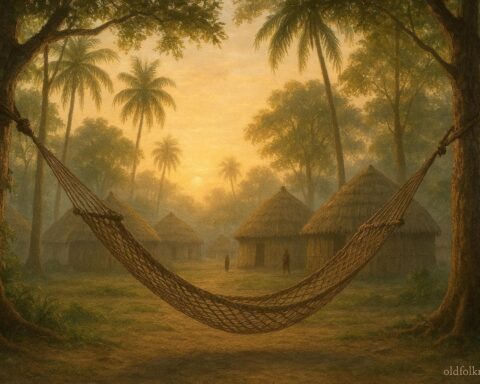
The Guayakí settlements flourished along the rivers and in the clearings of what would one day be called Paraguay. Their fields produced crops more abundant than those of neighboring tribes. Their hunters never returned empty handed. Their children were strong and healthy, their elders wise and respected. The people attributed their good fortune to their relationship with the gods, a relationship they maintained through careful observance of rituals and ceremonies that had been passed down through countless generations.
Click to read all South American Folktales — timeless stories from the Andes to the Amazon.
Among all the ceremonies the Guayakí observed, none was more important than the Great Presentation, held once every cycle when the moon completed its journey seven times across the sky. During this sacred ritual, representatives from the tribe would present themselves before the gods in a special clearing deep in the forest, a place where the veil between worlds grew gossamer thin and divine beings could manifest to receive offerings and observe their favored people.
The ritual required precise preparation. Those chosen to represent the tribe underwent purification ceremonies lasting many days. They fasted, bathed in sacred waters, and adorned themselves with specific ornaments that had been blessed by the shamans. Every detail mattered: the pattern of body paint, the type of feathers worn, the order in which offerings were presented, even the posture and manner of walking into the sacred clearing. These traditions had been established by the ancestors who first received divine favor, and deviation from them was considered not just disrespectful but dangerous.
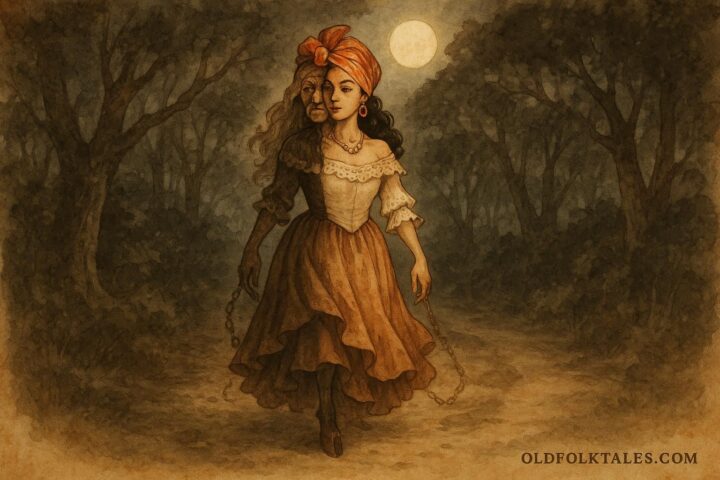
As the time for the Great Presentation approached in one particular cycle, the Guayakí people prepared as they always had. The elders selected five young warriors and five young women to serve as representatives, individuals chosen for their virtue, strength, and dedication to traditional ways. Among them was a young man named Kuruyú, known for his skill as a hunter and his bold spirit.
Kuruyú took pride in being chosen, perhaps too much pride. As the purification rituals progressed, he began to feel that some of the traditional preparations were unnecessarily elaborate. The fasting left him weak, the body paint took hours to apply correctly, and the ceremonial garments felt restrictive compared to his usual hunting clothes. In his youthful arrogance, he thought himself wise enough to determine what truly mattered to the gods.
“Surely,” Kuruyú whispered to his fellow representatives, “it is our hearts and intentions that matter to the divine ones, not whether every feather is placed exactly so. The gods see our devotion. They will not care about minor details.”
Some of the other young people, equally tired from the demanding preparations, found his words appealing. They began to rush through certain aspects of the ritual cleansing. They skipped some of the prescribed fasting periods. When it came time to apply the sacred body paint, they approximated the traditional patterns rather than following them precisely. The ornaments were put on hastily, without the proper prayers.
The elders, absorbed in their own preparations and trusting the young people to follow traditions they had been taught since childhood, did not notice these shortcuts. The shamans, deep in meditation to prepare themselves for communion with the divine, remained unaware of the growing carelessness among the representatives.
When the appointed day arrived, the entire tribe processed to the sacred clearing. The air hummed with spiritual energy. The trees seemed to lean inward, as if the forest itself was watching. The sky above the clearing shimmered with colors that had no names in human language. The gods were present, waiting to receive their favored people.
The ten representatives stepped forward into the clearing, and immediately, something felt wrong. The shimmer in the air intensified, but it no longer felt welcoming. The temperature dropped suddenly, and a wind arose from nowhere, whipping through the clearing with a sound like disappointed sighs.
Tupã himself manifested, his form vast and terrible, composed of storm clouds and lightning. His voice, when he spoke, rumbled like thunder across mountains.
“You come before us improperly prepared,” the god declared, his words shaking the ground beneath their feet. “You have dishonored the sacred traditions established by your ancestors. You have shown disrespect for the covenant between your people and the divine realm.”
Kuruyú fell to his knees, suddenly understanding the magnitude of their error. “Great Tupã, we meant no disrespect! Our hearts are devoted to you!”
“Your hearts may have held devotion,” the god replied, “but your actions showed contempt for sacred law. The rituals are not mere decoration or unnecessary tradition. They are the language through which the mortal and divine communicate. By altering them carelessly, you have broken that communication. By believing yourselves wise enough to determine what matters to beings beyond your understanding, you have revealed dangerous pride.”
The god’s judgment was swift and terrible. “The Guayakí people will no longer know the blessings of settled life. You will be scattered through the forests, forever wandering, forever separated from the civilized world you once knew. Your descendants will live as nomads in the deepest woods, and this wandering will continue until you relearn the humility you have forgotten.”
As Tupã spoke, transformation began. The Guayakí felt themselves pulled toward the forest’s depths by an irresistible force. Their settlements, once so permanent and prosperous, seemed suddenly foreign and unwelcoming. An overwhelming compulsion to move, to wander, to avoid staying in one place too long, settled into their bones like an ache that could never be soothed.
The tribe scattered into the deep forests of Paraguay, their former unity fragmenting into small, wandering bands. They became hunter gatherers, moving constantly through territories that other tribes feared to enter. Their old knowledge of agriculture faded, replaced by intimate understanding of the forest’s secrets. They learned to read signs in bark and leaves that others could not see, to find sustenance where others would starve, to move through dense undergrowth like shadows.
Generations passed, and the Guayakí remained wanderers. Their descendants became known as fierce forest people who avoided contact with settled communities, who seemed more comfortable among trees than in clearings, who possessed knowledge of the wilderness that bordered on supernatural. They carried with them the memory of what had been lost, passed down in stories told around temporary camps, a reminder of how divine favor, once squandered through carelessness and pride, could never be fully regained.
The other Guaraní tribes told the story of the Guayakí as a warning. They taught their children that traditions exist for reasons deeper than surface understanding, that what seems like mere ritual to human eyes may be essential language to divine ones, and that pride in one’s own judgment, especially regarding matters of the sacred, leads only to loss and exile.
In the deepest forests of Paraguay, the descendants of the Guayakí still wander, carrying within them the ancient curse born of a single moment of careless pride, forever separated from the settled life their ancestors once enjoyed, forever reminded that respect for tradition and humility before powers greater than ourselves are not optional virtues but essential wisdom.
Click to read all Andean Highland Folktales — echoing from the mountain peaks of Peru, Bolivia, and Ecuador.
The Moral of the Story
The tale of the Guayakí people teaches us those traditions and rituals, especially those connected to sacred or cultural practices, exist for profound reasons that may not always be immediately apparent. Pride and the assumption that we understand better than those who came before us can lead to devastating consequences. True wisdom lies in humility, in recognizing that some practices have deeper significance than we can perceive, and that respect for established customs reflects respect for the accumulated knowledge of our ancestors and the powers beyond our complete understanding.
Knowledge Check
Q1: Who were the Guayakí people in Guaraní mythology?
A: The Guayakí were a tribe specially favored by the gods, particularly by Tupã, the supreme god of thunder and creation. They enjoyed abundant harvests, successful hunts, and prosperity because of their careful observance of sacred rituals and their good relationship with the divine realm in ancient Guaraní cosmology.
Q2: What was the Great Presentation ceremony?
A: The Great Presentation was the most important sacred ritual held once every seven lunar cycles, where chosen representatives presented themselves before the gods in a special clearing. The ceremony required precise preparation including fasting, purification, specific body paint patterns, blessed ornaments, and exact procedures established by ancestors.
Q3: What mistake did Kuruyú and the young representatives make?
A: Kuruyú and the other young representatives became careless with the sacred preparations, believing that intentions mattered more than precise ritual observance. They rushed through purification ceremonies, skipped fasting periods, approximated body paint patterns instead of following them exactly, and hastily applied ornaments without proper prayers.
Q4: What punishment did Tupã impose on the Guayakí people?
A: Tupã condemned the entire Guayakí tribe to become eternal wanderers in the forests, separated from settled civilization. They lost their prosperous settlements and agricultural knowledge, becoming nomadic hunter gatherers compelled to move constantly through the deepest woods, with this curse extending to all future generations.
Q5: What does this legend teach about the importance of tradition?
A: The legend teaches that sacred traditions and rituals exist for profound reasons beyond surface understanding, serving as essential communication between mortals and the divine. It emphasizes that assuming we can modify or simplify traditions based on our limited understanding shows dangerous pride and can have catastrophic consequences.
Q6: How does the Guayakí story reflect Guaraní cultural values?
A: The story reflects core Guaraní values including respect for ancestral wisdom, humility before divine powers, the importance of maintaining proper relationships with the sacred realm through precise ritual observance, and the understanding that pride and carelessness regarding spiritual matters can affect entire communities across generations.
Source: Adapted from ancient Guaraní oral mythology and traditional folklore preserved in Paraguayan indigenous cultural records and anthropological documentation of Guaraní cosmology.
Cultural Origin: Guaraní people of Paraguay, South America