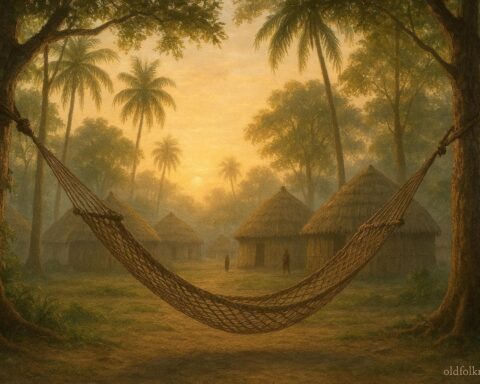
In the time before memory, when the world was still young and the shape of the land had not yet been fully decided, the Mapuche people lived in harmony with the forests, the valleys, and the fertile plains that stretched between the mountains and the sea. They fished in the abundant waters, hunted in the dense forests, cultivated their crops in soil that gave generously, and lived according to the rhythms and wisdom passed down through countless generations.
But beneath the peaceful surface of their world, great powers stirred ancient beings whose conflict would reshape the very land itself and test whether humanity would survive to see another dawn.
Click to read all South American Folktales — timeless stories from the Andes to the Amazon.
Deep in the ocean’s darkest trenches, where sunlight had never penetrated and the pressure could crush stone, dwelt Caicai Vilu, the lord of the seas and all waters. He was a serpent of unimaginable size, his body coiling through underwater canyons, his scales gleaming with the cold blue-green light of the deep. For ages untold, he had ruled his aquatic domain without challenge, master of currents and tides, commander of all that swam or drifted in the vast waters.
But Caicai Vilu looked upon the land with growing resentment. He saw the humans who lived upon the earth’s surface how they took fish from his waters, how they walked the beaches as though they owned them, how they seemed to give allegiance to the land rather than honoring the sea that sustained them with its abundance. His festered like a wound, growing deeper and darker with each passing season until it transformed into rage cold, vast, and implacable as the ocean itself.
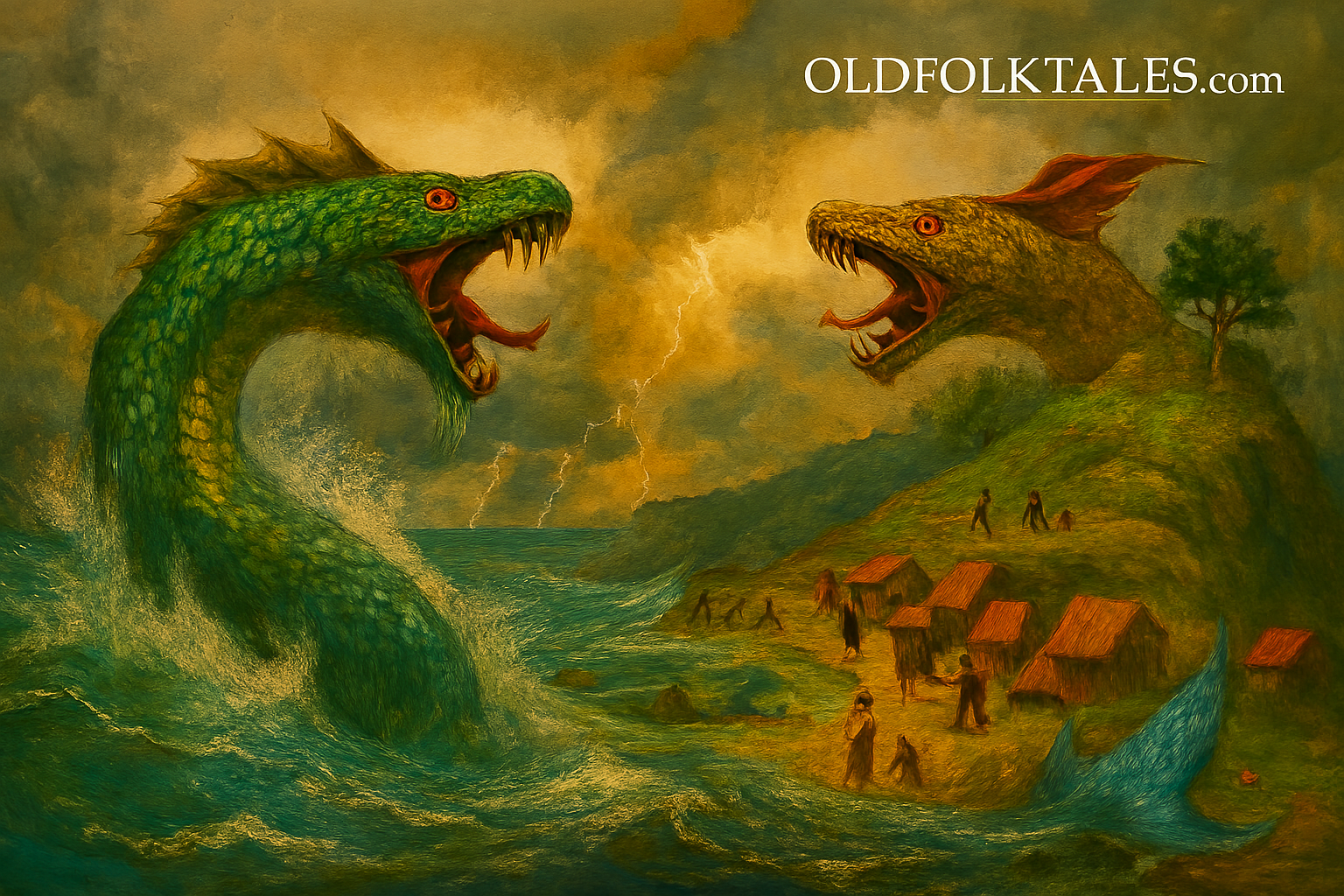
One day, Caicai Vilu’s fury reached its breaking point. With a roar that made the ocean floor tremble and sent waves racing toward distant shores, he rose from the depths. His massive body broke through the surface, water cascading from his scales like waterfalls, his eyes burning with determination to submerge the insolent land and reclaim the world for the waters.
The great serpent called upon all the power at his command. He summoned the tides, pulling them higher than they had ever risen. He drew the ocean toward the land, the waters responding to his will like obedient children. The sea began to swell, rising up the beaches, flooding the coastal plains, surging inland with relentless determination. Villages disappeared beneath the waves. Fields vanished under the advancing water. Forests that had stood for centuries found themselves submerged, their branches becoming new homes for fish rather than birds.
The Mapuche people fled in terror, abandoning their homes and running toward higher ground. Mothers carried children, elders were helped along by the young and strong, precious possessions were left behind as families raced against the rising waters. Behind them, they could hear the roar of Caicai Vilu’s flood, could see the waves climbing higher and higher, threatening to swallow everything the land, the mountains, humanity itself.
It seemed that nothing could stop the water serpent’s rage. The ocean continued its inexorable advance, consuming more land with each passing hour. The people climbed hills that became islands. They scrambled up mountainsides as the waters lapped at their heels. Despair began to settle over them where could they go when the water rose higher than the highest peaks? How could mere humans stand against a power as vast as the ocean itself?
But the earth had not abandoned its children. Deep within the mountains and valleys, coiled through the very bones of the land, dwelt another serpent Trentren Vilu, the defender of earth and humanity. Where Caicai Vilu was cold and fluid like water, Trentren Vilu was solid and enduring like stone. Where Caicai Vilu sought to submerge and destroy, Trentren Vilu existed to protect and preserve.
Feeling the terror of the people who lived upon his back, sensing the threat to the land he embodied, Trentren Vilu awakened from his ancient rest. The earth rumbled and shook as the great serpent stirred. Mountains trembled. The ground beneath the fleeing people’s feet began to move but not in a way that brought more fear. Instead, they felt themselves being lifted.
Trentren Vilu was raising the land itself.
Where the people had gathered, seeking refuge on hills and mountainsides, the earth began to rise higher. Mountains grew taller, pushing up toward the sky, lifting the refugees above the advancing waters. Hills became mountains. Plateaus lifted like platforms being hoisted by invisible hands. The earth serpent was using his power to create sanctuary, to build refuges that even Caicai Vilu’s floods could not reach.
But Caicai Vilu saw what his opponent was doing and responded with renewed fury. He pulled the oceans higher still, gathering water from across the world, drawing upon reserves of power that made the sea boil and churn. The waters rose to meet the rising land, climbing toward the peaks where the people huddled in desperate hope.
And so began a battle of titans that would reshape the face of the earth. Trentren Vilu raised the mountains. Caicai Vilu raised the seas. The land pushed upward. The water surged higher. Back and forth the struggle went, neither serpent willing to yield, both drawing upon power that seemed limitless and eternal.
The Mapuche people, caught between these warring forces, could only watch in awe and terror. They saw mountains thrust up from the earth like teeth breaking through gums. They saw valleys flood and drain and flood again as the battle’s tide shifted. They felt the ground heave beneath them as Trentren Vilu exerted himself to save them. They saw waterfalls of seawater pouring off the edges of lifted landmasses as Caicai Vilu’s floods tried to follow the rising earth.
The conflict lasted for days that felt like years, or perhaps years that felt like days time lost its normal meaning when the fundamental forces of water and earth were at war. The serpents struck at each other with the full force of their natures. Where they collided, islands were born. Where they pulled apart, channels and straits opened. Where Trentren Vilu’s body broke through the surface, mountain ranges appeared. Where Caicai Vilu managed to hold territory, deep lakes formed in basins that would never fully drain.
Gradually, painfully, the balance began to tip. Trentren Vilu, fighting to protect rather than destroy, defending rather than attacking, found strength in his purpose. Each time he raised the land, he was saving lives. Each mountain he thrust skyward was a refuge for the people who had sought his protection. His determination never wavered because he could feel the humans clinging to the earth, trusting him, believing in him.
Caicai Vilu, for all his power and rage, began to tire. Destruction requires immense energy, and even his vast reserves were not infinite. The waters he had raised so high began to recede, not all at once, but gradually, reluctantly, like a defeated army retreating from a battlefield.
The flood began to subside. Water that had covered valleys drained away, leaving behind rich silt and changed landscapes. Mountains that had been lifted remained lifted, standing as permanent monuments to Trentren Vilu’s protective power. The people, exhausted but alive, watched as the waters returned to their proper boundaries, as the ocean pulled back to reveal beaches once again.
But the land that emerged from the battle was not the land that had existed before. The conflict between the two great serpents had fundamentally altered the geography. Where once there had been continuous coastline, now there was an archipelago the islands of Chiloé and countless others, scattered like pearls torn from a broken necklace. Mountains stood taller than they had before, thrust upward by Trentren Vilu’s desperate defense. Deep lakes filled places where the earth had been torn or depressed during the struggle. Channels wound between islands where the serpents’ bodies had carved pathways through the contested terrain.
The people descended from their mountain refuges and explored this transformed world. They saw in every geographical feature the evidence of the great battle. That mountain range those were Trentren Vilu’s spine, thrust up to save them. That deep channel that was where Caicai Vilu had surged with particular fury. These islands each one marked a moment in the conflict, a place where earth and water had fought to a temporary stalemate.
Rock formations became sacred sites, each one telling part of the story. A stone shaped like a serpent’s head was surely a remnant of Trentren Vilu’s body, left visible as a reminder. A whirlpool that never quite settled was clearly where Caicai Vilu still lurked, his power diminished but not destroyed. The very topography became a text the Mapuche learned to read, finding in every hill and valley a verse in the epic poem of their survival.
From that time forward, the Mapuche held deep reverence for the land itself. They understood that the earth was not merely ground beneath their feet but the body of their protector, the serpent who had saved them when the waters sought to destroy them. They recognized that the balance between land and sea, between earth and water, between order and chaos, was delicate and hard-won.
They taught their children to respect Trentren Vilu, to honor the mountains and valleys, to recognize that the land’s very shape was a gift born from struggle and sacrifice. They also taught wariness toward Caicai Vilu, understanding that the ocean, while providing fish and transportation, retained its dangerous nature that the water serpent might sleep but was never truly gone, that his power still moved in tides and storms.
And they never forgot that they owed their existence to Trentren Vilu’s intervention, that humanity survived only because the earth had chosen to defend them, lifting them above the flood, holding them safe when all seemed lost.
Explore myths and legends from Brazil, Peru, and Argentina rooted in spirit and survival.
The Moral Lesson
The legend of Caicai Vilu and Trentren Vilu teaches that the natural world contains forces far greater than human power, and that humanity’s survival depends on the balance between these competing elements. It emphasizes deep respect and gratitude for the land itself, which serves as protector and sustainer. The tale shows that every geographical feature has meaning and history, that the landscape itself tells stories of cosmic struggles that shaped the world we inhabit. Most profoundly, it reminds us that the earth is not merely a resource but a living force that has actively defended humanity, deserving our reverence, care, and acknowledgment that we exist only through its continued grace and protection.
Knowledge Check
Q1: Who are Caicai Vilu and Trentren Vilu in Mapuche mythology? A: Caicai Vilu is the great water serpent, lord of the seas and all waters, who dwells in the ocean’s depths. Trentren Vilu is the earth serpent, defender of land and humanity, who exists within mountains and valleys. These two ancient beings represent opposing but necessary forces water/chaos versus earth/order whose conflict shaped Chile’s geography and determined humanity’s survival.
Q2: What caused Caicai Vilu to create the great flood in this Mapuche legend? A: Caicai Vilu’s flood was caused by his growing resentment and rage toward the land and its inhabitants. He resented humans who took fish from his waters, walked beaches as though they owned them, and seemed to honor the land rather than the sea. His festering anger eventually transformed into fury, leading him to rise from the depths and attempt to submerge all land and destroy humanity.
Q3: How did Trentren Vilu defend humanity from the rising waters? A: Trentren Vilu defended humanity by raising the land itself. He lifted mountains higher, elevated hills into mountains, and pushed plateaus upward to create refuges above the rising waters. As Caicai Vilu pulled the oceans higher, Trentren Vilu continuously raised the earth, keeping the people safe on elevated ground and creating sanctuaries that even the flood could not reach.
Q4: What geographical features resulted from the battle between the two serpents? A: The serpents’ battle created Chile’s distinctive southern geography, including the Chiloé Archipelago and numerous islands where continuous coastline once existed. Mountain ranges were thrust higher than before, deep lakes formed in basins created during the struggle, channels and straits opened where the serpents collided or pulled apart, and various rock formations emerged that mark specific moments in the conflict.
Q5: How did the Mapuche people survive the great flood? A: The Mapuche survived by fleeing to higher ground as the waters rose, climbing hills and mountains while abandoning their homes. Their ultimate survival depended on Trentren Vilu’s intervention the earth serpent continuously raised the land beneath them, lifting mountains and creating elevated refuges that kept them above the advancing flood until Caicai Vilu’s power finally waned and the waters receded.
Q6: What deeper meaning does this legend hold for Mapuche culture and worldview? A: The legend establishes the foundation for the Mapuche people’s profound respect and reverence for the land itself, which they understand as their active protector rather than merely ground beneath their feet. Every geographical featured mountains, valleys, islands, lakes carries meaning as evidence of Trentren Vilu’s defense of humanity. The story teaches that the landscape tells a sacred history, that balance between competing natural forces is delicate and hard-won, and that humanity exists only through the earth’s continued grace and protection, making gratitude and respect toward the land essential obligations.
Source: Adapted from Mapuche oral traditions as documented in Mapuche mythology collections
Cultural Origin: Mapuche people of southern Chile and Argentina, particularly associated with the Chiloé Archipelago region