Long before the world we know, the gods shaped and reshaped creation through countless ages, each ruled by a different Sun. The first Sun burned too fiercely, the second froze the earth in silence, and the third ended in wind so fierce it scattered people like leaves. Then came the Fourth Sun, Nahui Atl, the Sun of Water.
Under its light, humankind prospered for a time. Rivers shimmered, forests flourished, and mountains teemed with life. Yet, as always, the balance wavered. People grew proud, neglecting the offerings due to the gods. Their hearts hardened, their songs for the divine grew faint. Seeing this, the gods gathered in Teotihuacan, the sacred city of creation, to decide the fate of the world once more.
Explore myths and legends from Brazil, Peru, and Argentina rooted in spirit and survival.
The god Tezcatlipoca, whose obsidian mirror saw into every human heart, rose first. “Mortals have forgotten who gave them breath,” he declared. “They have defiled the earth and mocked the heavens. Let the world return to the waters from which it came.”
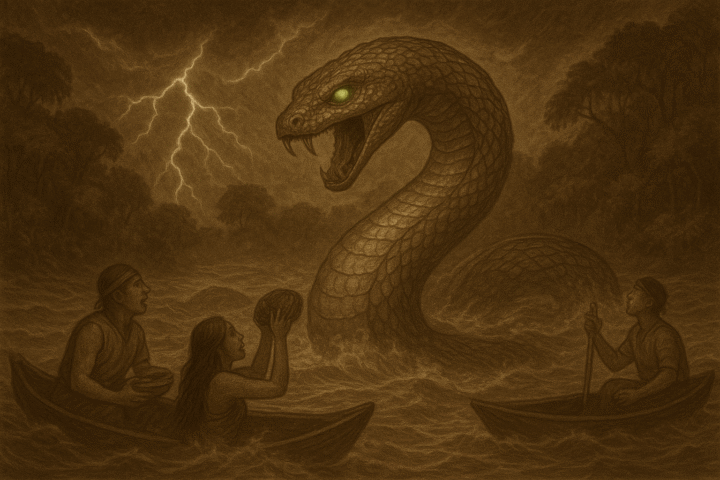
The other gods nodded in grave silence. With a single wave of Tezcatlipoca’s hand, the sky split open. Rain poured down for days uncounted, the lakes swelled and burst their banks, and the seas rose until even the mountains bowed beneath the waters.
All was lost. Humanity perished, and the Sun itself was swallowed by the flood. Only the whisper of the storm remained, until one faint light moved upon the endless water.
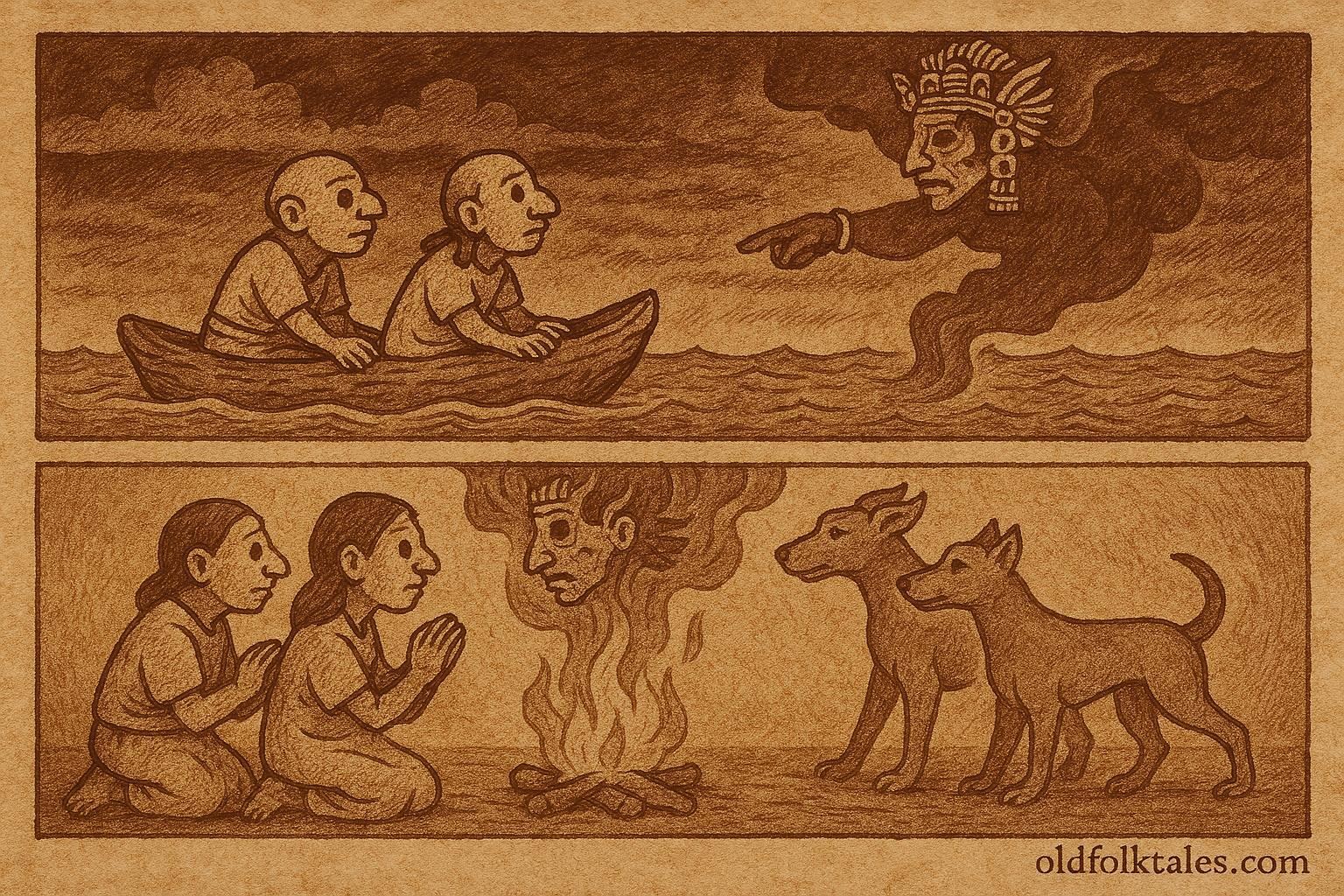
Upon a hollowed cypress tree floated Tata and Nene, a humble man and woman whose hearts had remained pure. It was Tezcatlipoca himself who had guided them before the deluge. “Take refuge,” he had said in a voice like thunder behind a veil of smoke, “for the waters will cleanse the world. Bring with you no fire, no food of flesh. When the rains cease, you shall plant anew.”
Tata and Nene obeyed. As the waters raged around them, they held fast to one another, trusting in the god’s words. For many days they drifted, past drowned cities, over mountains hidden beneath waves, through the shadow of the sunless sky.
At last, the storm began to tire. The clouds broke apart, and a pale glow spread across the heavens. The waters calmed. Their cypress raft struck against the peak of a mountain that had reemerged from the flood.
Exhausted but grateful, the couple stepped onto the soft, wet earth. They bowed their heads and wept, offering thanks to the unseen gods. The world was silent, empty, a newborn land still wrapped in mist.
Night came quickly. Cold and hungry, Tata gathered sticks to make a small fire, while Nene went to the edge of the receding waters to fish. When she returned with two small fish, they roasted them carefully over the flame, the first fire since the world had drowned.
As the smoke rose into the still air, a shadow appeared above them. From within it, the deep, echoing voice of Tezcatlipoca spoke:
“Who has dared to light fire upon this new earth?”
The couple trembled. Tata fell to his knees. “O Lord of the Smoking Mirror, forgive us! We were cold, and we feared the dark.”
Tezcatlipoca’s eyes, black as polished obsidian, glimmered through the smoke. “Did I not warn you?” he said. “You were spared to bring new life, not to repeat the errors of the old.”
The smoke thickened, swirling around them until the night itself seemed to twist. “You have tasted disobedience,” said the god, “and so you shall remember it for all time.”
Before they could cry out, the transformation began. Their limbs bent, their hands became paws, and their voices turned to howls that echoed through the valley. Tata and Nene had been turned into dogs, guardians of humankind’s future and reminders of its past.
Tezcatlipoca looked upon them not with anger but with sorrow. “Yet mercy is not forgotten,” he said. “You shall walk beside the new people when they are born. You shall serve them, protect them, and remind them that no fire burns without cost.”
Then he blew upon the embers of their fire. The sparks rose into the heavens and became the stars, signs of renewal after destruction.
From the smoke of that extinguished flame, the Fifth Sun would later rise: Nahui Ollin, the Sun of Motion, the age in which we live. And so, from obedience and disobedience alike, the cycle of creation continued, forever bound to the choices of humankind.
Even now, when the night wind carries the scent of rain and woodsmoke, people say they can hear the faint howling of Tata and Nene, calling across the ages, guardians of memory, companions of humankind, forever reminding us of the flood that once cleansed the world.
Explore the land of La Llorona, trickster coyotes, and magical realism in Mexican folklore
Moral of the Story
Even divine mercy carries law. Disobedience, however small, reshapes destiny. Renewal is born not only from destruction, but from the humility to remember what was lost.
Knowledge Check
- What caused the Great Flood of the Fourth Sun?
The gods, angered by human pride and neglect, decided to destroy the world with water. - Who were Tata and Nene?
They were the only human survivors chosen by Tezcatlipoca for their purity and faith. - What was Tezcatlipoca’s warning to them?
He forbade them to light a fire or eat flesh until the world was renewed. - Why did Tezcatlipoca turn them into dogs?
They disobeyed by lighting a fire and cooking fish, breaking divine command. - What do Tata and Nene symbolize in Aztec mythology?
They represent human frailty, memory, and the eternal bond between humans and dogs in life and death.
Source: Adapted from Leyenda de los Soles (“Legend of the Suns”), c. 1558, translated from Nahuatl by Ángel María Garibay.
Cultural Origin: Aztec (Mexica) – Central Highlands of Mexico.