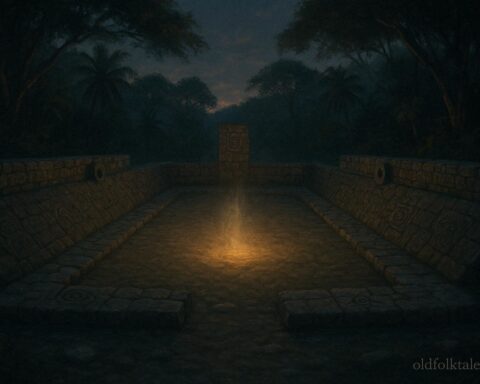
In the time before time as we know it, in the age that the Aymara people call Nayra Pacha the time of the ancestors the world existed in perpetual darkness. There was no sun to mark the passage of days, no golden warmth spreading across the high plains of the Altiplano. The people of that ancient age had never known sunlight, for the sun had not yet been born into the sky.
This was not the world we inhabit now. It was a different creation, an earlier attempt at existence, populated by beings who were the ancestors of ancestors the chullpa, ancient people who lived according to rhythms entirely foreign to our understanding. They moved through their lives by the cold silver light of the moon and the distant glimmering of stars that seemed closer then, more present, as if the sky itself pressed down upon the dark earth.
Click to read all South American Folktales — timeless stories from the Andes to the Amazon.
The chullpa were adapted to this perpetual twilight. Their eyes could see in the darkness as clearly as we see in daylight. They built their homes and monuments, their burial towers and ceremonial centers, all without ever knowing the sun’s warmth or brilliance. They planted their crops by moonlight, tended their herds of llamas and alpacas under the stars, and conducted their rituals in the eternal night that blanketed the Altiplano.
Life in the darkness had its own order, its own logic. The chullpa measured time not by days but by the phases of the moon, by the wheeling patterns of constellations across the black dome of sky. They had their own wisdom, their own ways of understanding the world. Some say they possessed powers that have been lost to us the ability to move great stones without effort, to build structures that still stand today though no one remembers how they were constructed or why they exist in such remote and desolate places.
But the universe was not finished with its creation. The cosmic powers that had made this first world of darkness were preparing something new, something transformative that would change everything. Deep in the realm beyond human perception, beyond even the awareness of the moon-people themselves, the sun was being born.
The chullpa had no warning of what was coming. How could they? The very concept of sunlight was unknown to them. They had no word for “sunrise,” no understanding of what heat and brilliant light might mean. They continued their lives in the familiar darkness, secure in the rhythms they had always known.
Then, one fateful dawn the first dawn the world had ever seen the sun began to rise.
At first, it was merely a strange glow on the eastern horizon, a faint brightening that the chullpa noticed with growing alarm. The sky, which had always been black or silver with moonlight, was turning colors, they had never seen before deep purple, then crimson, then shades of orange and gold that hurt their darkness-adapted eyes.
Panic spread through the chullpa settlements across the Altiplano. People emerged from their homes, pointing at the terrifying light that was growing stronger with each passing moment. The moon and stars were fading, overwhelmed by this new, incomprehensible radiance. What was happening? Was this the end of the world they knew?
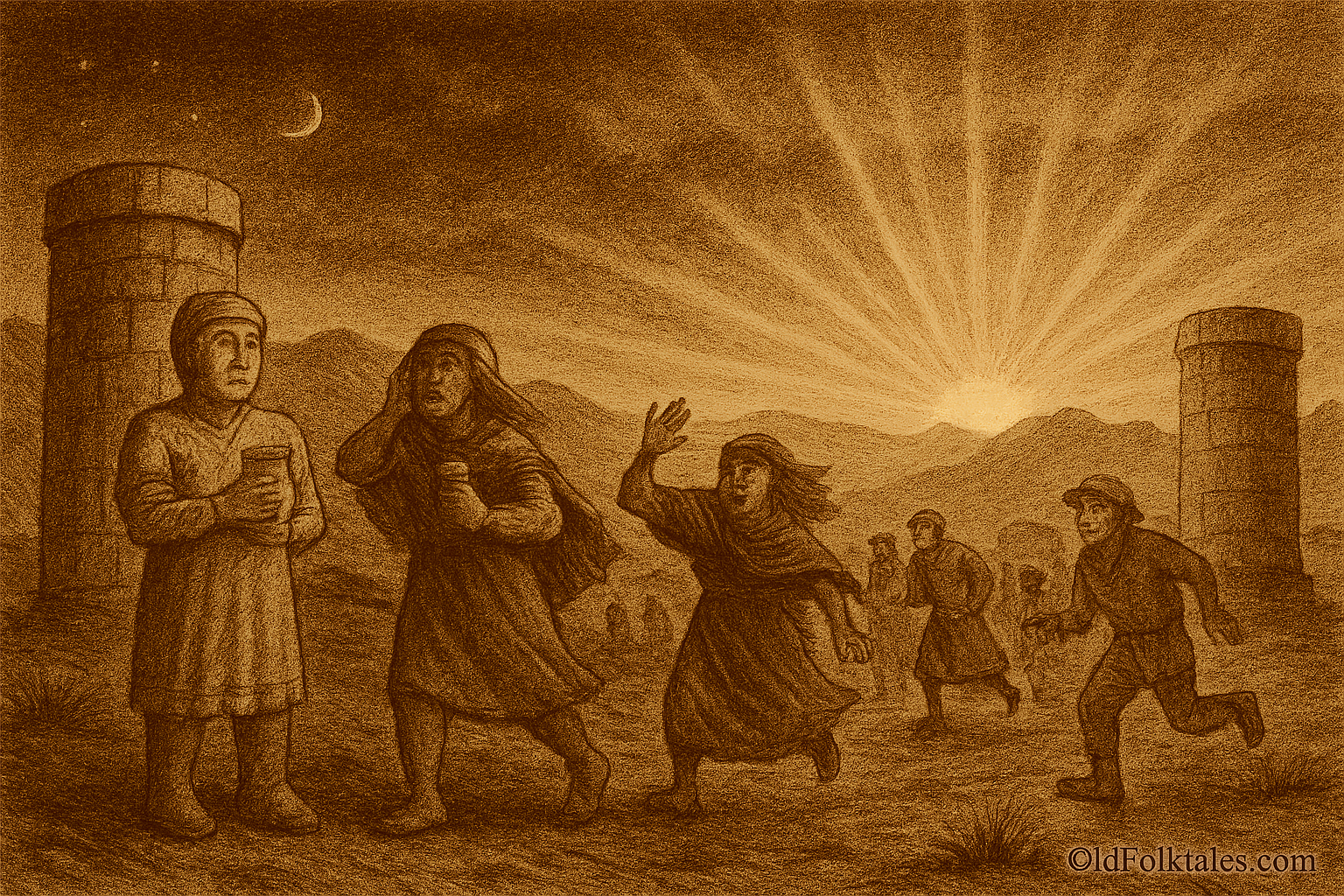
Some of the ancient people tried to hide. They retreated into their burial towers, the chullpas that would later bear their name, seeking shelter in the stone structures they had built for their dead. They huddled in caves, covered themselves with blankets, squeezed into any dark corner they could find. But the light of the sun, when it finally crested the horizon in terrible magnificence, penetrated everywhere.
The sun’s first rays were not gentle. They were fierce and absolute, the accumulated power of an entirely new cosmic force entering the world for the first time. When the light touched the chullpa, their bodies could not withstand it. Their darkness-adapted forms were not made for this new reality.
Those who had tried to hide in their towers were caught halfway some inside, some still scrambling for shelter. The sun’s light transformed them instantly into stone, freezing them in their final moments of terror and flight. They became part of their own monuments, petrified figures that would stand for millennia as mysterious remnants of an age that sunlight had destroyed.
Others who were caught in the open fared differently. The intense heat of that first sunrise burned some where they stood, reducing them to ash that the wind scattered across the desolate plains. Some, attempting to flee, found themselves frozen instead not by cold but by the shock of transformation, their bodies solidifying into stone statues in mid-stride, arms raised to shield eyes that would never see again.
The landscape of the Altiplano was forever changed in those first moments of dawn. Everywhere the sun’s light touched, it left evidence of the catastrophe. Stone towers stood empty or filled with petrified forms. Inexplicable ruins appeared where once there had been thriving communities. Scattered across the high plains were stone figures in poses of flight and terror, monuments no one living could explain because no one living remembered building them.
Not all the chullpa were destroyed. A very few managed to transform, to adapt somehow to this new reality of light and warmth. These rare survivors became the ancestors of the people who would inherit the sun-filled world but they were changed, no longer truly chullpa but something new, capable of existing in daylight.
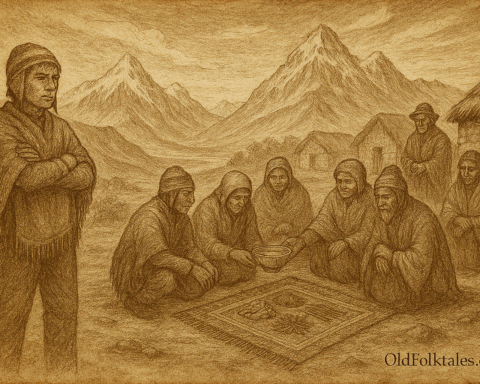
When the Aymara people emerged in this new age of the sun, they inherited a landscape haunted by the remains of those who came before. They found the mysterious chullpa towers scattered across the Altiplano, ancient stone burial structures whose purpose they could only guess at. They discovered inexplicable ruins in remote locations, built with a precision and knowledge that seemed impossible for the resources available. They encountered strange stone formations that looked almost like human figures frozen in impossible positions.
The Aymara elders passed down the story of the time before the sun, explaining to their children why these mysteries existed. “These are the remains of the chullpa,” they would say, “the ancient ones who lived in the age of darkness. When the sun rose for the first time, it destroyed their world and transformed them into stone. They were not prepared for the light, and so they could not survive its coming.”
To this day, travelers across the Bolivian and Peruvian Altiplano encounter these enigmatic ruins stone towers standing alone on windswept plains, ancient walls whose builders are unknown, stone formations that seem eerily human in their shapes. The archaeologists and historians of the modern world study these remnants and create their theories, but the Aymara people know the truth that has been preserved in their oral traditions: these are the monuments of the chullpa, the moon-people, the ancestors from the age before the sun, caught forever in stone at the moment when a new world was born and their ancient darkness ended forever.
The chullpa towers still stand as memorials to that first devastating sunrise, reminders that the world we know was built upon the ruins of an earlier creation, and that great cosmic changes leave their marks upon the earth for those who know how to read them.
Click to read all Andean Highland Folktales — echoing from the mountain peaks of Peru, Bolivia, and Ecuador.
The Moral Lesson
This profound Aymara creation narrative teaches about the transformative and sometimes destructive nature of cosmic change and the passage from one world-age to another. The story reflects the Andean concept of pachakuti the great turning or transformation that brings one era to an end and births another. It reminds us that adaptation is essential for survival during times of fundamental change, and that those who cannot or will not transform face petrification literal or metaphorical. The legend also preserves cultural memory of actual archaeological mysteries, using mythology to explain the inexplicable ruins and structures that dot the Altiplano, while emphasizing that current civilizations exist atop the remains of previous worlds and peoples, each destroyed or transformed to make way for what follows.
Knowledge Check
Q1: Who were the chullpa in Aymara mythology and tradition? The chullpa were the ancient people who lived during Nayra Pacha, the time before the sun existed, when the world was in perpetual darkness. They were the ancestors of ancestors moon-people adapted to darkness who could see by moonlight and starlight alone. They built the mysterious stone towers and ruins found across the Altiplano, possessing knowledge and abilities that were lost when their age ended with the first sunrise.
Q2: What was lifelike during the age before the sun in Aymara cosmology? During the age before the sun, the world existed in perpetual darkness illuminated only by the moon and stars. The chullpa people had adapted completely to this environment, with eyes that could see clearly in darkness. They measured time by lunar phases rather than days, conducted all activities farming, herding, building, ritual under moonlight and starlight, and possessed their own unique wisdom and powers suited to the dark world.
Q3: What happened when the sun rose for the first time according to this Bolivian legend? When the sun rose for the first time, it was catastrophic for the chullpa. The ancient people, completely unprepared for sunlight and unable to adapt to this new cosmic force, were destroyed in various ways. Some were transformed into stone where they stood, others were burned, and some were frozen mid-flight. Their civilization ended in that first dawn, leaving behind only mysterious ruins and stone formations across the Altiplano.
Q4: Why do mysterious stone ruins and towers exist across the Altiplano according to Aymara tradition? According to Aymara oral tradition, these mysterious ruins particularly the chullpa towers are the remnants of the ancient civilization that existed before the sun. They were built by the moon-people during the age of darkness. When the first sunrise destroyed the chullpa, their monuments remained as inexplicable structures that later peoples found but could not explain because no living memory existed of their construction or original purpose.
Q5: What is the significance of Nayra Pacha in Aymara cosmology? Nayra Pacha means “the time of the ancestors” or “ancient time” in Aymara cosmology. It refers to the previous world-age before the current sun-filled era, when different laws of nature applied and different beings inhabited the earth. This concept reflects the Andean belief in multiple creation cycles, where the current world exists atop the ruins of earlier, fundamentally different worlds that were destroyed and transformed.
Q6: How does this legend differ from Inca solar mythology? Unlike Inca mythology which centers on solar worship and the sun as the supreme organizing principle from the beginning, this Aymara legend presents the sun as a late arrival a transformative but also destructive force that ended an earlier age. The story is tied to Altiplano chullpa ideology, focusing on a pre-solar world and the catastrophic transition rather than celebrating the sun’s eternal supremacy, reflecting distinct Aymara rather than Inca cosmological perspectives.
Source: Adapted from Altiplano oral traditions (Bolivia/Peru) and Les ancêtres des Andes by Thérèse Bouysse-Cassagne
Cultural Origin: Aymara Indigenous Peoples, Altiplano Region of Bolivia and Peru