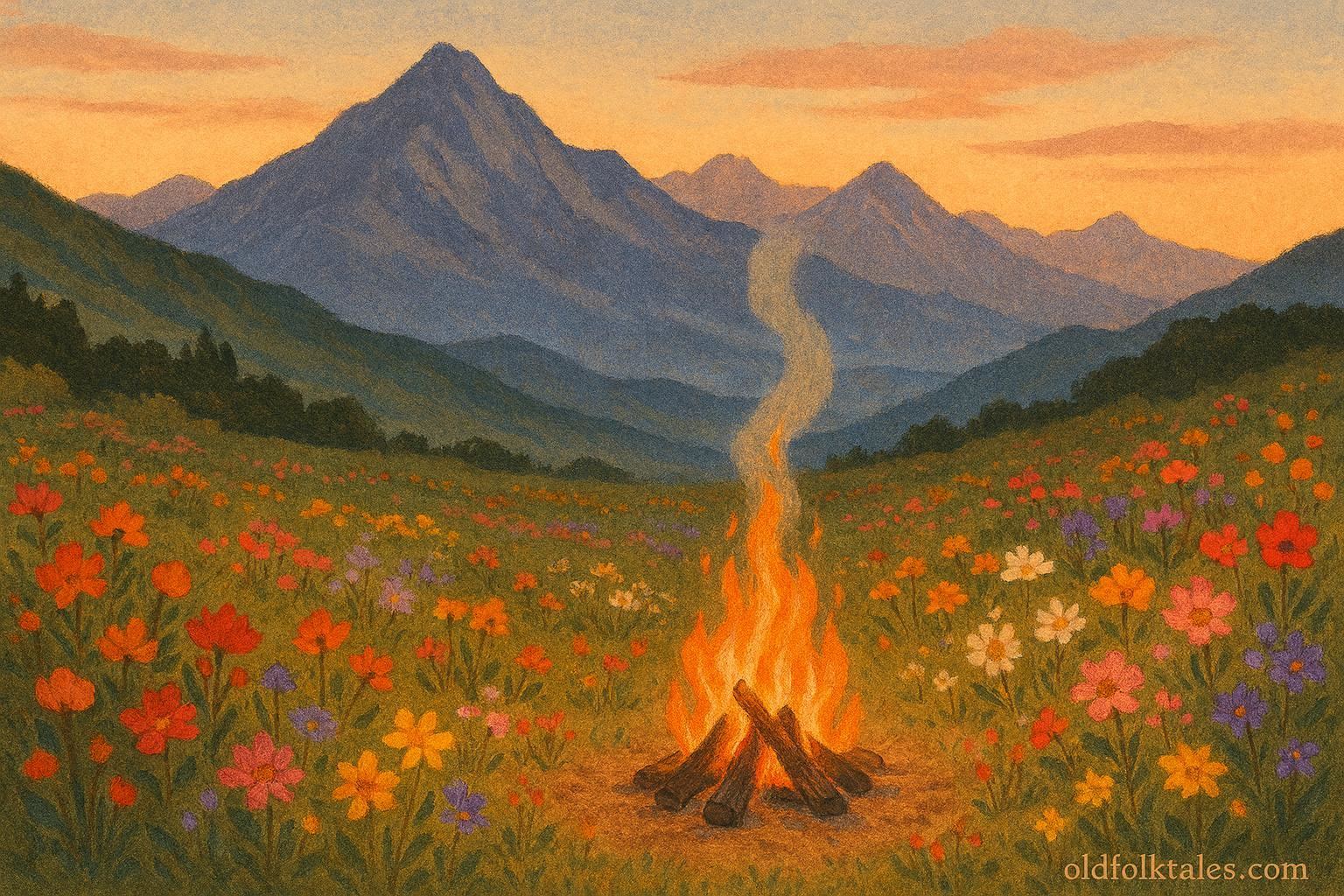
At the foot of a high Andean mountain, where stone met sky and the air thinned with every step upward, there was once a fire that never went out. It burned quietly in a shallow hollow near a village trail, fed by no visible wood and tended by no single hand. The elders said the fire had been there longer than memory, older than the paths carved by feet and older than the first terraces cut into the slopes.
The people used the fire for warmth during cold nights and for light during long ceremonies, but they were warned never to approach it carelessly. This was not a fire meant to be feared, nor was it meant to be controlled. It responded to the hearts of those who came near it.
In the early days, the villagers treated the fire with calm respect. When they approached, they brought offerings of maize husks, coca leaves, or water from the mountain streams. They spoke softly, acknowledging the fire as a living presence rather than a tool. Under their care, the fire burned steadily, neither flaring dangerously nor fading into embers.
Explore the ancestral legends of Canada, Mesoamerica, and South America’s Indigenous tribes.
One year, however, hardship struck the village. Frost damaged the crops, and hunger crept into homes. Fear replaced patience, and people began to approach the fire differently. Instead of gratitude, they came with demands. They shouted prayers, begged for warmth, and tried to force the fire to burn hotter, believing it could protect them from loss if only it were made stronger.
As fear grew, the fire changed. Its flames became sharp and restless. Sparks leapt outward, scorching the ground. No flowers grew near it anymore, and the earth around the hollow darkened and cracked. The elders warned the people that fear had disrupted the balance, but few listened.
Among the villagers was a young woman named Sumaq, known for her attentiveness rather than her voice. She had learned from her grandmother that fire listens best when spoken to with calm breath and steady hands. While others avoided the fire out of fear or approached it in desperation, Sumaq returned quietly to the old teachings.
One dawn, before the village stirred, she carried water from the stream and a small bundle of seeds wrapped in cloth. She sat beside the fire without speaking. She did not ask it for anything. She simply breathed and waited, letting the fire burn as it would.
After a long silence, Sumaq placed the seeds into the warm soil near the fire, not into the flames themselves. She poured water gently around them and whispered words of thanks for warmth, for light, and for the lesson of endurance. She did not stay to watch. She trusted the exchange and returned home.
Days passed, and the fire began to change again. Its flames softened. The crackling quieted. From the soil where Sumaq had placed the seeds, small green shoots appeared. At first, the villagers thought it was coincidence, but soon flowers bloomed in colors rarely seen at that height. Reds, yellows, and deep blues surrounded the fire, thriving in warmth but untouched by flame.
The elders recognized the meaning immediately. The fire had accepted gratitude and responded with life. It was not fear that fed it, nor force, but respectful care. The flowers became known as the fire’s children, living proof that balance could be restored.
As the villagers learned, they began to approach the fire differently. They came with thanks instead of demands. They tended the flowers, watered them carefully, and spoke to the fire as they once had. Over time, the ground healed, and the fire returned to its steady presence.
The flowers never spread beyond the fire’s hollow. They grew only where gratitude was practiced. When someone approached the fire with impatience or anger, the flowers would wilt slightly, reminding all who watched that intention mattered as much as action.
Sumaq never claimed credit for the change. She said only that the fire had always known what to do. It had simply been waiting to be treated as a partner rather than a servant.
From that time on, the story of the fire that grew flowers was told to children as a lesson. Fire can destroy, but it can also nurture. What it becomes depends on how it is approached. Gratitude invites transformation. Fear invites imbalance.
Even now, the elders say, fires across the mountains listen. Not all will grow flowers, but all respond to the spirit in which they are tended.
Click to read all South American Folktales — timeless stories from the Andes to the Amazon.
Moral lesson
Gratitude transforms power into partnership. When natural forces are approached with respect rather than fear or control, balance is restored and life is allowed to flourish.
Knowledge check
- Where does the sacred fire burn?
At the base of a mountain near a village trail. - Why does the fire become dangerous at first?
Because villagers approach it with fear and demands instead of gratitude. - Who restores balance to the fire?
A young woman named Sumaq. - What action leads to flowers growing near the fire?
Offering patience, gratitude, and gentle care without forcing the fire. - What do the flowers symbolize?
Harmony, reciprocity, and respectful relationship with natural forces. - What lesson do the elders teach through this story?
That intention shapes outcomes and gratitude restores balance.
Source: Adapted from Andean spiritual traditions in National Geographic Indigenous archives
Cultural origin: Quechua peoples, Peru