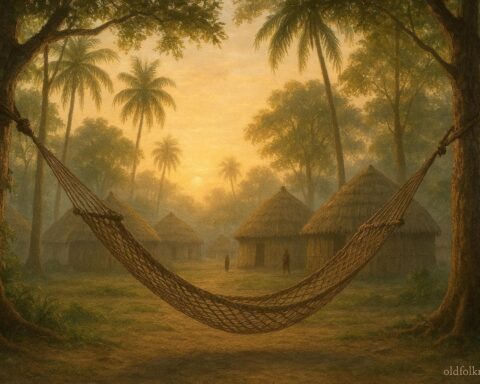
In the earliest days of the world, before the first smoke ever rose toward the sky, the earth lay cold and dim. The sun shone weakly through clouds of mist, and at night the wind crept into the huts of the people, stealing away their warmth. The Arawak people shivered through long nights, eating raw fruits and roots, for they had never known fire.
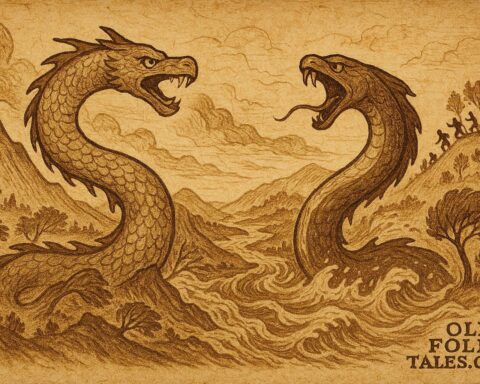
The forest animals fared no better. The jaguar prowled through darkness, the birds huddled silent in the trees, and even the proud serpent lay coiled in the cold earth, its scales dull from chill. In those days, warmth and light belonged only to the gods who lived atop the Great Volcano, a mountain so high its peak disappeared into the clouds. From that fiery throne, the gods kept the sacred flame for themselves, guarding it against the reach of humankind.
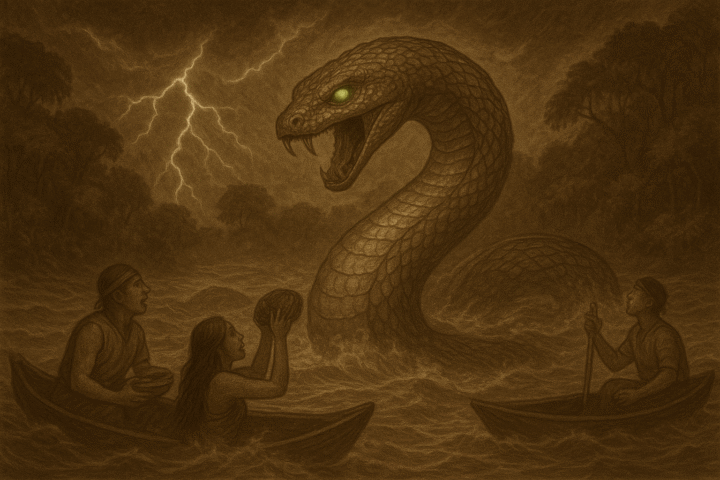
Among the people lived a serpent named Kahu, whose scales once shimmered green and gold. Unlike other snakes, Kahu had a heart that beat with the rhythm of the people’s sorrow. He slithered among their huts, feeling their hunger and hearing their cries through the long nights. One evening, as a child coughed from the cold and a mother wept softly beside her, Kahu lifted his head toward the dark horizon. “Why should the gods hoard the warmth?” he whispered. “The people below freeze and starve, while the sky burns with light. I will bring them fire, no matter the cost.”
Explore the land of La Llorona, trickster coyotes, and magical realism in Mexican folklore
The journey was long and dangerous. Kahu began to climb the steep slopes of the Great Volcano, his body winding over rocks and roots, through thick fog and biting wind. The mountain trembled beneath him, as if warning him to turn back. But Kahu pressed on, his scales scraped and bruised. As he climbed higher, the air grew hot and bitter. Sparks glowed through cracks in the earth, and the smell of burning stone filled his nostrils.
At last, Kahu reached the mouth of the volcano. There, within a circle of molten rock, the gods sat around their eternal fire. Their voices were like thunder, and their eyes burned brighter than the coals themselves. Kahu hid among the stones, trembling. He saw that the flame was beautiful beyond words, gold and crimson, alive with light and warmth.
“I must take only a spark,” he thought. “Enough to warm the people.”
Gathering his courage, Kahu slithered closer. The heat scorched his skin, but he did not stop. With one swift motion, he flicked the tip of his tail into the flame. A spark caught upon his scales, glowing like a jewel. At once, the fire burned into him, searing his flesh. Pain flooded through his body, yet he held fast and fled from the gods’ circle.
A roar shook the heavens. “Who dares steal our sacred fire?” the gods cried. Lightning split the sky, and stones rained down the mountainside. But Kahu raced through the smoke, the spark still clinging to his tail. His body burned, his scales blackened, and still he slithered onward.
Down and down he came, through storms and ash, until he reached the cool green forest below. Exhausted and trembling, he coiled before the people’s huts. The villagers gathered in awe. “It is Kahu,” they whispered. “What has happened to you?”
The serpent lifted his scorched tail. “I have brought you the gift of warmth,” he said, his voice weak but proud. The people gasped as they saw the spark gleaming faintly on his tail, glowing with divine light.
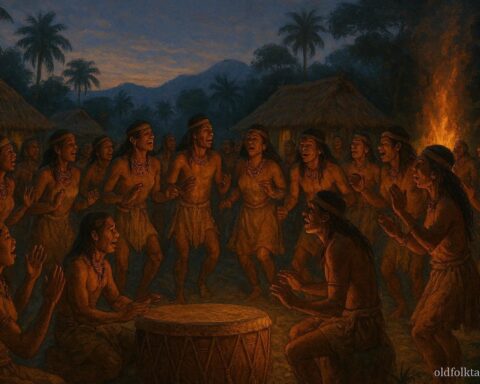
An elder stepped forward. “We will keep this flame safe,” he said softly. He took two dry branches and placed them against the spark. In an instant, fire sprang to life, leaping high and golden. Its light filled the huts, and its warmth spread through the night. The people cried out with joy. They roasted fruits and fish, sang songs of thanks, and for the first time, laughter rose into the cold air.
But when they turned to thank Kahu, he was gone. His body lay still, his once-bright scales turned to shades of black and brown. The people wept, realizing the price he had paid.
The forest spirits took pity on the brave serpent. They whispered over his body, blessing his spirit and giving new life to his kind. From that day, all snakes bore the marks of fire on their skin, the shimmer of red, gold, and black that tells of Kahu’s sacrifice. And even now, when the sun sets and the wind grows cold, the people say the crackle of the fire is the sound of Kahu’s breath, reminding them never to forget the one who gave them warmth.
Discover ancient tales passed down by the Indigenous peoples of the Americas.
Moral Lesson
True courage is born from compassion. The serpent’s sacrifice teaches that great gifts often come from great love, and that the warmth of one heart can light the world.
Knowledge Check
1. Who brought fire to the people in this story?
The serpent Kahu, who climbed the Great Volcano to steal a spark from the gods.
2. Why did Kahu decide to bring fire to humans?
He felt pity for their suffering in the cold and wanted to help them survive.
3. Where did the gods keep the fire?
In the heart of a Great Volcano, guarded as a divine treasure.
4. What happened to Kahu when he touched the flame?
He was burned and scarred, but he did not let go of the spark.
5. How did the people react to the fire?
They rejoiced, using it for warmth, cooking, and light, and honored Kahu’s gift.
6. What lasting mark did Kahu’s sacrifice leave?
All snakes carry fire’s colors, red, gold, and black as a reminder of his courage.
Source: Adapted from Arawak myths in South American Indian Myths and Legends by Hartley Burr Alexander (1920), New York: Dover Publications.
Cultural Origin: Arawak (Guiana and Northern Amazon Basin)