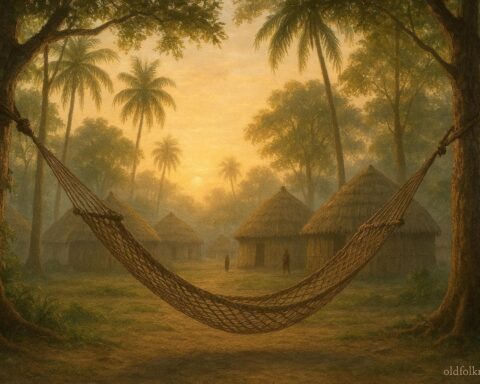
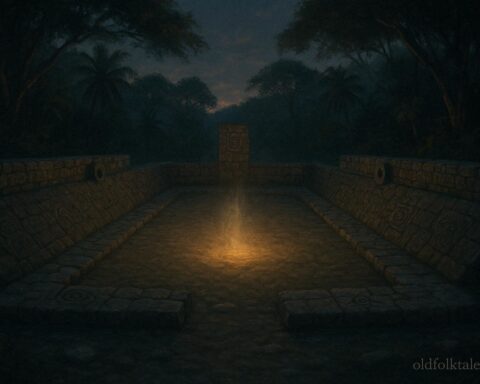
In the deep forests of the Yucatán, where the air hums with life and the ceiba trees rise like pillars to the heavens, there lived a hunter renowned throughout the villages. His name was Kanan, which in the old tongue meant “guardian.” But in truth, Kanan had long forgotten what it meant to guard.
He was swift, clever, and tireless, his arrows true, his traps cunning. Deer, birds, and jaguars fell to his skill, and soon his home overflowed with pelts and horns, tokens of his mastery. Yet, with each hunt, he felt a hunger that meat and trophies could not satisfy.
Discover ancient tales passed down by the Indigenous peoples of the Americas.
Elders warned him that the forest had its own spirit, that each creature carried the breath of the gods, and to take more than one needed was to disturb the sacred balance. But Kanan laughed. “The forest is endless,” he said. “Its gifts are mine to claim.”
Then one dawn, as golden light spilled through the canopy, Kanan saw something that stilled his breath, a white deer grazing near a stream. Its coat shimmered like moonlight, and its eyes, deep and calm, seemed to look straight into his soul.
Never before had he seen such a creature. In Maya belief, the white deer was sacred, a messenger between gods and men. Yet Kanan’s heart raced not with reverence, but with greed. “That hide will be my greatest prize,” he whispered, not realizing that fate had already begun to weave his undoing.
He followed the deer for days through tangled vines and ancient ruins swallowed by moss. Each time he thought he had it cornered, it vanished, appearing again just beyond reach. It led him through sacred groves, across streams where jade stones glimmered beneath the water, and into places no man had walked in generations.
At last, as twilight deepened and the forest fell silent, the deer stopped in a clearing bathed in moonlight. Kanan raised his bow. His fingers trembled, not from fear, but from the strange quiet that filled the air. Even the wind seemed to hold its breath.
He loosed the arrow.
It struck true. The white deer staggered, its eyes locking with his one last time. But before his prey fell, a blinding light burst forth. Kanan shielded his face. When he opened his eyes again, the deer was no longer there. In its place stood a radiant figure, neither man nor beast, its form shifting like light on water.
The voice that spoke was gentle yet filled with power. “You have slain more than bodies, Kanan. You have wounded the spirit of the forest itself.”
Kanan fell to his knees. “Who are you?” he whispered.
“I am what you chase and what you destroy,” the spirit said. “The deer, the trees, the rivers, all are one breath, and you have forgotten that breath.”
He trembled, unable to look up. “I only sought to provide for myself.”
“And yet you took more than you needed,” said the spirit. “You filled your home with trophies but emptied your heart of gratitude. The forest is not yours to conquer, it is yours to protect.”
As the spirit spoke, the forest seemed to stir. The leaves rustled like whispering ancestors, and a soft wind carried the scent of rain and earth. “You have one choice,” the spirit continued. “Devote your life to healing what you have harmed, or your soul will wander the woods forever, lost among the shadows.”
The light faded. When Kanan looked again, the deer was gone. In its place lay a single white feather, glowing faintly in the moonlight.
Shaken, he returned to his hut but sleep never came. The sound of rustling leaves haunted him, the whisper of the forest calling for balance. He dreamed of animals he had slain, their eyes filled with sorrow rather than anger. He awoke with tears in his eyes and the feather clutched in his hand.
From that day forward, Kanan laid down his bow. He broke his traps, scattered his arrows into the river, and went into the forest not as a hunter but as a guardian reborn.
He planted new trees where fires had burned. He tended to wounded animals, left offerings of maize and flowers at sacred groves, and taught the children of his village to respect the forest as a living being.
Years passed. His hair turned white like the deer’s coat, but his heart grew lighter with every act of care. The villagers began to call him Kanan Ajaw, “Guardian Lord,” and though he smiled at the name, he knew he was merely repaying a debt to the spirit who had shown him mercy.
One morning, he followed a trail of dew into the clearing where he had first seen the white deer. There, standing in the same patch of light, the creature appeared once more. It bowed its head toward him; eyes filled with calm and understanding.
Kanan fell to his knees, his spirit at peace. The deer stepped forward, touched his forehead with its nose, and then vanished like mist under the rising sun.
When the villagers came searching for their old guardian, they found only his footprints leading into the forest, and beside them, the white feather glowing softly in the dawn light.
From that day, the Maya of the Yucatán spoke of Kanan and the White Deer, saying that those who wander the woods with greed will lose their way, but those who walk with reverence will find the forest’s heart.
Explore the land of La Llorona, trickster coyotes, and magical realism in Mexican folklore
Moral of the Story
Greed blinds the heart, but humility restores balance. True strength lies not in taking from the world, but in protecting what gives us life.
Knowledge Check
- Who was Kanan?
A skilled Maya hunter who learned to respect nature after encountering a sacred white deer. - What did the white deer symbolize?
It represented the spirit of the forest and the divine connection between all living things. - How did the hunter offend the gods?
By taking more from nature than he needed, showing greed instead of gratitude. - What transformation occurred in the story?
The hunter’s heart transformed from greed to devotion, and the deer revealed itself as a spirit. - What did Kanan do after his encounter?
He devoted his life to protecting the forest and teaching others to live in harmony with it. - What is the central moral of the tale?
Respect for nature ensures spiritual balance and redemption.
Source: Adapted from Maya Folk Tales from the Yucatán by Nelson Reed (1966).
Cultural Origin: Yucatec Maya (Yucatán Peninsula, Mexico).