In the hills overlooking the town of Areguá, where Lake Ypacaraí stretches like a mirror reflecting the endless sky, there stands a stone unlike any other. Weathered by countless seasons, its surface marked by time and tears, this rock has become a sacred place a monument not built by human hands but shaped by the purest form of love and the deepest kind of sorrow.
The Guaraní people who have lived in these lands for generations know this stone well. They call it the Crying Stone, and they speak of it with reverence and sadness, for it holds within its silent form one of the most heartbreaking stories ever told.
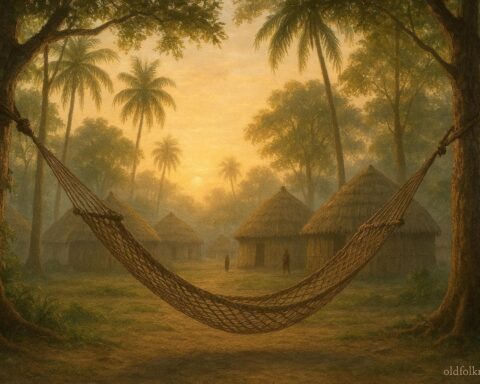
Long ago, before the coming of strangers to these shores, before the world grew complicated with new ways and new wars, there lived in a village near Areguá a woman named Yasy. Her name meant “moon,” and like the moon itself, she was gentle and constant, her presence bringing comfort to all who knew her.
Click to read all South American Folktales — timeless stories from the Andes to the Amazon.
Yasy had a son named Avaí, a young warrior whose strength and courage were known throughout the region. He was the light of her life, the child she had raised alone after her husband had been taken by illness many years before. Avaí was everything to her her past, her present, and her hope for the future.
He had his father’s strong features and his mother’s kind heart. When he walked through the village, children followed him, and elders nodded in approval. He hunted with skill, shared his catch generously, and spoke with wisdom beyond his years. Every evening, he would return home to Yasy, and they would sit together watching the sun set over the lake, talking of the day’s events and dreaming of tomorrow.
But peace, like all precious things, can be fragile.
Word came that a neighboring tribe, driven by hunger and desperation, had begun raiding villages to the south. The attacks were growing bolder, moving closer. The elders gathered in council and decided that warriors must be sent to defend their territory and protect their people.
Avaí did not hesitate. When the call came for warriors to join the defensive force, he stepped forward immediately. It was his duty, his honor, and his choice.
Yasy felt her heart crack like dried clay when she heard his decision, but she did not try to stop him. She was Guaraní she understood that a warrior must follow his path, that courage was a gift to be used, not hidden away. Instead, she held her son close, breathing in his scent, memorizing the feel of his embrace.
“I will return, Mother,” Avaí promised, his voice steady and sure. “When the moon is full again, I will walk up this hill and find you waiting, just as you always are.”
“I will be here,” Yasy replied, her voice barely a whisper. “I will wait for you, my son. I will wait as long as it takes.”
She walked with him to the edge of the village, to the high hill where the land sloped down toward the distant forests. From this vantage point, one could see for miles the perfect place to watch for a warrior’s return. She stood there as he walked away, stood there until his figure disappeared into the green embrace of the forest, stood there until the sun had set and the stars emerged like scattered diamonds across the velvet sky.
The next day, she returned to that spot. And the day after that. And the day after that.
Days became weeks. The full moon came and went, and Avaí did not return. Still Yasy waited, sitting on the hill from dawn until dusk, her eyes fixed on the horizon, searching for any sign of her son’s familiar stride.
The women of the village brought her food and water. They urged her to come home, to rest, to accept what they all feared but could not say aloud. Yasy refused. She had made a promise she would wait.
Weeks became months. The seasons changed. Rain fell and sun blazed, but Yasy remained on her hill, weathering every storm, enduring every hardship. Her hair, once black as night, turned white as clouds. Her face, once smooth, became lined with worry and grief. But her eyes never stopped searching, and her vigil never ended.
Then, one terrible day, a warrior returned from the battle. He carried news that shattered the village like thunder splits the sky.
There had been a great battle. Many warriors had fought bravely. Many had fallen.
Avaí was among the dead.
He had died with honor, they said. He had saved three of his companions before an enemy spear found his heart. He had spoken Yasy’s name with his final breath.
The villagers rushed to tell Yasy, to bring her home, to help her grieve properly. But when they reached the hill, they found something that stole the words from their mouths and the strength from their legs.
Yasy was gone.
In her place stood a stone a large, smooth stone the color of weathered granite, shaped almost like a seated figure gazing toward the horizon. And from the stone, water trickled down its surface like tears flowing from invisible eyes.
The people touched the stone with trembling hands. It was warm, as though life still pulsed within it. The water that flowed from it was neither rain nor dew it came from within the stone itself, emerging from its core as though the very rock was weeping.
The elders understood. Yasy’s grief had been so profound, her love so powerful, her vigil so steadfast that the earth itself had transformed her preserving her watch for eternity, giving physical form to sorrow that could never be contained by a human heart alone.
From that day forward, the stone has wept. During storms, when the sky unleashes its fury and rain lashes the land, the Crying Stone weeps most profoundly, as though the tempest stirs memories of loss that can never fade. The water that flows from it is said to be sacred tears of pure maternal love, crystallized into stone yet forever flowing.
People come from distant places to see the Crying Stone of Areguá. They bring offerings of flowers and leave prayers for their own lost loved ones. They touch its surface and feel the warmth of Yasy’s enduring presence. They listen to the wind moving through the hills and imagine they can hear a mother’s voice, still calling for her son, still waiting for his return.
The stone remains on its hill, overlooking the lake, gazing toward the forest where Avaí disappeared so long ago. It stands as a testament to love that transcends death, to grief that becomes sacred, and to the truth that some promises are kept forever even when the one who made them has become one with the earth itself.
Discover the sacred tales of llamas, condors, and gods who guard the Andes
The Moral Lesson
The legend of the Crying Stone teaches us about the enduring power of maternal love and the depth of grief that accompanies profound loss. Yasy’s transformation into stone represents how sorrow, when pure and complete, can become eternal and sacred. The story reminds us to honor those who wait faithfully for loved ones who never return, and to recognize that some bonds transcend even death. It also speaks to the Guaraní understanding that intense human emotion can merge with the natural world, creating sacred places that connect the living with memory, love, and loss across generations.
Knowledge Check
Q1: Who was Yasy in the Areguá legend and why is she significant? A: Yasy (meaning “moon”) was a Guaraní mother who waited faithfully for her son Avaí to return from battle. Her significance lies in her transformation into the Crying Stone a sacred rock that weeps eternally, symbolizing unending maternal love and grief that transcends human form.
Q2: What happened to Avaí, Yasy’s son, in the story? A: Avaí was a brave young Guaraní warrior who went to battle to defend his people from raiding tribes. He died honorably in combat, saving three companions before being killed by an enemy spear. He spoke his mother’s name with his final breath, never knowing she waited for him on the hill.
Q3: Why does the Crying Stone of Areguá weep during storms? A: According to the legend, the stone weeps most profoundly during storms because the tempest stirs the eternal grief contained within it. The water flowing from the stone represents Yasy’s tears of loss and longing for her son, made perpetual through her transformation into sacred stone.
Q4: What is the cultural significance of the Crying Stone to the Guaraní people? A: For the Guaraní people, the Crying Stone is a sacred site that represents the connection between human emotion and the natural world. It symbolizes maternal devotion, honors those who grieve lost warriors, and serves as a place where people can connect with their own losses while recognizing that profound love never truly ends.
Q5: Where is the Crying Stone located and what can visitors see there? A: The Crying Stone is located on a hill overlooking the town of Areguá and Lake Ypacaraí in Paraguay. Visitors can see a large stone that appears to weep water from within, particularly during storms. People bring flowers and prayers, touching its warm surface to honor Yasy’s memory and their own lost loved ones.
Q6: What does Yasy’s transformation into stone represent in Guaraní beliefs? A: Yasy’s transformation represents the Guaraní belief that powerful human emotions can merge with nature, creating sacred places. Her metamorphosis shows that when grief and love are absolute and pure, they transcend physical form, becoming eternal parts of the landscape teaching that some bonds and promises never end, even with death.
Source: Adapted from Paraguayan folklore as compiled by Francisco Pérez Maricevich in Mitos y Leyendas del Paraguay
Cultural Origin: Guaraní people, Areguá region, Paraguay, South America