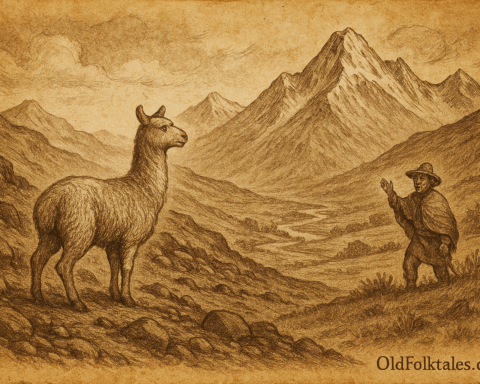
In the high Andes of southern Peru rises Ausangate, a mountain so tall that its summit seems to hold the sky in place. For the Quechua people, Ausangate was never stone alone. It was an Apu, a living mountain spirit, ancient and aware. The elders taught that Ausangate listened to footsteps, remembered words, and responded to human behavior with patience that lasted generations.
The villages scattered along its slopes lived according to reciprocity. Every harvest, every birth, every journey across the mountain required acknowledgment. Offerings of coca leaves, chicha, and woven cloth were placed at stone altars facing the peaks. These acts were not superstition but duty. The mountain provided water, protection from storms, and fertile grazing lands. In return, the people remembered.
For many seasons, the balance held.
Then the younger generation began to change. Travel routes opened beyond the valleys. Traders returned with stories of towns where rituals were mocked and time was valued more than tradition. Slowly, the offerings grew fewer. Ceremonies shortened. Elders noticed that children no longer knew the old prayers by heart.
Immerse yourself in Latin America’s stories of passion, transformation, and spirit.
At first, Ausangate remained silent.
The mountain did not punish quickly. The elders said this was the way of Apus. They waited, allowing humans the chance to remember on their own.
One dry season, the meltwater streams began flowing earlier than expected. Villagers welcomed the extra water, believing it a blessing. But the elders grew uneasy. The snowline receded too fast. The mountain’s white crown thinned unnaturally.
Soon after, the first tears appeared.
Thin streams ran down the dark stone faces of Ausangate, not from seasonal melt but from deep fractures in the ice. These streams did not nourish the fields. They flooded paths, collapsed walls, and washed away grazing terraces. The people whispered that the mountain was crying.
Still, no offerings were made.
When the floods worsened, livestock was lost. Children fell ill from cold water exposure. The elders gathered the community and spoke plainly. Ausangate was not angry. It was grieving. The reciprocal bond had been neglected, and the mountain mourned the loss of respect.
A young herder named Kusi listened carefully. Unlike others, he had learned the old teachings from his grandmother, who had walked the mountain paths barefoot in her youth. She had told him that when mountains cry, they do so because they are remembering what humans have forgotten.
Kusi climbed alone toward the higher slopes, carrying what offerings he could gather. He placed coca leaves carefully on a flat stone and spoke aloud, not with elaborate words but with sincerity. He apologized, not only for himself but for his people. He promised remembrance, not abundance.
The wind shifted.
Snow fell lightly for the first time in weeks, settling gently instead of melting. The tears slowed. The elders noticed that the streams stabilized, returning to their proper paths.
Kusi did not return immediately. He stayed on the mountain through the night, listening. In the silence, he felt the presence of Ausangate not as sound but as weight and calm. The mountain was not forgiving a single act. It was testing continuity.
When Kusi returned, the community followed him back to the old ways. Rituals were restored, not as obligation alone but as relationship. The mountain’s tears faded gradually, leaving behind scars in the rock that remain visible to this day.
Elders say those scars are reminders. Ausangate does not forget neglect, but it also does not reject those who remember again. Even now, when storms gather unexpectedly around the peak, people say the mountain is reminding them to listen.
Click to read all South American Folktales — timeless stories from the Andes to the Amazon.
Moral lesson
Reciprocity is not a one time act but a continuous relationship. When humans forget their responsibilities to living landscapes, imbalance follows. Restoration begins not with fear, but with remembrance and humility.
Knowledge check
- What is Ausangate considered by the Quechua people?
Answer: A living mountain spirit known as an Apu. - Why did the mountain begin to cry?
Answer: Communities abandoned reciprocal rituals owed to the mountain. - How did the mountain’s tears affect the villages?
Answer: They caused flooding, loss of livestock, and environmental imbalance. - Who attempted to restore balance with the mountain?
Answer: A young herder named Kusi. - What stopped the mountain’s crying?
Answer: Sincere offerings and the return to reciprocal rituals. - What do the scars on Ausangate represent?
Answer: A lasting reminder of neglected duty and restored balance.
Source:
Adapted from Andean Apus and Living Mountains, Universidad Nacional San Antonio Abad del Cusco (2009)
Cultural origin:
Quechua peoples, Peru