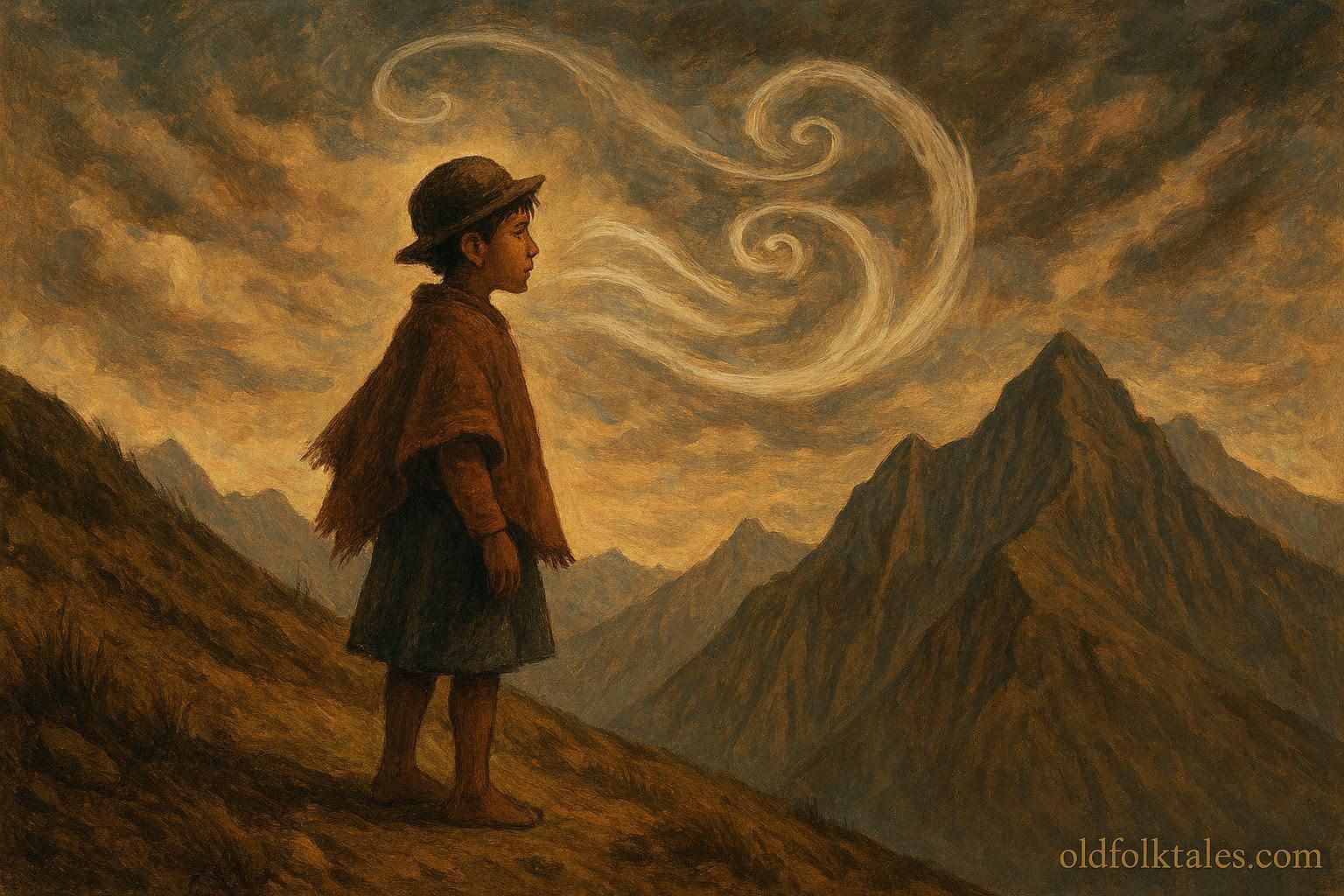
In a high valley of the Andes, where the mountains rose like guardians and the wind moved freely between them, there lived a boy named Illari. From the moment he learned to walk, it was clear that he was different. His feet touched the earth lightly, and he ran faster than any child in the village. When others chased llamas, Illari chased shadows. When children played games, he finished before they began.
The elders watched him with quiet concern. Speed was a gift, but gifts were never without responsibility. The wind, they said, was not empty air. It was alive. It carried memory, balance, and temper. To run against it without respect was to invite correction.
Illari laughed when he heard such warnings. He believed the wind followed him because it admired his speed. When gusts rose suddenly behind him, he took it as applause. When the air whistled sharply around cliffs, he called it jealousy.
Discover ancient tales passed down by the Indigenous peoples of the Americas.
One afternoon, during the season when winds grew restless, Illari climbed a ridge above the village. From there, the land opened wide. Valleys stretched like folded cloth, and clouds drifted low enough to touch. The wind rushed past him, strong and playful.
“I outrun you every day,” Illari shouted into the open sky. “You are fast, but I am faster.”
The wind answered with silence.
Encouraged, Illari ran. He raced along the ridge, feet barely touching stone. The wind chased him, roaring louder, but he laughed and ran harder. He crossed distances that would take others hours in minutes. At last, breathless and proud, he stopped and raised his arms.
“I have beaten you,” he said. “Even the wind cannot catch me.”
That night, Illari dreamed uneasily. In his dream, the wind gathered into shapes without faces. They circled him, whispering in voices like moving grass.
“You run fast,” they said. “But do you know where you are running?”
Illari woke unsettled but said nothing.
The next day, his speed was greater than ever. He ran from one end of the valley to the other without tiring. People stared in amazement. Children followed him. Praise grew loud.
Illari began running for attention rather than joy. He raced elders. He challenged travelers. He mocked the slow. Each time the wind rose, it no longer followed playfully. It pushed. It twisted. It cut sharp against skin.
Still, Illari refused to listen.
One morning, a sudden windstorm swept through the valley. Roofs rattled. Dust filled the air. The elders gathered the people indoors, but Illari ran outside.
“This is my challenge,” he said. “Today I outrun the wind itself.”
He ran into the open plain beyond the fields. The wind met him head on. It roared, not in anger, but in warning. Illari ran faster. Faster than ever before.
Suddenly, the ground beneath him shifted. His feet no longer touched earth. He was lifted, not high, but just enough to lose balance. He fell hard and rolled. When he stood again, he tried to run.
He could not.
His legs moved, but the wind pressed against him from every side. No matter how hard he pushed forward, he stayed in place. The air thickened, heavy as stone.
Illari panicked. He shouted, but his voice scattered into the wind.
“You challenged without listening,” the wind spoke, not aloud, but inside him. “Speed is movement, but wisdom is direction.”
For three days, Illari was trapped in the plain. The villagers searched and found him standing in place, exhausted and frightened. They carried him home.
From that day on, Illari could no longer run. His legs were not broken, but his speed was gone. He walked slowly, feeling each step.
At first, he burned with anger. He watched other children run and felt shame. But as days passed, he noticed things he had never seen before. The way shadows shifted. The sound of wind through grass. The rhythm of breathing.
An elder came to him one evening and said, “The wind did not take your gift. It taught you how to carry it.”
Illari listened.
Months later, during another wind season, the air softened around him. When he walked, the wind guided rather than pushed. One day, as he crossed the same ridge, his feet felt light again. He ran, not fast, but steady. The wind moved beside him, calm and even.
Illari had learned that speed meant nothing without humility. From then on, he ran only when needed and taught others to listen before they moved.
The wind never chased him again, but it never opposed him either.
Click to read all South American Folktales — timeless stories from the Andes to the Amazon.
Moral lesson
Gifts granted without humility can become burdens. True strength lies not in challenging forces greater than oneself, but in learning when to listen, slow down, and move with balance.
Knowledge check
- Why was Illari considered different from other children?
He possessed supernatural speed and could run faster than anyone else. - What warning did the elders give Illari about the wind?
They warned that the wind was a living force that demanded respect. - Why did Illari challenge the wind?
He became arrogant and believed his speed made him superior. - How did the wind respond to Illari’s challenge?
It stripped him of his speed and forced him to stand still. - What lesson did Illari learn after losing his ability to run?
That humility, awareness, and balance are more important than raw ability. - How did Illari’s relationship with the wind change at the end?
He learned to move with the wind rather than against it.
Source:
Adapted from Wind Spirits in Andean Oral Tradition, Universidad Nacional de La Plata (2003)
Cultural origin:
Andean peoples, Argentina