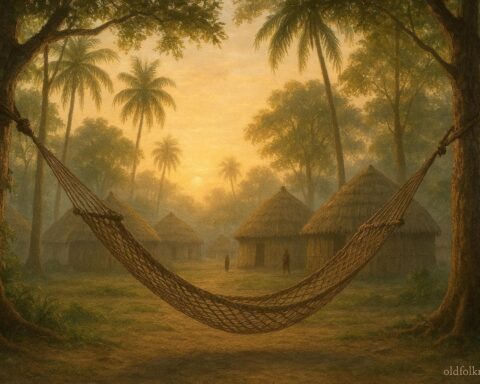
In a village along the winding rivers of the Western Amazon, there lived a boy who watched the forest more than he spoke. He was not weak, nor was he strong beyond his years, but he believed strength was something others possessed more fully than he did. Hunters carried heavy game. Elders spoke with authority. Even the animals seemed certain of their place. The boy, however, felt small beneath the towering trees.
At the edge of the village, jaguars moved like living shadows. Their presence was rarely seen but deeply felt. The people respected them as masters of strength and balance, creatures that belonged fully to themselves. The boy admired them above all else.
Journey through Central America’s heartlands and hear its stories of creation, courage, and nature.
One evening, as mist rose from the forest floor, the boy wandered alone beneath the canopy. There, where light and darkness met, he encountered a jaguar resting silently. Fear froze him, yet the jaguar did not attack. Instead, its shadow stretched long across the ground, thick and powerful.
The boy spoke without thinking. He wished to be strong. He wished to walk without fear. He wished to be more than he was.
The jaguar did not answer with words, but its shadow stirred. In the quiet of the forest, the boy stepped into it. The shadow clung to him, folding around his feet and rising behind his shoulders. When he turned away, the jaguar was gone, and the shadow followed him home.
At first, the borrowed shadow brought exactly what the boy desired. His steps grew confident. His voice carried weight. Animals moved aside when he passed. Children stared at him with awe, and even adults grew uneasy in his presence. The boy felt powerful, but the power did not feel entirely his own.
Soon, the shadow began to change him. His laughter sounded unfamiliar. His movements were sharp, predatory. Where once he spoke gently, he now startled others with his presence. The village dogs growled at him. Fires flickered when he passed.
The people whispered. They said the boy no longer walked like himself. Mothers called their children indoors. Elders watched with concern, recognizing the signs of imbalance.
The boy noticed too. He no longer recognized his reflection in the river. The shadow loomed larger than his body, stretching ahead of him even in full daylight. Though strong, he felt hollow, as if his own shape had thinned beneath the borrowed darkness.
One night, unable to sleep, the boy returned to the forest. He called out to the jaguar, admitting his fear and confusion. He said he had borrowed what was never his to hold.
From the trees, the jaguar emerged once more. It stood calm and unmoving. The shadow loosened its grip and slid away from the boy, returning to its rightful owner. Immediately, the boy felt lighter. Smaller, but whole.
He returned to the village as himself. Though no longer feared, he was welcomed. The people understood that strength taken without understanding leads only to loss.
From that day on, the boy learned his own limits and his own worth. And the forest remained balanced, each shadow belonging to the body that cast it.
Discover South America’s folktales filled with magic, transformation, and ancestral wisdom
Moral Lesson
This folktale teaches that borrowed power brings imbalance. True strength comes from understanding one’s own identity and limits.
Knowledge Check
1. What did the boy desire most at the beginning of the story?
Strength and confidence beyond his own.
2. Whose shadow did the boy borrow?
A jaguar’s shadow.
3. How did the borrowed shadow affect the boy?
It gave him power but caused fear and loss of self.
4. Why did the village grow uneasy?
The boy no longer behaved like himself.
5. What restored balance to the boy and the village?
Returning the shadow to the jaguar.
6. What does the jaguar symbolize in the story?
True power that belongs only to its rightful owner.
Source: Indigenous transformation folklore; recorded in Western Amazon collections
Cultural Origin: Amazon Basin (Indigenous folklore)