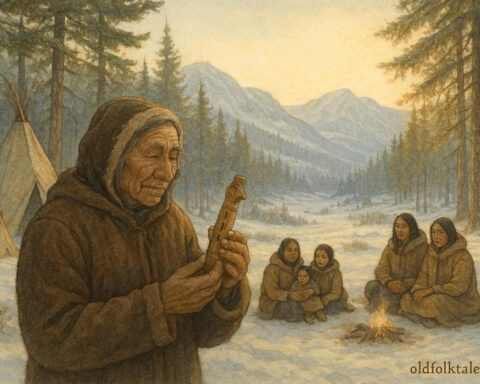
In the northern lands of the Dene, where spruce forests leaned toward frozen lakes and the wind carried stories across long distances, words were treated with care. Speech had weight. Once released, it could not be gathered again. For this reason, the elders taught that silence was not emptiness, but a space where understanding could grow.
Long ago, during a time of growing tension between families, there existed a ceremonial tool unlike any other. It was a needle carved from the polished bone of a caribou, smooth and pale, with a single dark marking near its eye. The needle was small enough to rest in the palm, yet its presence carried authority. It was not used for clothing or hides. It was used only when words had failed.
The people called it the Needle of Stillness.
It was kept by a woman named Tetsa, known throughout the camps for her patience and steady hands. She was not loud, nor did she rush to settle disputes. When arguments rose, she listened. When voices overlapped and anger thickened the air, she waited.
The needle hung from a leather cord inside her dwelling, wrapped carefully in soft fur. It was brought out only when a conflict had grown too tangled for ordinary speech.
One winter, such a conflict arose.
Two families shared access to a narrow stretch of river where fish gathered beneath the ice. For generations, the spot had been used carefully, each household taking only what was needed. But during a season of scarcity, accusations began to spread. One family claimed the other had taken more than their share. The other responded with equal bitterness. Words sharpened. Children repeated what they overheard. The harmony of the camp weakened.
Meetings were held, but they turned quickly into arguments. No one listened. Each person spoke only to defend themselves.
At last, the elders turned to Tetsa.
She did not respond immediately. Instead, she prepared the needle.
When the families gathered again, Tetsa stepped forward holding the bone needle. At once, the murmuring stopped. Everyone recognized it. Some felt relief. Others felt fear.
Tetsa spoke only once.
“Until silence is sewn,” she said, “no healing can begin.”
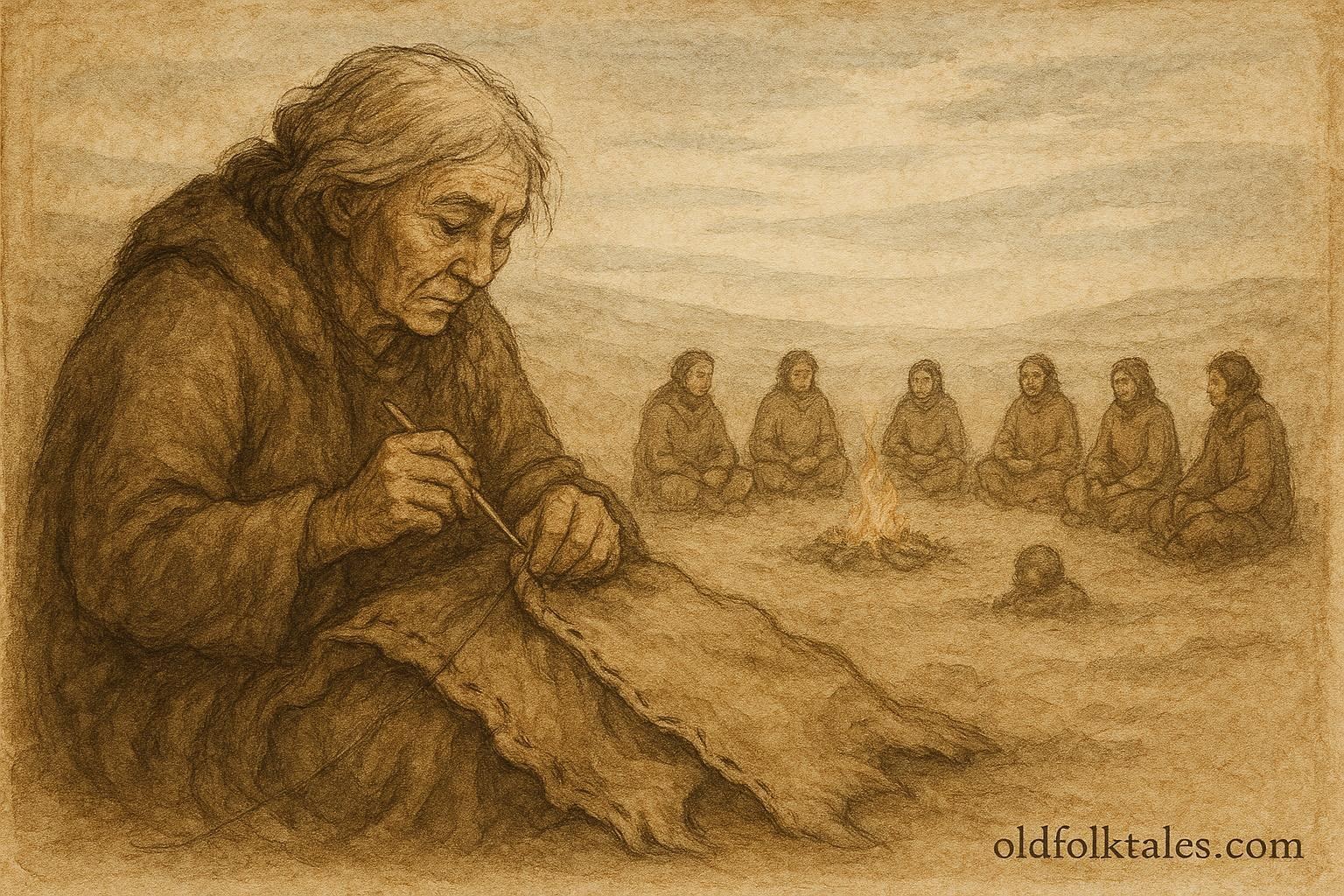
She moved slowly among the people, choosing a thick piece of hide stretched across a frame near the center of the gathering space. Without looking at anyone directly, she threaded sinew through the needle’s eye. Then, with steady hands, she began to stitch.
As she worked, no one was allowed to speak.
At first, the silence was uncomfortable. People shifted. Some opened their mouths out of habit, then stopped. The sound of the needle piercing hide echoed softly, rhythmically. Stitch by stitch, the hide closed over itself.
Minutes passed. Then longer.
Without words to shield them, the people became aware of other things. Breathing slowed. The fire crackled. Someone noticed the fatigue in their neighbor’s posture. Another felt the ache of hunger they all shared. Anger softened into reflection.
When Tetsa tied the final knot, she lifted the needle and laid it across the stitched hide.
Only then did she look up.
“Now,” she said, “you may speak. But only what you are willing to carry.”
One of the elders spoke first, not to accuse, but to remember. He recalled a time when the river nearly failed and how cooperation had saved them. A woman followed, admitting fear had guided her words more than truth. Slowly, others spoke. Apologies emerged, uneven but sincere.
No one interrupted.
By the time the fire burned low, the conflict had loosened its grip. The river was shared again, carefully. The needle was returned to its place.
Years later, another test came.
A young man named Kori challenged a leader openly, mocking decisions and stirring unrest. His words were clever and loud. People listened, but tension followed him like a shadow. Meetings became fractured. Trust eroded.
Again, Tetsa was called.
This time, Kori laughed when he saw the needle.
“Silence will not change the truth,” he said.
Tetsa nodded. “No,” she replied. “But it will reveal it.”
She stitched longer than before. The silence stretched until impatience drained from the air. When Kori finally spoke, his voice was different. Slower. Less certain.
He admitted he had spoken to be noticed, not to heal.
The needle had done its work.
When Tetsa grew old, she passed the needle to another woman, and then another. The needle itself did not change, but the lesson remained.
Among the Dene, it was remembered that before wounds can be closed, noise must fall away. Silence, carefully held, can stitch together what anger has torn apart.
Explore the ancestral legends of Canada, Mesoamerica, and South America’s Indigenous tribes.
Moral Lesson
This story teaches that silence is not weakness, but a necessary step toward reconciliation. True listening requires restraint, patience, and humility. Healing begins only when people are willing to quiet themselves and face the truth beneath their words.
Knowledge Check
1. What is the Bone Needle used for?
It is a ceremonial tool used to restore peace by enforcing silence.
2. Who keeps the needle?
A respected woman known for patience and wisdom.
3. Why is silence important in resolving conflict?
It allows reflection, listening, and emotional clarity.
4. What happens when people resist the needle’s lesson?
Their true motivations are revealed over time.
5. What does the stitched hide symbolize?
The mending of relationships and broken harmony.
6. What lesson does the community learn?
That healing begins with listening, not arguing.
Source
Adapted from Indigenous women’s material culture archives; Canadian Museum of History.
Cultural Origin
Dene First Peoples, Northwest Territories.