In the remote countryside of Uruguay, where vast estancias stretch across rolling grasslands and isolated homesteads dot the landscape like islands in an ocean of grass, there exists a creature that walks the boundary between protector and omen, between blessing and curse. The gauchos who work these lands speak of it in voices that mix reverence with unease: a massive black dog, larger than any natural hound, that prowls the estates after darkness falls.
The Black Dog appears without warning and vanishes just as suddenly, leaving only paw prints too large to belong to any earthly animal and the lingering sense that something ancient and powerful has passed through. Some see it as a guardian spirit, a supernatural protector watching over the land and those who work it honestly. Others believe it to be a cursed soul, bound eternally to the earth it once owned or wronged, unable to find rest in death.
Click to read all South American Folktales — timeless stories from the Andes to the Amazon.
The estancias of Uruguay are worlds unto themselves. These sprawling rural estates can encompass thousands of acres, their boundaries marked by fence lines that stretch beyond the horizon. The main house often sits at the heart of the property, surrounded by outbuildings, corrals, and the simple dwellings of the workers. During the day, the estancia bustles with activity: cattle being moved, horses being trained, crops being tended. But when night falls and the workers retreat to their quarters, a different character settles over the land. The darkness becomes absolute, broken only by scattered lamplight from distant windows. The wind carries strange sounds across the empty plains. And the Black Dog begins its rounds.
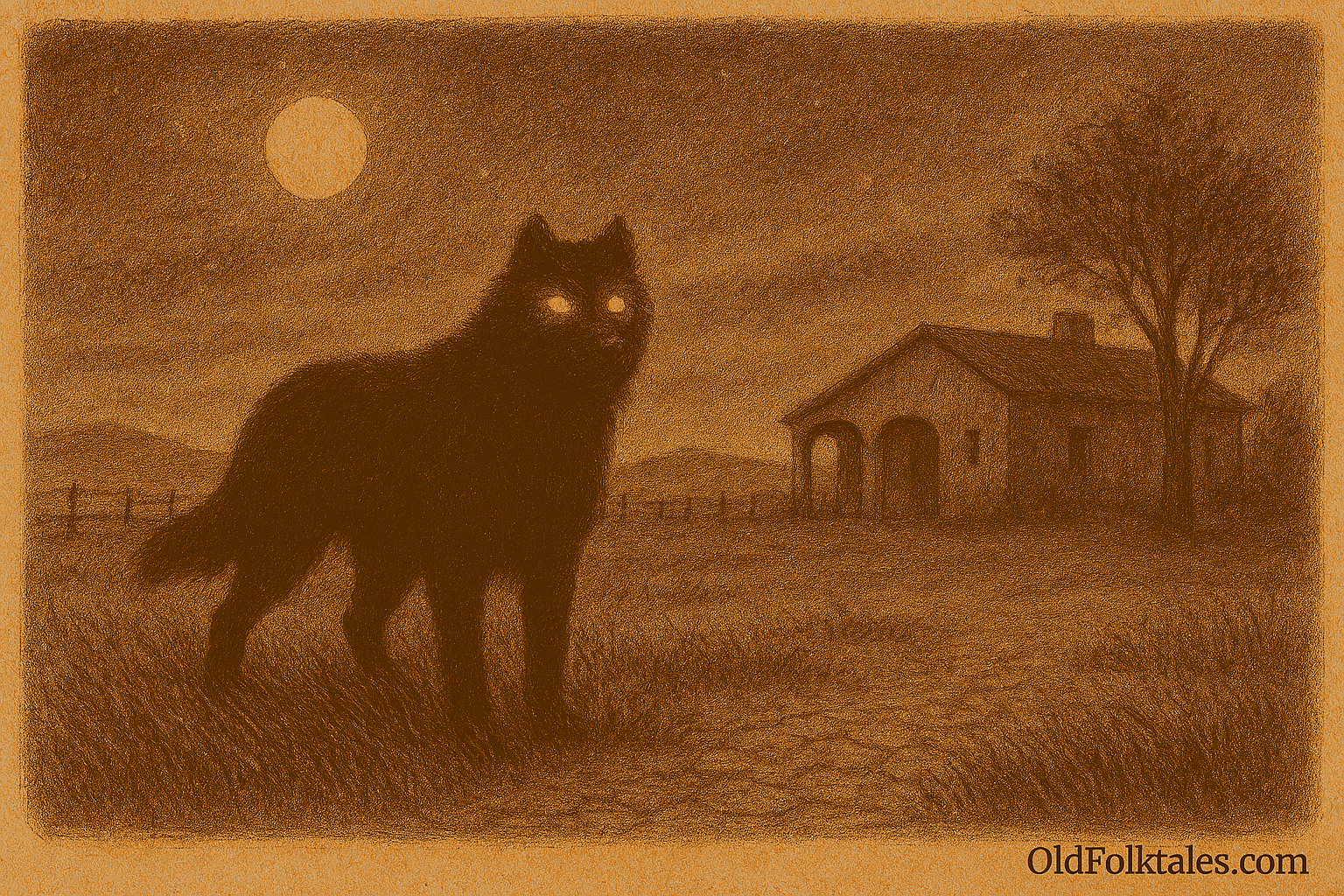
Those who have encountered the creature describe it in remarkably similar terms. It stands as tall as a man’s waist, sometimes higher, with a coat so black it seems to absorb light rather than reflect it. Its eyes glow with an otherworldly luminescence, sometimes red like burning coals, sometimes green like foxfire in a swamp, sometimes pale yellow like distant stars. The dog makes no sound as it moves, its massive paws falling silent on grass and dirt alike, giving it a ghostly quality that adds to its supernatural aura.
The Black Dog follows no predictable pattern in its appearances. It might be seen for several nights in succession, then disappear for months or even years. Some estancias report regular sightings, while others go generations without a single encounter. But when it does appear, there is always meaning behind the visitation.
Old timers on the estancias tell stories passed down through generations about the dog’s protective nature. There are accounts of thieves who came in the night to steal cattle or horses, only to be confronted by the massive hound. Some fled in terror at the sight of it, abandoning their criminal intentions and never returning. Others, more foolish or desperate, attempted to stand their ground or harm the creature. These men were found the next morning, uninjured but profoundly changed, their hair turned white, their voices reduced to whispers, their eyes haunted by whatever they had witnessed in their confrontation with the supernatural guardian.
Families living on the estancias speak of nights when the Black Dog appeared during times of danger. A woman alone in the main house while her husband was away reported seeing the dog stationed outside her door all night when bandits were known to be in the area. The criminals passed by without incident, as if something had warned them away. Children who wandered too far from home at dusk have been gently herded back toward safety by the silent creature, which followed behind them until they reached their doorstep, then vanished into the gathering darkness.
But the Black Dog is not universally benevolent. There are darker tales as well, stories that suggest the creature serves as more than just a protector. Some believe it appears as a harbinger, a warning of death or disaster approaching. When the dog is seen pacing restlessly near the main house,or heard howling in the distance despite making no sound when visible, old superstitions hold that someone on the estancia will soon die. And indeed, these sightings have often been followed by accidents, illnesses, or other tragedies.
The origin of the Black Dog remains a subject of debate and speculation. One version of the legend claims the creature is the spirit of a loyal dog that died defending its master and the estancia from attackers long ago. Its devotion was so complete that even death could not end its watch, and it continues to guard the land as it did in life, now possessed of supernatural powers befitting its eternal vigilance.
Another telling suggests something far more complex and troubling. According to this version, the Black Dog is the cursed soul of an estancia owner who committed terrible wrongs during his lifetime. Perhaps he stole the land through violence or deceit. Perhaps he mistreated his workers with such cruelty that their suffering cried out for justice. Perhaps he broke sacred oaths or violated the trust of those who depended on him. Whatever his sins, they were grave enough that upon his death, his spirit could not ascend or descend to its proper place. Instead, it was bound to the land, transformed into the shape of a great black dog, condemned to walk the boundaries of the property for all eternity.
In this interpretation, the dog’s protective behavior takes on a different meaning. It guards the estancia not out of love or loyalty, but because it is chained to the land by invisible bonds of guilt and cosmic justice. Its appearance serves as a reminder that certain debts must be paid, certain wrongs cannot be escaped, and that the land itself remembers and holds accountable those who misuse it or abuse those who depend upon it.
Some gauchos believe the truth encompasses elements of both explanations. They say the Black Dog’s nature depends on the character of the estancia’s current owners. For those who work the land honestly, treat their workers fairly, and maintain proper respect for the old ways and traditions, the dog appears as a guardian and protector. But for those who come to the land with dishonest intentions, who exploit their workers, or who show contempt for the responsibilities of stewardship, the dog becomes something else entirely: a judge, an avenger, a force that ensures that injustice on the land will ultimately be answered.
Whatever its true nature, the Black Dog remains a powerful presence in the folklore of rural Uruguay. Workers on the estancias still report sightings, their stories adding to the centuries of accumulated testimony. Skeptics dismiss these accounts as superstition, the product of isolation, darkness, and overactive imaginations. But the believers, those who have seen the creature with their own eyes or heard it moving through the night, know better.
They understand that the Black Dog serves a purpose beyond rational explanation. It represents the idea that the land itself has memory and agency, that places of human habitation accumulate spiritual energy from the lives lived and deaths experienced within their boundaries, and that certain forces exist to maintain balance between the human and supernatural worlds.
On still nights, when the moon hangs low over the pampas and shadows pool in the hollows of the rolling grassland, the workers on Uruguay’s estancias remain alert. They listen for the sound of massive paws moving through grass, watch for the gleam of unearthly eyes in the darkness, and remember the stories of the Black Dog. Whether guardian or ghost, protector or curse, it walks the land still, eternal in its vigil, mysterious in its purpose, and undeniable in its power.
Discover the sacred tales of llamas, condors, and gods who guard the Andes
The Moral Lesson
This legend embodies the complex relationship between land, justice, and spiritual accountability. The Black Dog serves as a reminder that how we treat the land and the people who depend upon it matters profoundly. For honest stewards who respect their responsibilities, supernatural protection may manifest to guard against harm. But for those who abuse their position, exploit others, or dishonor their obligations, that same spiritual force becomes a judge and reminder of inescapable accountability. The story teaches that our actions toward the land and our fellow humans create spiritual consequences that persist beyond our lifetimes, and that true guardianship requires honor, fairness, and respect for both the seen and unseen forces that inhabit the places we call home.
Knowledge Check
Q1: What is the Black Dog of the Estancias in Uruguayan folklore?
A: The Black Dog is a massive supernatural hound, larger than any natural dog, that appears on rural estates in Uruguay. It is described as having a coat so black it absorbs light, with glowing eyes that change color, and moves silently through the night watching over the land.
Q2: How does the Black Dog protect the estancias and their inhabitants?
A: The dog confronts thieves and bandits, causing them to flee or leaving them profoundly changed if they resist. It stands guard over vulnerable residents during dangerous times, gently herds lost children back to safety, and appears to ward off threats to those who work the land honestly.
Q3: What are the two main theories about the Black Dog’s origin?
A: One theory holds that it is the spirit of a loyal dog that died defending its master and continues its eternal watch with supernatural powers. The other suggests it is the cursed soul of an estancia owner who committed terrible wrongs and is now bound to the land as punishment for his sins.
Q4: When might the Black Dog be seen as an omen rather than a protector?
A: When the dog is seen pacing restlessly near the main house or heard howling despite making no sound when visible, it may serve as a harbinger warning of approaching death or disaster on the estancia.
Q5: How does the Black Dog’s behavior change based on the estancia owner’s character?
A: According to gaucho belief, the dog acts as a guardian and protector for honest landowners who treat workers fairly and respect traditions. But for those with dishonest intentions who exploit workers or abuse their stewardship, the dog becomes a judge and avenger ensuring injustice is answered.
Q6: What cultural values does this legend reflect in Uruguayan gaucho society?
A: The legend emphasizes proper stewardship of the land, fair treatment of workers, respect for supernatural forces, and the belief that actions carry spiritual consequences. It reflects the gaucho understanding that the land has memory and agency, and that justice transcends the physical world into the spiritual realm.
Source: Adapted from Uruguayan countryside folklore traditions and gaucho superstition records collected from rural estate workers and oral storytelling traditions.