The wind moved softly through the towering cedar trees as a young Tsimshian woman made her way along the forest’s edge, her basket heavy with sweet berries. The sunlight filtered through moss-covered branches, dappling her face with gold and shadow. She was beautiful and proud, the daughter of a respected hunter from a nearby coastal village. Yet that day, pride led her to mock the creatures who also gathered among the berry bushes.
When she saw signs of bears, broken twigs, paw-prints in the soft earth, berry-laden branches bent low, she laughed aloud. “Clumsy beasts,” she said. “Do you think you own the forest?” Her voice carried into the stillness, echoing among the trees.
But the forest heard her words. And the bears, who were listening, did not forget them.
Journey into the rhythm, wit, and wonder of Caribbean storytelling — from Haiti to Jamaica
Taken into the Forest
As the young woman turned to return home, a great shadow moved silently behind her. Before she could cry out, strong paws pulled her into the depths of the forest. The world grew darker and cooler as the trees thickened, their trunks rising like pillars of an ancient temple.
She trembled, expecting death. But to her astonishment, the bears did not harm her. They brought her to their dwelling, a wide, hidden cave carpeted with ferns and lined with soft moss. Inside sat the Bear Chief, an immense creature with wise eyes that shone like amber in the firelight. His voice rumbled low, yet his words were clear.
“You mocked our kind,” he said, “but you will learn that bears, too, have hearts and homes. You will stay among us until you understand.”
The woman bowed her head, too afraid to speak. Yet as the days passed, she began to see the truth in his words.
Life Among the Bears
The bears treated her not as a prisoner, but as a guest. They shared their food with her, berries, roots, and fish caught from the mountain streams. They showed her how to find honey hidden within fallen logs, how to sense danger in the wind, and how to live in balance with the forest.
Each evening, the Bear Chief’s son sat beside her and told stories in a deep, gentle voice. He spoke of the seasons, of rivers that remember every footstep, and of the unity of all living beings beneath the sky.
Slowly, affection grew between them. The woman, once fearful and proud, found herself smiling at his humor and moved by his kindness. In time, she became his wife, and together they built a family.
The Children of Two Worlds
Soon, she gave birth to twin cubs, soft, golden-furred creatures who could speak in both the language of bears and the speech of humankind. They were strong, curious, and gentle, just like their father.
The Bear Chief rejoiced, for these children were a bridge between two worlds. “They will teach our peoples to respect one another,” he said.
Years passed peacefully. The woman’s love for her bear family deepened, yet her heart sometimes ached for her human kin. She wondered if they still searched for her, or if they had forgotten her entirely.
The Return of the Hunters
One summer morning, the deep call of a human horn echoed through the forest. The woman froze. She recognized that sound, it was the signal of hunters from her village.
Her bear husband and the other forest creatures grew uneasy. The Bear Chief warned, “Your people come with weapons. They will not understand what you have become.”
Still, she could not stay hidden. Gathering her courage, she stepped out of the cave and climbed a rise from which she could see the hunters moving through the trees. When she called out, they stopped in shock.
“Do not shoot!” she cried. “It is I, your kinswoman! The bears are not your enemies!”
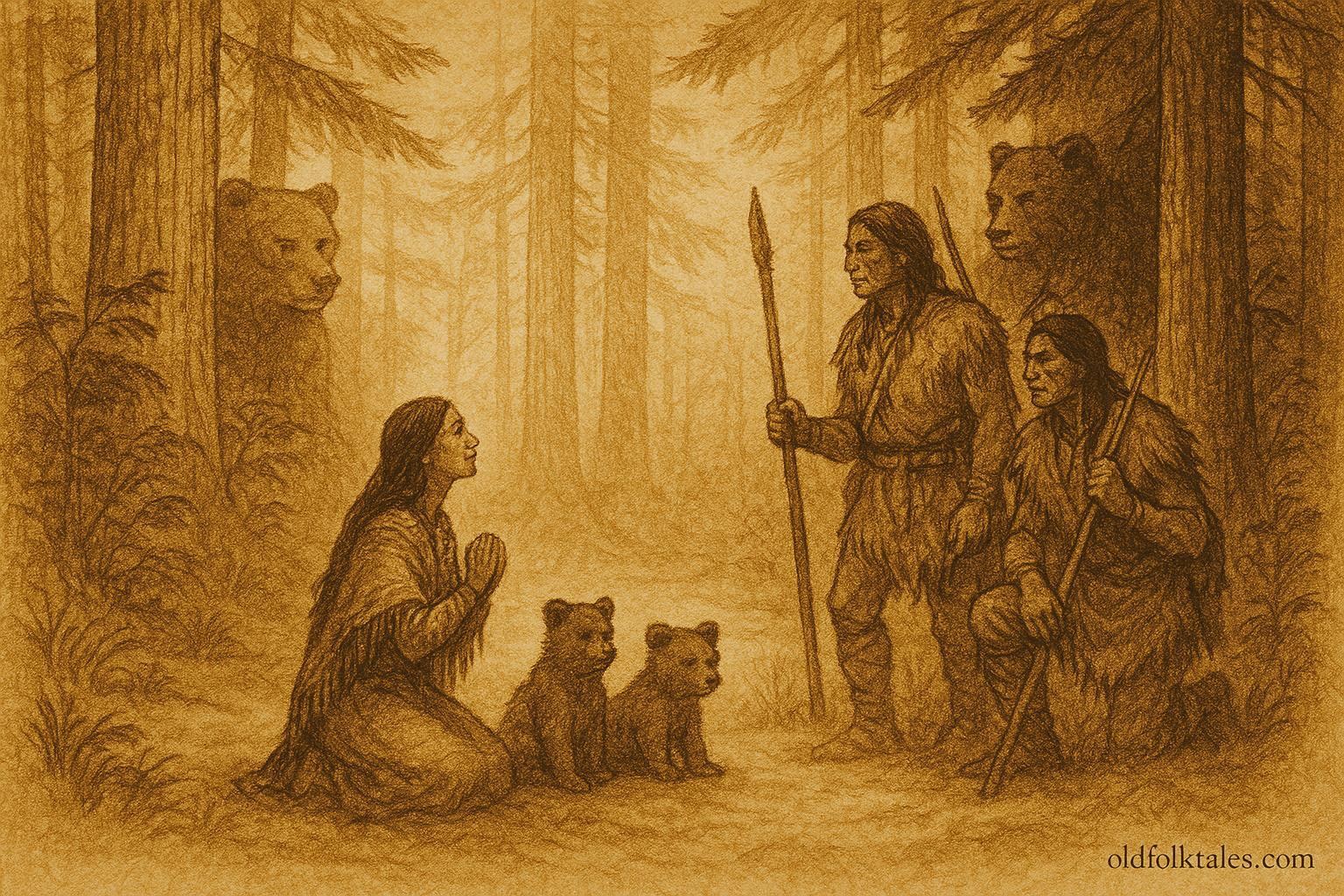
The hunters hesitated. But when they saw the huge forms of the bears behind her, fear took hold. Bows were drawn, arrows ready to fly.
At that moment, the twin cubs ran forward, calling out in voices that blended human words and bear growls. The sound startled everyone, the hunters, the bears, even the wind seemed to hold its breath.
The woman fell to her knees before the hunters. “Look at them,” she pleaded. “These are my children. They carry both your blood and the spirit of the forest. Do not bring death between us.”
Peace Between Worlds
The hunters lowered their weapons. Awe replaced fear as they saw the truth, the cubs were not beasts, but beings of harmony, symbols of kinship between man and nature.
The leader of the hunters bowed his head. “We have been blind,” he said. “We came to destroy what we did not understand.”
He promised that no hunter would ever again harm a bear without cause. From that day forward, the Tsimshian people honored the bear as a relative, a guardian of the woods, and a reminder that all life is bound together by respect.
When the woman and her family vanished deeper into the forest, the people built carvings and totems to honor her memory, the Bear Mother, who lived between two worlds and united them forever.
Explore the ancestral legends of Canada, Mesoamerica, and South America’s Indigenous tribes.
Moral Lesson
The Bear Mother teaches that true wisdom comes from respect for all living beings. When we look beyond fear and pride, we discover that humanity and nature are not separate, they are reflections of one another. Peace is found not in domination, but in understanding.
Knowledge Check
- Who is the main character in “The Bear Mother”?
The main character is a young Tsimshian woman who is taken by bears and becomes the wife of the Bear Chief’s son. - What causes the woman to be taken by the bears?
She mocks the bears while gathering berries, showing disrespect, which prompts the bears to teach her a lesson. - What do the twin cubs symbolize in the story?
The cubs represent unity between humans and nature, children of two worlds who bridge the gap between species. - What moral lesson does “The Bear Mother” teach?
It teaches respect for animals, empathy, and the importance of harmony between humans and the natural world. - What is the origin of “The Bear Mother” folktale?
This legend comes from the Tsimshian First Nations people of the Pacific Northwest Coast, Canada. - How does the story reflect Indigenous cultural values?
It reflects the Tsimshian belief in kinship with nature, spiritual connection among all beings, and moral lessons conveyed through storytelling.
Source: Adapted from Tsimshian Mythology, collected by Franz Boas (1916).
Cultural Origin: Tsimshian First Nations, Pacific Northwest Coast, Canada.