In the mining communities scattered across the Bolivian Altiplano, where mountains are carved open to reveal the precious metals hidden within, there is a figure more feared and respected than any earthly authority. His name is Supay, and he is the rightful owner of all that lies beneath the surface of the earth the silver, tin, copper, and gold that humans covet, and the dark spaces where these treasures rest.
Supay is not a demon, though outsiders often mistranslate his name as such. He is the lord of the underworld, Ukhu Pacha, the realm beneath the earth where minerals form and underground rivers flow. He is ancient, powerful, and particular about the terms under which humans may take what belongs to him. To the Aymara miners who work in the deep shafts and tunnels, Supay is neither evil nor benevolent he simply is, and he must be respected.
Click to read all South American Folktales — timeless stories from the Andes to the Amazon.
This is the story of what happens when that respect is forgotten.
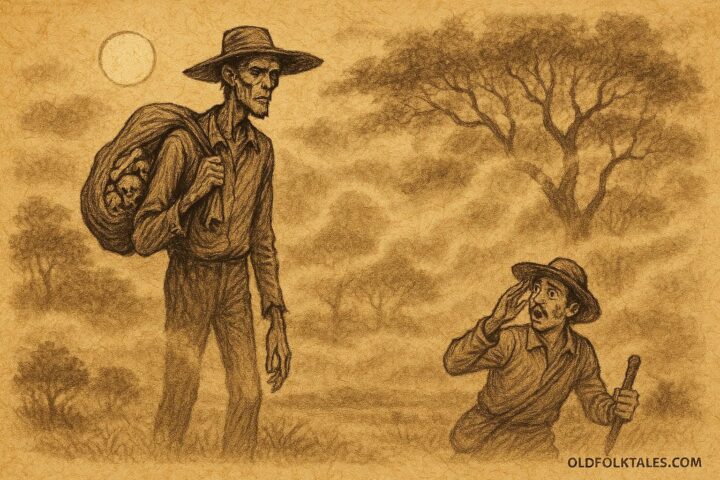
In a mining town called Potosí, during the time when silver flowed from the mountain called Sumaq Urqu like water, there worked a miner named Tomas. He was young and ambitious, recently arrived from a distant valley where his family had always been farmers. He had come to the mines seeking fortune, dreaming of accumulating enough wealth to return home and live in comfort.
The older miners tried to teach Tomas the proper ways the rituals that must be performed before entering the shafts, the offerings that must be made to Supay, the respectful attitude that must be maintained while working underground. Every Friday, they would gather at the entrance to the mine and make ch’alla, pouring chicha on the ground and burning llama fat mixed with coca leaves. They would speak to Supay directly, asking permission to enter his domain, promising to take only what they needed, acknowledging his ownership of all they would extract.
But Tomas thought these rituals were superstition, remnants of an old world that had no place in the modern business of mining. He had been educated by missionaries who taught him that such practices were pagan nonsense. He believed that the metals belonged to whoever had the strength and courage to extract them, that the earth was simply raw material waiting to be exploited.
“Old man’s foolishness,” he would mutter when the other miners performed their rituals. While they made their offerings at the entrance, Tomas would already be descending into the shaft, eager to start working, to get ahead, to extract more ore than anyone else.
At first, Tomas seemed to prosper. He found rich veins of silver that the other miners had somehow overlooked. His production was higher than anyone else’s, and the mine supervisors praised his diligence and efficiency. He worked longer hours than his companions, descending into the depths before dawn and emerging long after sunset, his lamp the last to extinguish each night.
The other miners watched with growing concern. “He takes without asking,” one old miner named Bartolomé warned. “Supay will notice. Supay always notices.”
“Supay is patient,” another added, “but he is not forgiving. The young fool is accumulating a debt that will come due.”
Tomas ignored their warnings. His success continued, and his arrogance grew alongside his wealth. He began to boast about his productivity, mocking the older miners for wasting time on useless rituals. “You see?” he would say. “I take what I want, and nothing happens. Your Supay is a fantasy.”
But Supay’s realm operates on different time scales than the human world above. What seems like getting away with transgression is often merely accumulating interest on an inevitable payment.
The changes in Tomas began subtly. He started to complain of headaches that wouldn’t go away, a constant pressure behind his eyes as if something were pushing outward from inside his skull. He had trouble sleeping, plagued by dreams of endless tunnels that twisted deeper and deeper into the earth, leading to chambers where shadowy figures gestured for him to follow.
His behavior grew strange. He would stand at the mine entrance for long periods, staring down into the darkness as if listening to something only he could hear. He began talking to himself, carrying on conversations with someone invisible. The other miners heard him arguing in the depths of the shaft, his voice echoing up from below, though he was alone.
“Supay has claimed him,” Bartolomé said with certainty. “He went too deep, took too much, showed no respect. Now he belongs to the underworld.”
Tomas’s physical appearance deteriorated rapidly. His skin took on a grayish pallor, as if he were becoming more mineral than flesh. His eyes developed a strange shine, like polished metal catching lamplight. He moved with a jerky, unnatural gait, as though his joints had calcified.
One evening, Tomas descended into the mine for his usual shift and did not return. When the other miners went looking for him the next morning, they followed his usual route through the tunnels, calling his name, their lamps casting dancing shadows on the rough stone walls.
They found his tools abandoned in a deep chamber, along with his lamp, still burning though its oil should have been exhausted hours ago. But Tomas himself was nowhere to be found. The tunnel appeared to continue beyond where they had ever mapped it, descending at a steep angle into darkness so absolute their lamps seemed unable to penetrate it.
One of the miners claimed to hear Tomas’s voice echoing up from those unmapped depths laughing, but with a quality that was no longer entirely human, mixed with the sound of rocks grinding together and water dripping in vast underground spaces.
They did not pursue him further. They knew where he had gone. Supay had taken what was owed to him not just the silver Tomas had extracted without permission, but Tomas himself. The young miner who had refused to acknowledge the lord of the underworld would now serve him forever in the deep places beneath the mountain, working eternal shifts in mines that no human eye would ever see.
The entrance to that deep tunnel was sealed. The miners performed elaborate rituals, making generous offerings to Supay, apologizing for their companion’s disrespect, asking that the lord of metals be satisfied with the one he had claimed and not extend his retribution to the rest of them.
From that day forward, no miner in Potosí ever again entered the shafts without first performing the proper rituals. They made their ch’alla every Friday without fail. They burned their offerings of llama fat and coca. They spoke respectfully to Supay, acknowledging his ownership, asking permission humbly, promising to take only what was needed.
And when they worked in the deep tunnels, they sometimes heard sounds rising from even deeper places the ring of picks on stone, the rumble of ore carts on tracks that didn’t exist, the sound of work continuing in Supay’s domain where the miners he had claimed labored forever, paying with eternal service for the metals they had taken without respect.
The story of Tomas became a teaching story, told to every new arrival at the mines. “Supay is not evil,” the old miners would explain. “He is the rightful owner. The metals are his. We are guests in his realm, permitted to take what we need only if we show proper respect and make proper offerings. To do otherwise is not bravery or modernity it is theft, and Supay always collects what is owed to him.”
Even today, in the mines that still operate in the Bolivian highlands, you will see shrines to Supay at every entrance offering of coca leaves, alcohol, cigarettes, and llama fat burning in small fires. The miners stop before these shrines without exception, making their requests, showing their respect, acknowledging the true owner of the wealth they seek.
They have learned the lesson that Tomas learned too late: the earth’s treasures are not free for the taking. They belong to powers older and more patient than human ambition, and those who forget this truth do not simply die they disappear, claimed by the darkness, joining the eternal workforce in Supay’s kingdom beneath the mountain.
Click to read all Andean Highland Folktales — echoing from the mountain peaks of Peru, Bolivia, and Ecuador.
The Moral Lesson
This Aymara mining legend teaches that natural resources, particularly metals and minerals beneath the earth, have a spiritual owner who must be respected through proper ritual and reciprocity. Supay represents not evil but rightful ownership humans are guests in his underground realm and must ask permission, make offerings, and acknowledge that they are taking what belongs to another. The story warns that approaching resource extraction with arrogance, disrespect, or purely materialistic attitudes leads to madness, illness, and ultimately disappearance or death. It emphasizes that traditional ritual knowledge is not superstition but practical wisdom about maintaining proper relationships with the spiritual forces that govern natural wealth, and that modernization or education does not exempt anyone from these obligations.
Knowledge Check
Q1: Who is Supay in Aymara cosmology and mining culture? Supay is the lord of Ukhu Pacha, the underworld realm beneath the earth’s surface. He is the rightful owner of all underground wealth silver, tin, copper, gold, and other metals. Despite often being mistranslated as “devil,” Supay is not inherently evil in Aymara understanding but rather a powerful figure who demands proper respect and ritual reciprocity from those who enter his domain and take his resources.
Q2: What rituals must miners perform to respect Supay according to this legend? Miners must perform ch’alla ceremonies before entering the mines, pouring chicha on the ground and burning offerings of llama fat mixed with coca leaves. They must speak directly to Supay, asking permission to enter his domain, acknowledging his ownership of the metals, and promising to take only what they need. These rituals are typically performed every Friday and whenever entering a new shaft or section of the mine.
Q3: Why did Tomas refuse to perform the traditional mining rituals? Tomas refused to perform the rituals because he had been educated by missionaries who taught him that such practices were pagan superstition. He believed the metals belonged to whoever had the strength to extract them, viewing the earth as raw material for exploitation rather than as territory with a spiritual owner. His modern, materialistic worldview made him dismiss traditional ritual knowledge as “old man’s foolishness.”
Q4: What were the signs that Supay had claimed Tomas? The signs of Supay’s claim included persistent headaches, inability to sleep, disturbing dreams of endless tunnels, strange behavior like staring into the mine entrance for long periods, talking to invisible presences, physical deterioration (grayish skin, metallic-looking eyes, stiff movements), and finally his disappearance into unmapped depths of the mine, from which he never returned but where his voice could still be heard echoing up from below.
Q5: What happened to Tomas at the end of the story? Tomas descended into the mine for his usual shift and never returned. His tools and lamp were found abandoned in a deep chamber, but he himself had disappeared into unmapped tunnels that descended into absolute darkness. He had been claimed by Supay taken to serve eternally in the lord of metals’ underground kingdom, working forever in mines no human eye would see, paying with eternal service for the metals he took without respect or permission.
Q6: How is this story used in actual mining communities today? This story functions as a teaching tale told to every new miner in Bolivian mining communities. It explains why proper rituals must never be skipped and why Supay must always be respected. Even in modern mines, shrines to Supay stand at every entrance where miners leave offerings of coca leaves, alcohol, cigarettes, and llama fat before entering. The legend reinforces practical safety culture by framing respect for mining dangers in terms of respecting the underground realm’s spiritual owner.
Source: Adapted from Aymara mining folklore studies by Tristan Platt and oral traditions from Bolivian mining communities
Cultural Origin: Aymara Indigenous Peoples, Mining Regions of Bolivia’s Altiplano