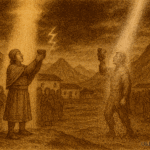
In the fertile valleys near Ayacucho, where the Andean peaks stand as silent guardians and terraced fields climb the mountainsides like green staircases to the sky, there once lived a farmer named Tomás. The land here was generous but demanding it required respect, care, and the cooperative spirit that bound the community together like the strong threads of a well-woven poncho.
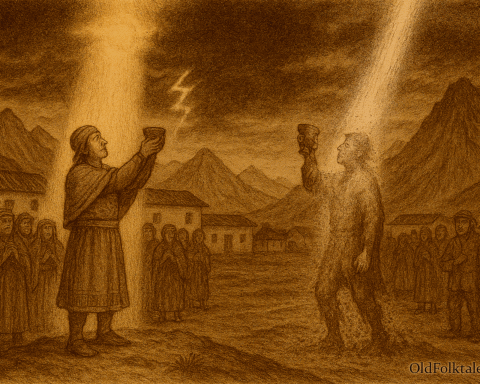
The people of Tomás’s village understood this truth deeply. They practiced ayni, the sacred tradition of reciprocal work, where neighbors helped neighbors’ plant and harvest, where no one prospered alone, and where the community’s strength came from shared labor and mutual support. When one family’s field needed tending, all hands came together. When the irrigation channels required repair, everyone contributed their effort. This was the way of their ancestors, the way that honored Pachamama, the Earth Mother who provided their sustenance.
Click to read all South American Folktales — timeless stories from the Andes to the Amazon.
But Tomás had grown lazy and bitter. While his neighbors rose with the sun to work their fields, he would sleep late, claiming his back ached or his head pounded. When the village called for communal workdays to maintain the ancient terraces or clear the irrigation canals, Tomás would make excuses or simply not appear. His own small plot grew wild with weeds, the stones of his terrace walls loosened and fell, and his potato plants produced less each season.
“Why should I break my back in the fields?” Tomás would grumble to anyone who would listen. “Life is short. Others can do the work.” He would sit in the shade while his wife struggled alone with their crops, and he would laugh mockingly when the village elders spoke of honoring Pachamama through honest labor.
“Pachamama, Pachamama,” he would sneer. “If she cares so much, let her plant the potatoes herself!” His neighbors shook their heads in dismay, whispering that such disrespect would bring misfortune. But Tomás only laughed louder.
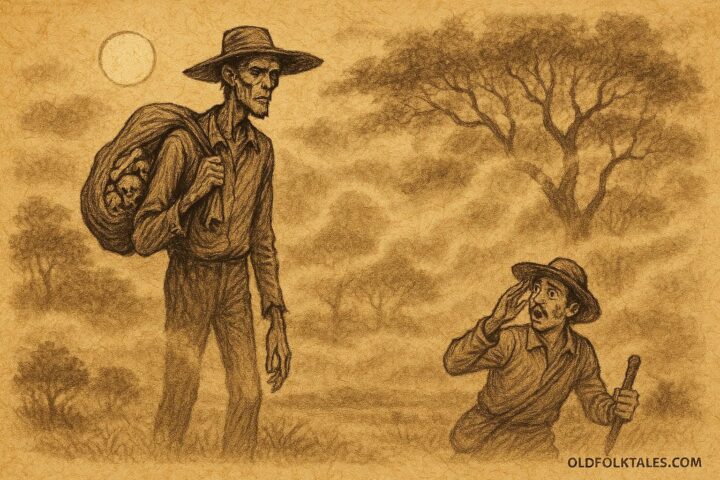
One evening, as the sun painted the mountains in shades of gold and crimson, a stranger appeared at Tomás’s door. He was a tall man dressed in fine but dusty traveling clothes, with a wide-brimmed hat that cast his face in shadow. His eyes, when they caught the fading light, seemed to gleam with an unusual intensity like embers in the darkness.
“Good evening, friend,” the stranger said, his voice smooth as aguardiente. “I’ve traveled far and couldn’t help but notice your… difficult situation. A man of obvious intelligence like yourself, struggling with such a small, stubborn piece of land.”
Tomás’s chest swelled with the flattery. Finally, someone who understood! “Exactly!” he exclaimed. “I’m too smart to waste my life scratching at dirt like a chicken.”
The stranger smiled, revealing teeth that seemed just a bit too white, too sharp. “What if I told you there was another way? A way to have wealth without the burden of endless labor? Gold and silver, fine clothes, abundant food all without ever soiling your hands again?”
Tomás’s eyes widened with greed. “Tell me more, friend. Please, come in, sit by my fire.”
The stranger entered, and though the evening was warm, a chill seemed to follow him across the threshold. He produced a parchment from his cloak old and strange, covered with symbols that seemed to writhe in the firelight. “Simply make your mark here,” the stranger said, “and wealth beyond imagining will be yours. All I ask in return is that you abandon your fields completely. No more planting, no more harvesting. Let the land return to wilderness.”
“Abandon my fields?” Tomás laughed. “They’re barely worth working anyway! Where do I sign?”
The stranger’s smile widened impossibly. “Right here.” He pointed with a finger that seemed longer than it should be, the nail more like a talon.
Without hesitation, without even reading the contract, Tomás made his mark. The parchment vanished in a wisp of smoke that smelled of sulfur, and the stranger stood. “Remember your promise,” he said, and stepped out into the night.
For a few weeks, Tomás’s fortunes seemed to change miraculously. He found a leather pouch full of silver coins on his doorstep. A merchant passing through town gave him fine cloth and exotic foods “by mistake.” Tomás stopped going to his fields entirely, spending his days drinking and boasting about his sudden good fortune.
But then the darkness came.
The coins he’d found turned to dried leaves in his pocket. The fine cloth unraveled into cobwebs. The food rotted overnight, filling his home with the stench of decay. His abandoned fields, once neglected but still alive, began to die completely the soil turned gray and lifeless, cracking like old pottery. The weeds themselves withered. Nothing would grow there, as if the earth itself had turned its face away.
Then his home began to fall apart. First, the roof beams cracked and sagged. Then the adobe walls developed fissures that spread like veins of poison. The doors hung crooked on their hinges. The cold mountain wind howled through gaps that appeared overnight. Tomás’s wife, ashamed and frightened, left to stay with her family in a neighboring village.
One moonless night, Tomás sat alone in his crumbling house, hungry and shivering, when he heard footsteps. The stranger returned, but now there was no pretense of humanity in his appearance. His eyes burned like coals, his shadow seemed to have substance and weight, and the smell of sulfur was overwhelming. Curved horns caught the lamplight, and his grin revealed rows of pointed teeth.
“Supay,” Tomás whispered, recognizing at last the lord of the underworld, the spirit of the deep earth who punished those who betrayed Pachamama’s laws.
“Yes,” Supay hissed. “Did you think wealth could come without work? Did you believe you could mock the Earth Mother and prosper? You abandoned your responsibilities to your land, your community, and your gods. You chose greed over honest labor, comfort over character.”
Tomás fell to his knees. “Please, I didn’t understand! I’ll work, I’ll change”
But Supay was already fading into shadow, his laughter echoing like distant thunder. “The land remembers. Your neighbors remember. You made your choice.”
And then he was gone.
Tomás was left with nothing no wealth, no home, no crops, and no community willing to help a man who had so thoroughly betrayed their values. He became a wanderer; a cautionary tale told to children around evening fires. His fields remained barren for generations, a stark reminder visible from the village of what happens when one turns away from ayni, from honest work, and from respect for Pachamama.
The villagers would point to that dead patch of land and say, “There is where Tomás chose Supay’s false promises over true wealth the wealth of community, of honest labor, and of living in harmony with the earth.”
Click to read all Andean Highland Folktales — echoing from the mountain peaks of Peru, Bolivia, and Ecuador.
The Moral Lesson
This powerful Andean tale teaches that true prosperity comes not from shortcuts or selfish greed, but from honest labor, respect for the land, and commitment to community. Tomás’s downfall illustrates the consequences of abandoning one’s responsibilities and mocking the sacred relationship between humans and nature. The story reminds us that wealth earned through deception or laziness is hollow and temporary, while the real treasures of life purpose, dignity, and community belonging come only through respecting the values of hard work, reciprocity, and reverence for the earth that sustains us.
Knowledge Check
Q1: Who is Supay in Andean mythology and what does he represent?
A1: Supay is the lord of the underworld in Andean mythology, associated with the depths of the earth and often depicted as a punisher of those who violate sacred laws. He represents the consequences of moral transgression, particularly disrespect toward Pachamama and abandonment of community values.
Q2: What is ayni and why is it important in Quechua culture?
A2: Ayni is the Andean principle of reciprocal labor and mutual aid, where community members help each other with agricultural work and other tasks. It’s fundamental to Quechua culture because it ensures survival in harsh mountain environments and reinforces the values of cooperation, solidarity, and shared responsibility that hold communities together.
Q3: What was Tomás’s main character flaw in the story?
A3: Tomás’s main flaw was his laziness combined with greed and disrespect for traditional values. He rejected honest labor, mocked Pachamama, abandoned his community responsibilities, and sought wealth through shortcuts rather than earning it through work and respect for the land.
Q4: Why did Supay specifically require Tomás to abandon his fields?
A4: Supay required Tomás to abandon his fields because cultivating the land is an act of honoring Pachamama and maintaining the sacred relationship between humans and earth. By making Tomás abandon his fields completely, Supay ensured that Tomás would sever his connection to both the Earth Mother and his community, leading to his complete spiritual and material ruin.
Q5: What symbolic meaning does the barren field hold in this tale?
A5: The barren field that remained lifeless for generations serves as a visible, enduring warning about the consequences of betraying community values and disrespecting the earth. It symbolizes how moral corruption can create lasting damage, and how turning away from Pachamama leaves one spiritually and materially desolate.
Q6: How does this story reinforce the relationship between morality and prosperity in Andean culture?
A6: The story demonstrates that in Andean worldview, material prosperity and moral behavior are inseparably linked. True wealth comes from respecting Pachamama through honest labor, maintaining community bonds through ayni, and fulfilling one’s responsibilities. Supay’s punishment of Tomás shows that greed, laziness, and disrespect for these values inevitably lead to ruin, regardless of temporary gains.
Source: Adapted from Ayacucho Quechua oral narratives and Ministerio de Cultura del Perú folklore documentation.
Cultural Origin: Quechua people, Ayacucho region, Andean Highlands of Peru