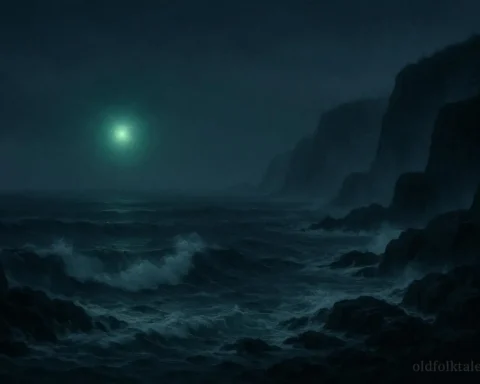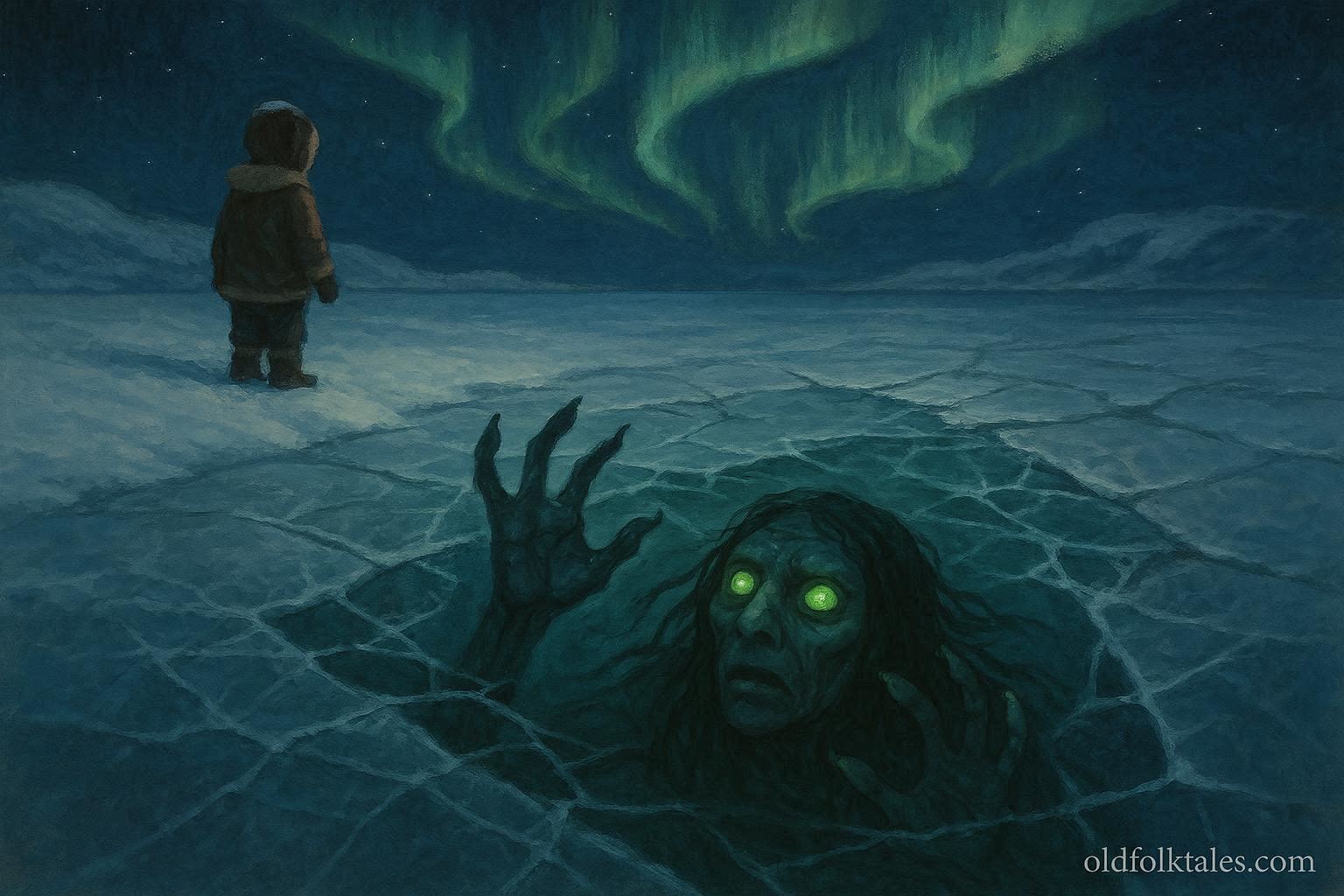
Far in the frozen North, where the sea is hidden beneath sheets of ice and the wind sings through the snow, there are stories that the people of the Arctic tell their children to keep them safe. Among the most chilling of these tales is that of the Qalupalik, a creature that waits beneath the water, watching and listening for the sound of wandering footsteps on the shore.
Long ago, in a small Inuit village by the sea, families lived close to the rhythm of nature. They fished through holes in the ice, hunted seals and whales, and taught their children the old ways to respect the water, the weather, and the spirits that lived beyond sight. The elders warned the young never to stray too close to the ocean’s edge, for the sea was alive and filled with both beauty and danger.
But one child, a curious boy named Nukka, did not always listen. He loved to explore. He followed the trails of seals and threw stones across the frozen surface, laughing as the sound echoed into the distance. His mother often called him back sharply, saying, “Stay near the village, Nukka. The Qalupalik is out there, and it takes children who do not obey.”
Discover the blend of magic and wisdom that defines the folktales of the Caribbean islands
Nukka would laugh and pretend to be brave. “The Qalupalik cannot catch me,” he would boast. But he did not truly know what he was defying.
As the elders told it, the Qalupalik was a creature of the deep. Its skin was pale green and smooth like a seal, but its fingers were long and webbed, ending in sharp claws. Its hair floated dark and tangled in the icy water, and its eyes glowed softly like lanterns beneath the sea. The Qalupalik wore a large amauti, a pouch like that of a mother carrying a baby, and in that pouch it kept the children it captured, rocking them gently as it swam through the cold depths.
Some said the Qalupalik stole children to raise them under the sea. Others said it fed on their voices and laughter, keeping them as treasures of the deep. Whatever the truth, no child taken by the Qalupalik ever returned.
One still morning, the sea was quiet and the wind was soft. Nukka’s parents had gone to gather driftwood, leaving him near the edge of the village. He sat by the shore, staring into a hole in the ice where the fishermen had been cutting earlier that day. The water below was dark and still. He leaned closer, peering into the shadows.
That was when he heard it, a faint humming, like a song carried through water. It was a woman’s voice, low and sweet, calling his name. “Nukka,” it sang, “come closer. I have something beautiful for you.”
He froze, his breath catching. The sound was both frightening and comforting, as though someone far below was calling out in kindness. He crept closer to the hole, his mittened hands pressed to the ice.
“Nukka,” the voice said again. “Do not be afraid. Come to me.”
Just as he leaned forward, he saw something move beneath the water, a flash of pale green, a ripple of long hair. A webbed hand reached up from the depths, the fingers curling toward the ice.
Terrified, Nukka stumbled backward and ran, slipping across the snow. He did not stop until he reached the warmth of his family’s tent. Breathless, he told his mother what he had seen.
His mother held him close, whispering a prayer. “You are lucky, my son,” she said. “The Qalupalik nearly had you. It sings to children who wander, and if you had listened longer, it would have pulled you under the ice.”
From that day on, Nukka never went near the shore without his parents. Yet the story of his encounter spread through the village, and the elders began to tell it more often during the long winter nights, when the wind howled and the ice cracked like thunder.
Years later, another story spread through the same village this time about a brave girl who turned the Qalupalik’s trick back on itself. She was clever and quick, and when the creature tried to lure her with its song, she called out, “If you come any closer, my feet will bite you!”
The Qalupalik, who had never heard such words, grew frightened. It thought the girl’s feet were alive and dangerous, and it fled into the sea, never to return near that village again.
The elders said that from that day, the Qalupalik kept its distance from brave and clever children. It waited only for those who disobeyed or wandered too far, trusting that fear and wisdom would keep the rest safe.
Even now, Inuit parents tell their children of the Qalupalik. In the howling wind, you can sometimes hear the faint hum of its song beneath the ice, especially when the sea begins to thaw in spring. It reminds all who live in the North that the waters hold both life and danger, and that the old stories are not just to frighten, they are to protect.
The Qalupalik is more than a monster. It is a lesson, a spirit of the sea that demands respect. The elders say that if you listen to your family, honor the rules of the land, and remember your people’s stories, the Qalupalik will have no power over you. But if you forget, if you wander too far or ignore the wisdom of your elders, the sea may come for you in the shape of a whisper and a hand reaching up from the dark.
Moral Lesson
The story of the Qalupalik teaches children to respect their parents and elders and to understand that nature must be approached with caution and reverence. It reminds the Inuit that every element of their world even the sea holds spirit and power. Obedience and awareness are not just virtues; they are keys to survival in the Arctic.
Knowledge Check
1. What is the Qalupalik said to look like?
It has green skin, long hair, and webbed hands, living beneath the icy waters.
2. Why does the Qalupalik take children?
It captures children who disobey their parents or wander too close to the water’s edge.
3. How did Nukka escape from the Qalupalik?
He ran away after seeing its hand reach up through the ice and told his mother what happened.
4. What did the clever girl say to frighten the Qalupalik away?
She told it that her feet would bite, which scared it into fleeing.
5. What lesson does the story teach?
It teaches the importance of obedience, respect for nature, and listening to one’s elders.
6. Why is the Qalupalik still remembered today?
It serves as both a warning and a reminder of the Arctic’s dangers and the wisdom passed down through Inuit storytelling.
Source: The Qalupalik by Elisha Kilabuk, Inhabit Media, 2011.
Cultural Origin: Inuit First Nations, Arctic Canada