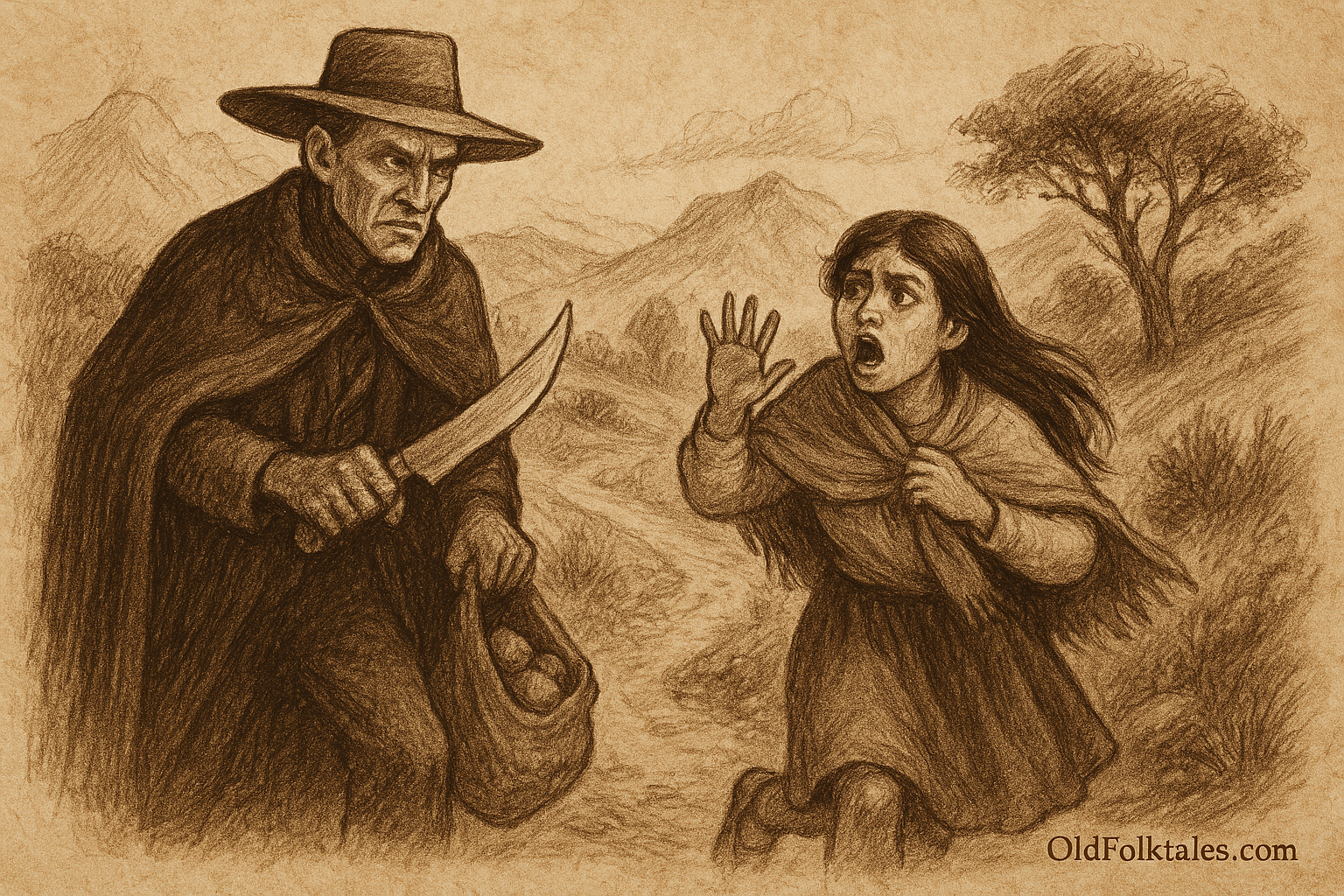
In the remote villages of the Peruvian highlands, where ancient paths wind between terraced fields and mist clings to the mountains like ghostly wool, mothers still whisper a name that makes children press closer to the fire. That name is Pishtaco, and it carries with it centuries of fear, memory, and warning.
The story begins not in myth but in history, in those dark years when strangers came from across the sea, bringing with them steel and cruelty and an insatiable hunger for gold. The Quechua people, who had lived in harmony with the apus and the earth for generations beyond counting, found their world shattered. Their bodies were not their own anymore. They were made to labor in mines until their lungs filled with dust, to carry impossible loads up impossible slopes, to die far from their families in service to foreign masters who saw them as nothing more than tools to be used and discarded.
Click to read all Central American Folktales — where ancient Maya spirits meet the voices of the rainforest and volcano.
But there was something else the colonizers wanted, something that chilled the blood even more than forced labor. They wanted the fat from indigenous bodies. Whether for waterproofing boots, greasing machinery, making medicines, or consecrating their church bells, the colonizers valued this human tallow. Stories spread through the villages of people disappearing, of bodies found drained and hollow, of unholy transactions in the darkness.
From this trauma, from this violation of the most fundamental human dignity, the legend of the Pishtaco was born.
In the village of Huayllabamba, nestled in a valley where the river sang over ancient stones, there lived a girl named Sumaq. Her name meant “beautiful” in Quechua, and indeed she was lovely, with long black hair that shone like obsidian and eyes that held the warmth of her mother’s hearth. She was sixteen years old, strong from working the fields, and blessed with the kind of robust health that comes from generations of mountain people whose bodies have adapted to the thin air and harsh conditions.
Sumaq’s grandmother, Mamá Rosita, was the village’s memory keeper, the one who held the stories and the warnings that kept the community safe. On cold nights, when the wind howled down from the peaks like hungry wolves, Mamá Rosita would gather the children around her and speak of the Pishtaco.
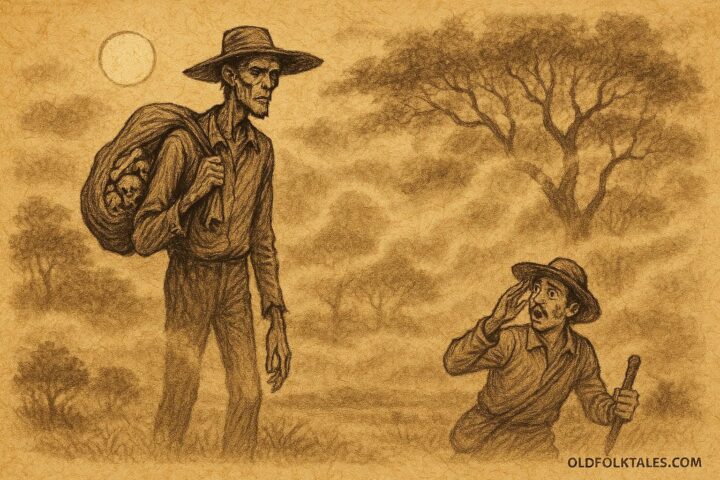
“He appears as a stranger,” she would say, her voice dropping to barely more than a whisper. “A white man or a mestizo, someone who does not belong to our mountains. He dresses well, sometimes in the clothes of a priest or a merchant or a doctor. He speaks sweetly and offers help, offers money, offers rides in vehicles that appear on lonely roads. But his eyes are cold, like chips of ice, and if you look carefully, you will see that he casts no shadow in the sunlight.”
The children would huddle closer, and Mamá Rosita would continue, her weathered hands moving in the firelight like birds.
“The Pishtaco carries special tools: razor-sharp knives that can slice through skin like water, bottles to collect what he steals, and magic that puts his victims into a deep sleep from which they never wake. He hunts for those who are young and strong, whose bodies are rich with the fat he craves. He strikes on lonely roads, in isolated fields, anywhere a person might be alone. And when he is finished, he leaves behind only a hollow shell, drained of life and substance.”
One autumn day, when the potato harvest had been gathered and the village was preparing for the festival of Todos Santos, Sumaq was sent to the neighboring village of Ollantaytambo to purchase special candles for the celebration. The path between the villages followed an old Inca road, well-maintained but lonely, winding through areas where houses were scarce and the land belonged more to the vicuñas and the condors than to people.
Sumaq set out early in the morning, carrying a woven bag with coins her mother had saved and wearing her warmest manta shawl against the mountain chill. The journey would take most of the day, there and back, but she was strong and unafraid. She had walked this path many times before.
As the sun reached its zenith, casting short shadows on the ancient stones, Sumaq noticed a figure ahead on the path. It was a man, tall and pale-skinned, dressed in a fine jacket that seemed too clean for mountain travel. He stood beside a truck that looked new and expensive, a vehicle unlike any that belonged to the local people.
“Buenos días, señorita,” the man called out in Spanish, his voice smooth as honey but carrying an accent that marked him as a foreigner. “I seem to have taken a wrong turn. Could you help me find my way to Cusco?”
Sumaq felt a chill run down her spine that had nothing to do with the mountain air. She remembered Mamá Rosita’s warnings, remembered the old stories. The man’s smile was wide, but it didn’t reach his eyes. And when she glanced down at the ground, she saw his feet clearly in the sunlight, but no shadow stretched behind him.
“I’m sorry, señor,” Sumaq said, backing away slowly. “I don’t know the road to Cusco. Perhaps someone else can help you.”
The man’s smile faltered. He took a step toward her, and now she could see something in his hand, something that glinted like metal. “Don’t be afraid, little one. I only want to help you. You look tired from your journey. Why don’t you rest in my truck for a moment? I have cold water, fresh bread.”
But Sumaq was already running, her feet finding purchase on the stones even as her heart hammered against her ribs. She heard the man curse behind her, heard the sound of his feet pounding after her. He was fast, faster than any normal man should be, and she knew with terrible certainty that if he caught her, she would become another story, another warning, another unexplained disappearance that the villagers would whisper about in the darkness.
Ahead, she saw a cluster of houses, smoke rising from their chimneys. She could hear voices, the sound of life and community. Summoning every ounce of strength her mountain heritage had given her, Sumaq ran faster than she had ever run before, screaming at the top of her lungs.
“Pishtaco! Pishtaco! Help me!”
The effect was immediate and electric. Doors flew open, and men and women rushed out armed with hoes, sticks, and stones. No one questioned whether the threat was real. The very word Pishtaco galvanized the community into instant protective action. The fear was ancient and bone-deep, passed down through generations who had learned that such threats were real and deadly.
The pale stranger saw the crowd forming and stopped his pursuit. For a moment, his mask of civility slipped completely, and Sumaq saw his face contorted with rage and something else, something inhuman and hungry. Then he turned and ran back toward his truck with impossible speed, the vehicle roaring to life and disappearing around a bend in the road, leaving only a cloud of dust and the acrid smell of exhaust.
Sumaq collapsed into the arms of the villagers, sobbing with relief and terror. They brought her water and coca tea, wrapped her in blankets, and praised her quick thinking. An older man who had fought in his youth inspected the spot where the stranger’s truck had been parked and found drops of an oily substance on the ground that smelled wrong, chemical and foreign.
“Pishtaco,” he confirmed grimly. “No doubt about it. The girl was wise to run.”
They sent word to Huayllabamba, and that night, every village in the valley posted watchers on the roads. The stranger’s truck was never seen again, but neither did anyone doubt what had almost happened. Sumaq had looked into the face of the legend and survived through knowledge, speed, and the protective power of community.
Mamá Rosita held her granddaughter close that night and spoke words that would echo through Sumaq’s life and the lives of her children and grandchildren to come.
“The Pishtaco is real,” she said. “Whether he is a man made monstrous by greed or a monster that walks in man’s shape hardly matters. He represents the danger that comes from outside our community, the exploitation of our bodies and our lives by those who see us as less than human. We remember the Pishtaco not to live in fear, but to stay vigilant, to stay together, and to trust our instincts when something feels wrong. The stories keep us safe because they keep us aware.”
To this day, in villages throughout the Andes, the Pishtaco remains a figure of dread and warning. Parents tell their children to never talk to strangers on lonely roads, to never accept rides from those they don’t know, to never wander alone in isolated places. The legend has evolved with time, adapting to modern fears while maintaining its essential core, a reminder of historical trauma and the ongoing need for community protection against those who would exploit the vulnerable.
The Pishtaco is more than a boogeyman. He is a cultural memory made flesh, a warning system encoded in story, and a testament to a people’s determination to protect their own in a world that has not always valued their lives or their humanity.
Click to read all Andean Highland Folktales — echoing from the mountain peaks of Peru, Bolivia, and Ecuador.
The Moral of the Story
This legend teaches us that folklore often emerges from historical trauma and serves as a protective mechanism for vulnerable communities. The Pishtaco represents the very real dangers of exploitation, the violation of bodily autonomy, and the threat posed by those who see others as resources to be extracted rather than humans to be respected. The story emphasizes the importance of community vigilance, trusting one’s instincts when something feels wrong, and maintaining cultural knowledge passed down through generations.
Knowledge Check
Q1: What is the Pishtaco in Quechua folklore, and what does he do to his victims?
The Pishtaco is a terrifying figure in Quechua legend described as a killer who extracts the fat from his victims’ bodies for sinister purposes. He typically appears as a white or mestizo stranger, often well-dressed and seemingly respectable, who uses deception to isolate victims before draining their body fat. The legend portrays him using special knives and supernatural abilities to render victims unconscious before stealing their fat, leaving behind hollow, lifeless bodies.
Q2: What historical trauma does the Pishtaco legend reflect?
The Pishtaco legend emerged from the colonial period when Spanish colonizers exploited indigenous bodies in various ways, including the actual harvesting of human fat for industrial and religious purposes such as waterproofing, machinery lubrication, and bell consecration. The legend embodies the deep historical trauma of colonization, forced labor, bodily violation, and the dehumanization of indigenous people who were treated as resources to be extracted rather than human beings deserving dignity and autonomy.
Q3: How can someone identify a Pishtaco according to traditional descriptions?
According to folklore, a Pishtaco appears as a stranger, often a white or mestizo person who doesn’t belong to the local community. He typically dresses well, sometimes as a priest, doctor, or merchant, and speaks persuasively. The key supernatural sign is that despite standing in sunlight, he casts no shadow. He carries special tools including razor-sharp knives and bottles for collection, and he frequents lonely roads and isolated areas where he can find victims alone.
Q4: Why does Sumaq’s community respond so quickly and decisively when she calls out “Pishtaco”?
The community’s immediate, unified response demonstrates how deeply embedded the Pishtaco fear is in Andean culture. The legend functions as a community protection system, where the mere invocation of the name triggers collective defensive action. This reflects both the historical reality of threats to indigenous people and the cultural understanding that safety lies in community solidarity. No one questions or hesitates because the danger the name represents is understood by all as both real and serious.
Q5: How has the Pishtaco legend evolved to remain relevant in modern times?
While rooted in colonial-era trauma, the Pishtaco legend has adapted to contemporary fears and contexts. The stranger in a truck in this story represents modern mobility and technology, while the core warning remains the same: beware of outsiders who seek to exploit you. The legend continues to serve practical purposes, warning against human trafficking, organ theft rumors, and other modern dangers while maintaining its role as a keeper of historical memory and community protector.
Q6: What does the Pishtaco legend teach about cultural memory and community protection?
The Pishtaco demonstrates how traumatic historical experiences become encoded in folklore as a form of cultural memory and practical protection mechanism. The legend keeps alive awareness of past exploitation while providing actionable guidance for present safety: don’t trust suspicious strangers, stay in groups, trust your instincts, and rely on community solidarity. It shows that traditional stories often contain survival wisdom and that dismissing them as mere superstition ignores their protective function and the real dangers they warn against.
Source: Adapted from traditional Quechua oral narratives and folklore documented in ethnographic research of Andean supernatural beliefs and preserved in collections of Peruvian highland legends and cultural anthropology research on the Pishtaco phenomenon.
Cultural Origin: Quechua communities, Andean highlands of Peru