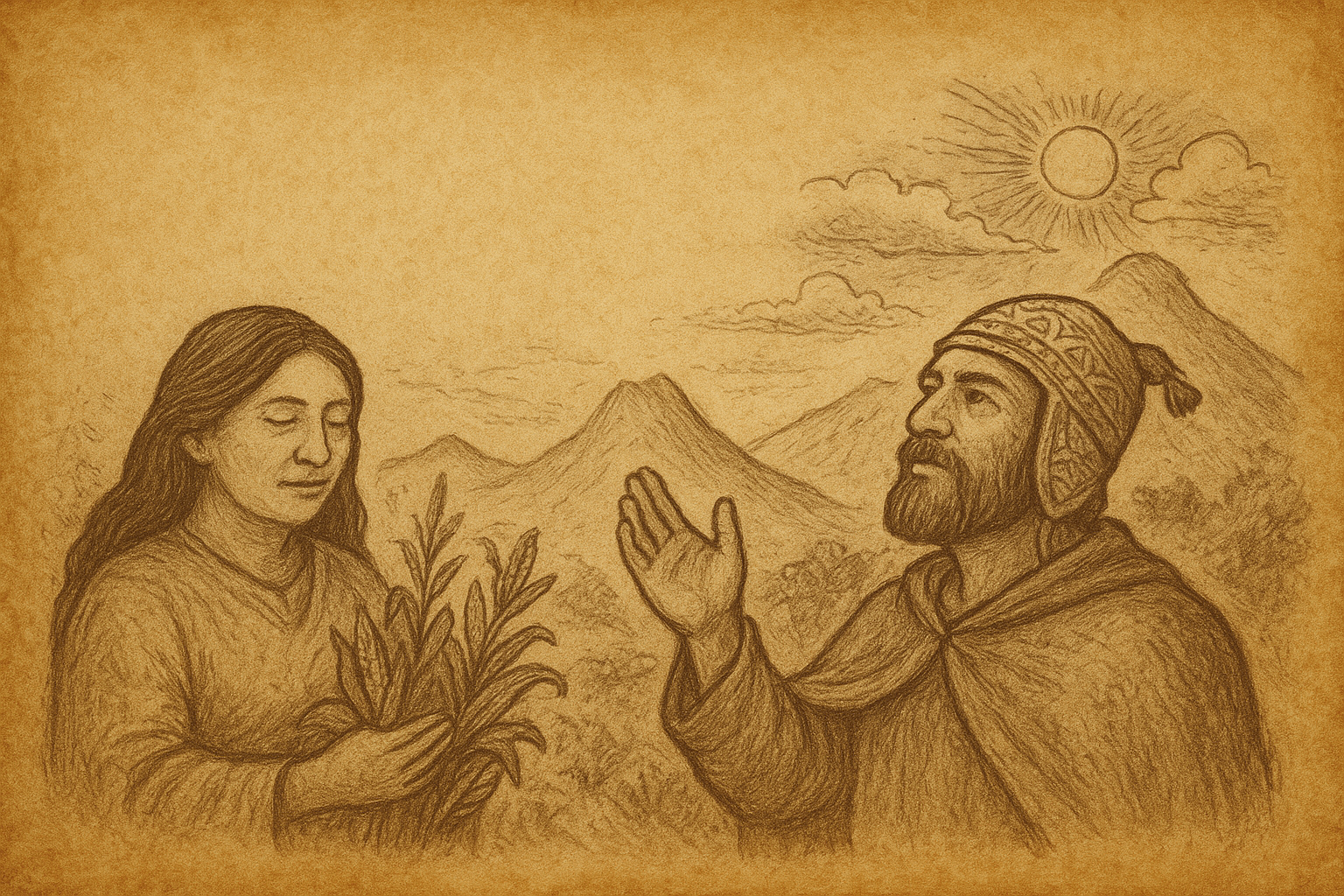
In the early days of the Andes, when the world was still learning its rhythms and the mountains were finding their voices, the land existed in perfect balance. This harmony was not accidental, nor was it simply the natural order of things. It was maintained, carefully and lovingly, by two great powers who stood as the foundations of all existence Pachamama, the Mother Earth, and Pachatata, the Father Sky.
Pachamama was everything beneath and upon the ground. She was the rich dark soil that cradled seeds and coaxed them into life. She was the mountains themselves, those ancient stone giants whose peaks scraped the heavens, whose slopes cradled valleys and terraced fields. She was the force that made corn push through the earth each spring, that filled potato plants with their hidden treasures, that caused quinoa to bow its seed-heavy heads in acknowledgment of another successful growing season. Her body was the earth itself, and everything that lived upon it or within it was her child, her responsibility, her gift to the world.
Click to read all South American Folktales — timeless stories from the Andes to the Amazon.
Pachatata was her partner and complement, everything above. He was the vast dome of sky that arched over the mountains like a protective hand. He held dominion over the wind that swept through the high passes, carrying seeds and rain clouds, whispers and warnings. He commanded the peaks, those places where earth and sky met and merged, where the boundary between Pachamama’s realm and his own became wonderfully unclear. The heavens were his domain the sun that warmed the fields, the stars that guided travelers, the moon that measured time and tide.
Together, Pachamama and Pachatata maintained the world’s harmony. She provided the foundation, the substance, the nurturing ground. He provided the space to grow, the rain to nourish, the light to ripen. Neither could exist without the other. The earth without sky would be a dark, lifeless stone. The sky without earth would be an empty void with nothing to embrace, no purpose to fulfill. Their partnership was the very definition of balance, the model for all relationships, the pattern that kept the universe spinning in its proper course.
The people who lived in these mountains the Quechua and their ancestors, the Aymara and countless others whose names have been lost to time understood this balance instinctively. They knew they were not separate from Pachamama and Pachatata but part of the great web of relationships that connected all things. When they planted their fields, they spoke to Pachamama, asking permission, offering thanks. When storms gathered, they acknowledged Pachatata’s power, respected his moods, sought his blessing.
For many generations, this understanding held. The people took from the earth, yes ,they had to eat, to clothe themselves, to build shelter but they took with awareness and gratitude. They performed rituals of thanks at planting time and harvest. They left offerings at sacred places. They spoke to the mountains as one speaks to grandparents, with reverence and affection. And in return, the land provided abundantly. The rains came when needed. The soil remained rich. The crops flourished. The balance held.
But memory is a fragile thing, especially across generations. As time passed and prosperity became familiar, some people began to forget the old ways. The young ones, who had never known real scarcity, started to take abundance for granted. They saw the fields yielding their crops year after year and thought this was simply how things were, not understanding that it was how things were maintained through careful reciprocity.
They grew careless. They took from Pachamama without offering thanks. They harvested without acknowledgment, planted without permission, altered the landscape without asking if such changes were acceptable. They treated the earth as though it were merely dirt, as though the mountains were simply piles of stone, as though the soil existed solely for their convenience and benefit.
The disrespect spread like a disease through the villages. More and more people abandoned the old rituals, dismissing them as superstitions their grandparents clung to. “We understand how farming works now,” they said with the arrogance of those who know a little and mistake it for knowing everything. “We don’t need to talk to the earth. We don’t need to leave offerings for the sky. These are just stories, just old customs with no real meaning.”
But Pachamama felt every act of disrespect like a wound. Each time someone took without asking, planted without blessing, harvested without gratitude, she felt it. The earth, which had always been generous, began to close herself off, to withdraw the freely given gifts. And Pachatata, seeing his partner wounded and disrespected, felt his own anger rising like storm clouds gathering over the peaks.
The soil began to feel different under the farmers’ hands , harder, less responsive, as though it had lost interest in cooperating. Seeds that should have sprouted remained dormant. Plants that did grow seemed weak, their leaves pale, their fruits small and sparse. The rich dark earth that had always smelled of life and promise began to smell of nothing at all, becoming mere dirt, inert and unresponsive.
The hills, which had always stood as silent guardians of the valleys, began to weep. Springs that had flowed for countless generations slowed to trickles, then stopped altogether. Landslides occurred where the ground had always been stable. It was as though Pachamama herself was crying, her tears taking the form of stone and mud sliding down mountainsides, her sorrow manifesting as the land literally coming apart.
And Pachatata’s thunder rolled across the highlands like the voice of an angry father who has been patient too long. The sky darkened with storms that brought no nourishing rain, only destructive wind and hail that flattened whatever crops had managed to struggle into existence. The sun, which had always blessed the fields with warmth and light, now beat down mercilessly, baking the earth into cracked clay. The balance had been broken, and the consequences were devastating.
The fields withered. The harvests failed. Hunger crept into villages that had known abundance. Children cried with empty bellies. The elders grew thin and weak. And finally, when the suffering had become undeniable, when even the most skeptical could no longer dismiss what was happening, the people began to remember.
They gathered the young and old, the believers and the doubters and the elders spoke. “We have broken the covenant,” they said. “We have taken Pachamama’s gifts without gratitude. We have ignored Pachatata’s presence. We have forgotten that we are not masters of this land but part of it, dependent on the goodwill of powers far greater than ourselves. We must restore the balance.”
And so the people revived the ancient ritual known as “pago a la tierra” the payment to the earth. They understood now that this was not superstition or meaningless tradition but a necessary acknowledgment of relationship, an essential act of reciprocity in the great web of mutual dependence that connected all things.
They climbed to the high mountain plateaus where earth and sky met, where Pachamama and Pachatata’s realms intermingled. There, in those sacred places where the wind blew clean and strong and the view stretched forever, they made their offerings. They brought coca leaves, those plants sacred throughout the Andes, arranging them carefully in patterns of respect and supplication. They brought llama fleece, soft and warm, a gift from the animals that were themselves gifts from Pachamama. They brought corn golden, white, red, purple representing the abundance they had taken for granted and now desperately missed.
But the offerings were not the most important part. What mattered was the spirit in which they were given. The people came with genuine humility now, with hearts that had been broken open by hardship and remade into something capable of true gratitude. They spoke to Pachamama, asking forgiveness, promising to remember, vowing to teach their children what they themselves had forgotten. They acknowledged Pachatata, apologizing for their arrogance, recognizing his power and their dependence on his blessing.
They understood, finally and completely, that the land and sky were partners in the life-sustaining work of the world, and that humans were part of that network of respect rather than masters of it. They were not above the system but within it, dependent on it, responsible to it.
Slowly, gradually, as the seasons turned and the people maintained their renewed commitment, the balance began to restore itself. Pachamama, feeling genuine respect and gratitude once more, opened herself to the people again. The soil softened and became responsive. Seeds sprouted with renewed vigor. Springs began flowing again, trickling at first, then running clear and strong.
Pachatata’s anger subsided like storms passing over the mountains. The rains came again, gentle and nourishing rather than destructive. The sun warmed rather than scorched. The wind carried blessings instead of warnings.
The harvests returned. Not immediately, not all at once, but steadily, reliably, as the covenant was honored once more. And the people, having learned their lesson at such cost, maintained the pago a la tierra. It became not just an annual ritual but a constant awareness, a way of living that acknowledged every day that they walked upon the body of Pachamama, lived beneath the embrace of Pachatata, and existed only through the continued grace and balance of these great powers.
From that time forward, the people of the Andes taught their children carefully: “We are not separate from the earth and sky. We are their children, and like all children, we owe our parents respect, gratitude, and acknowledgment. The land is not ours to use as we please. We belong to it, not it to us. And the balance the sacred balance between Pachamama and Pachatata, between earth and sky, between taking and giving this balance is the foundation of all life. Break it at your peril. Maintain it with devotion, and it will sustain you through all the seasons of your life.”
Explore myths and legends from Brazil, Peru, and Argentina rooted in spirit and survival.
The Moral Lesson
The legend of Pachamama and Pachatata teaches that humans are not masters of nature but participants in an interconnected system of mutual respect and reciprocity. It emphasizes that abundance is not an entitlement but a gift that must be acknowledged with genuine gratitude and offerings. The tale shows that taking without giving, consuming without thanks, and treating the natural world as mere resources rather than sacred partners leads inevitably to imbalance and suffering. Most profoundly, it reminds us that the relationship between earth and sky, between the forces that sustain life, is a partnership and humans must honor that partnership through ritual, respect, and the constant awareness that we depend utterly on powers greater than ourselves.
Knowledge Check
Q1: Who are Pachamama and Pachatata in Andean cosmology and what do they represent? A: Pachamama is Mother Earth, embodying everything beneath and upon the ground, the soil, mountains, fields, and crops. Pachatata is Father Sky, representing everything above, the heavens, wind, peaks where earth meets sky, and celestial elements. Together they maintain the world’s harmony through their complementary partnership, with neither able to exist meaningfully without the other.
Q2: What caused the balance between Pachamama and Pachatata to break in this Peruvian folktale? A: The balance broke when people grew careless and forgot the old ways of respect and reciprocity. They began taking from the earth without offering thanks, harvesting without acknowledgment, and treating Pachamama as mere dirt rather than a sacred being. They dismissed traditional rituals as superstition, showing arrogance and disrespect that wounded both Earth Mother and Sky Father.
Q3: How did Pachamama and Pachatata respond to human disrespect? A: Pachamama withdrew her generosity the soil became hard and unresponsive, seeds wouldn’t sprout, crops grew weak, springs dried up, and hills wept through landslides. Pachatata expressed his anger through destructive storms with no nourishing rain, punishing sun that baked the earth into cracked clay, and thunder that rolled across the highlands. Together, their response brought failed harvests and hunger.
Q4: What is “pago a la tierra” and why is it significant? A: “Pago a la tierra” means “payment to the earth” a ritual offering made on mountain plateaus where earth and sky meet. People bring coca leaves, llama fleece, and corn as gifts, but more importantly, they offer genuine gratitude, humility, and acknowledgment of their dependence on Pachamama and Pachatata. This ritual represents the essential reciprocity required to maintain balance between humans and the natural/spiritual world.
Q5: What offerings do Andean people bring during the pago a la tierra ritual? A: During pago a la tierra, people bring coca leaves (sacred plants of the Andes), llama fleece (soft, warm gifts from animals that are themselves Pachamama’s gifts), and corn in various colors golden, white, red, purple representing the abundance they receive from the earth. These offerings are arranged carefully in patterns of respect on high mountain plateaus where Pachamama and Pachatata’s realms intermingle.
Q6: What fundamental relationship does this Andean folktale teach about humans and nature? A: The folktale teaches that humans are not masters or owners of nature but participants within an interconnected system requiring mutual respect and reciprocity. People belong to the land rather than the land belonging to them. The partnership between Pachamama and Pachatata models the balance all relationships should maintain, and humans must honor this through constant awareness, gratitude, and ritual acknowledgment that they depend utterly on powers greater than themselves for survival and prosperity.
Source: Adapted from Andean oral traditions and cosmological beliefs as referenced in “Calendario 2025 Perú” and traditional Quechua/Aymara teachings.
Cultural Origin: Quechua, Aymara, and other indigenous peoples of the Andean highlands, primarily Peru, Bolivia, and Ecuador