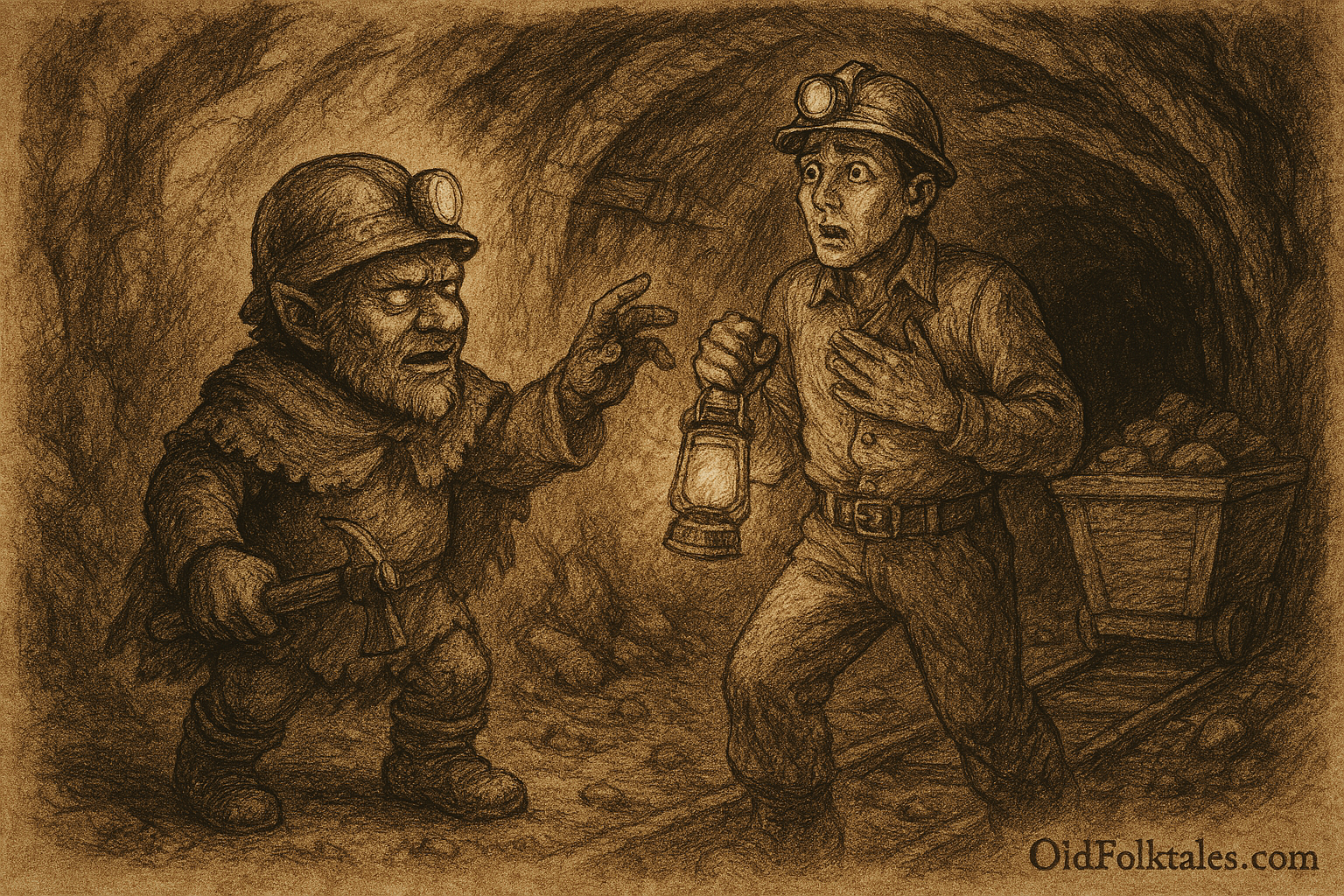
Deep beneath the towering peaks of the Peruvian Andes, where the sun’s light has never reached and the air grows thick with the breath of the earth itself, there exists a world known only to those brave or desperate enough to seek their fortune in the darkness. It is here, in the labyrinth of tunnels that snake through rock and ore, that the Muki makes his home.
The mining town of Cerro de Pasco clung to the mountainside like a stubborn bird’s nest, its wooden houses and stone buildings huddled together against the perpetual cold. For generations, families had sent their men into the belly of the mountain, extracting silver and tin and copper from veins that glittered in the lamplight like frozen rivers. The work was dangerous, backbreaking, and often deadly. Cave-ins, toxic gases, and exhaustion claimed lives regularly, and every miner knew that each descent into the darkness might be his last.
Click to read all South American Folktales — timeless stories from the Andes to the Amazon.
But there was another danger in those mines, one that the old-timers spoke of in hushed voices after the day’s work was done and the chicha had loosened their tongues. They spoke of the Muki, the goblin of the depths, a creature neither fully human nor entirely spirit, who had dwelt in the underground world long before the first Quechua pickaxe ever struck stone.
The Muki was said to be no taller than a child of five years, but what he lacked in stature he possessed in power and cunning. His appearance varied depending on who told the tale. Some miners swore he had skin the color of rock itself, gray and rough as granite. Others claimed his face was red as the hottest forge fire, with eyes that glowed like coals in the darkness. His hands were gnarled and strong, ending in fingers that could scratch through solid stone. He wore the clothes of a miner, they said, a tattered poncho and a helmet that sat crooked on his oversized head, and from his belt hung tools no human hand had ever crafted.
The Muki was the true master of the underground realm. He knew every tunnel, every vein of ore, every pocket of gas that could explode with a single spark. He could make a poor miner rich beyond imagination or condemn a greedy one to wander lost in the darkness until his lamp died and the mountain claimed him forever.
Among the miners of Cerro de Pasco was a man named Gregorio, who had worked the tunnels for fifteen years. He was neither the strongest nor the most skilled, but he was respectful and careful. Every morning before entering the mine, Gregorio would pause at the mouth of the shaft and leave his offering: three perfect coca leaves, a splash of chicha from his flask, and a cigarette placed carefully on a flat stone. He would whisper a prayer to the Muki, asking for safe passage and perhaps, if the spirit was generous, guidance to a rich vein of ore.
“Tío Muki,” Gregorio would say, using the respectful title of uncle that showed proper deference. “I enter your home with humility. Protect me from the falling rock and the bad air. If you guide me to silver, I will share my good fortune with offerings worthy of your power.”
For years, this arrangement had served Gregorio well. He found enough ore to feed his family, and he never suffered the terrible accidents that befell other miners. Sometimes, in the deepest tunnels where he worked alone, he would hear the sound of whistling echoing from passages where no other human ventured, or catch a glimpse of lamplight bobbing in the distance when he knew he was the only one in that section. These signs told him the Muki was near, watching over him.
One day, a young miner named Carlos joined the crew. He was strong and ambitious, having come from a coastal city where he’d heard tales of mountain fortunes waiting to be claimed. Carlos listened to the stories about the Muki with barely concealed contempt, his lip curling in a sneer.
“Superstitious nonsense,” he declared loudly in the barracks where the miners rested between shifts. “There are no goblins in the mines. Only rock and ore and men foolish enough to leave their cigarettes and good chicha for the rats.”
Gregorio and the older miners exchanged worried glances but said nothing. The young learned best from their own mistakes, and some lessons could not be taught with words.
Carlos descended into the mines without offering, without prayer, without respect. At first, luck seemed to favor him. He found a promising vein of silver in an abandoned tunnel and worked it eagerly, filling his cart with ore that glittered in his lamplight. As the days passed, his findings grew richer. The vein seemed inexhaustible, and Carlos began to boast that his success proved skill mattered more than superstition.
But Gregorio noticed something troubling. The tunnel where Carlos worked was one that old-timers avoided, a place where three men had died in a collapse decades ago. And sometimes, when Carlos emerged at the end of his shift, his eyes had a strange, feverish gleam, and he would mutter to himself in words that made no sense.
One evening, as Carlos prepared to descend for a night shift, a figure appeared at the mouth of his tunnel. It was small, no higher than Carlos’s waist, with skin that seemed to absorb the light rather than reflect it. The creature wore a miner’s helmet and poncho, and its eyes blazed with an inner fire that cast no illumination.
“You have taken much from my home,” the Muki said, his voice like rocks grinding together deep underground. “But you have given nothing in return. You mock what you do not understand. You disrespect the ancient laws of the deep places.”
Carlos, frozen with sudden terror, could only stare as the creature approached. The Muki’s face split into a grin that showed too many teeth, each one pointed like a shard of broken stone.
“I have been generous with you, leading you to the richest veins, helping you fill your pockets with silver. I did this as a test, to see if wealth would teach you gratitude. But you have learned nothing. You believe yourself clever, when really you are just a thief in another’s house.”
The Muki reached out one gnarled hand, and though he did not touch Carlos, the young miner felt an invisible force grip his heart like ice.
“Make your offering now,” the Muki commanded. “Coca, chicha, tobacco, and a promise that you will show proper respect. Do this, and you may continue to work in my domain. Refuse, and you will learn why wise men fear the dark places of the earth.”
Carlos, his courage shattered, fumbled for his pack. His hands shook as he pulled out coca leaves, his flask of chicha, and his last cigarette. He placed them on the ground before the Muki, and in a trembling voice, he spoke the words he should have spoken from the beginning.
“Tío Muki, forgive my disrespect. I am a fool who did not understand. I will honor you with offerings and treat your home with the reverence it deserves. Please, allow me to work here safely.”
The Muki studied him for a long moment, those coal-bright eyes seeming to look through flesh and bone to the soul beneath. Finally, the creature nodded slowly.
“I accept your offering and your promise. But remember this: I forget nothing. Break your word, and there are tunnels so deep and so dark that not even your bones will ever be found.”
With that, the Muki vanished, simply ceased to be, as if he had never been there at all. But Carlos knew better. He had seen the guardian of the depths, the master of the underground realm, and he understood now that there were powers in this world far older and stranger than anything taught in the cities of the coast.
From that day forward, Carlos made his offerings faithfully, and he told his story to any new miner who came with disrespect in his heart. The Muki, he would say, is real. The Muki is watching. And the Muki always collects his due, one way or another.
In the mines of the Andes, this truth remains: the mountain provides for those who honor it, and the Muki guards the treasures of the deep. Wise miners make their offerings and speak their prayers. Foolish ones learn their lessons in darkness and terror. And some, those who truly break their promises or show unforgivable disrespect, are never seen again, lost forever in the winding tunnels where the Muki rules supreme.
Click to read all Andean Highland Folktales — echoing from the mountain peaks of Peru, Bolivia, and Ecuador.
The Moral of the Story
This legend teaches us that respect for the unseen forces of nature and tradition is not mere superstition but wisdom earned through generations of experience. When we enter spaces that belong to powers beyond our understanding, whether physical places like mines or metaphorical realms of ancient knowledge, we must approach with humility and proper acknowledgment. The Muki represents the principle that taking from the earth or any source of sustenance requires reciprocity and gratitude. Those who show respect and make appropriate offerings receive protection and guidance, while those who mock traditions and take without giving face consequences. Promises made to powers greater than ourselves must be kept, for broken faith brings retribution. True wisdom lies in recognizing that our modern knowledge does not diminish the reality of ancient truths, and that dismissing what we do not understand is the height of dangerous arrogance.
Knowledge Check
Q1: Who is the Muki in Quechua mining culture, and what is his role?
The Muki is a supernatural dwarf-like creature who inhabits the underground tunnels and mines of the Andes. He is the guardian spirit and true master of the subterranean realm, possessing intimate knowledge of every tunnel, ore vein, and danger. His role is dual: he can guide respectful miners to rich deposits and protect them from accidents, or he can punish those who show disrespect or break promises by causing accidents, leading them astray, or making them disappear forever in the depths.
Q2: What offerings do miners traditionally give to the Muki, and why?
Miners traditionally offer coca leaves, chicha (corn beer), and cigarettes or tobacco to the Muki. These offerings represent respect and reciprocity, acknowledging that miners are guests in the Muki’s domain and must give something in exchange for the wealth they extract. The practice reflects the Andean principle of ayni, or reciprocal exchange, where taking from the earth requires giving something back. Without these offerings, miners risk the Muki’s anger and the dangers that come with it.
Q3: How does the Muki’s appearance vary, and what does this signify?
The Muki’s appearance varies by region and telling: some describe him with gray, rock-like skin, others with red skin and glowing eyes like hot coals. He is always dwarf-sized, wears miner’s clothing, and carries supernatural tools. This variation reflects how different mining communities have encountered and interpreted the spirit according to their own experiences, but the core characteristics remain consistent, showing that the Muki is a widespread and deeply rooted figure in Andean mining culture.
Q4: What does Carlos’s story teach about the consequences of disrespecting traditional beliefs?
Carlos’s experience demonstrates that dismissing traditional beliefs as mere superstition can have serious consequences. His initial contempt for the Muki stories led him into danger, and only his terrified submission and sincere offerings saved him from a worse fate. The story teaches that indigenous knowledge and spiritual practices often contain practical wisdom about surviving in dangerous environments, and that respecting these traditions, even if one doesn’t fully understand them, is essential for safety and success.
Q5: Why is the Muki referred to as “Tío” (Uncle), and what does this reveal about miner-spirit relationships?
Calling the Muki “Tío” is a term of respect and kinship that acknowledges the spirit’s power while establishing a relationship of mutual obligation. In Andean culture, family titles given to non-relatives indicate respect and create bonds of reciprocal responsibility. By addressing the Muki as uncle, miners position themselves as younger family members who deserve protection in exchange for proper deference and offerings, transforming a potentially dangerous entity into a powerful ally through culturally appropriate social framing.
Q6: How does the Muki legend reflect the real dangers of mining in the Andes?
The Muki legend embodies the very real and constant dangers miners face: cave-ins (the Muki’s power over falling rock), toxic gases (bad air he can protect against or expose miners to), getting lost in complex tunnel systems, and the psychological stress of working in darkness and isolation. By personifying these dangers as a supernatural being who can be appeased through proper behavior, the legend provides both a psychological framework for managing fear and a cultural mechanism for enforcing safety practices and mutual respect among miners.
Source: Adapted from traditional Quechua oral narratives from Andean mining communities, as documented in ethnographic research of Peruvian mining folklore.
Cultural Origin: Quechua-speaking mining communities, Andean highlands of Peru (especially Cerro de Pasco and other historic mining regions)