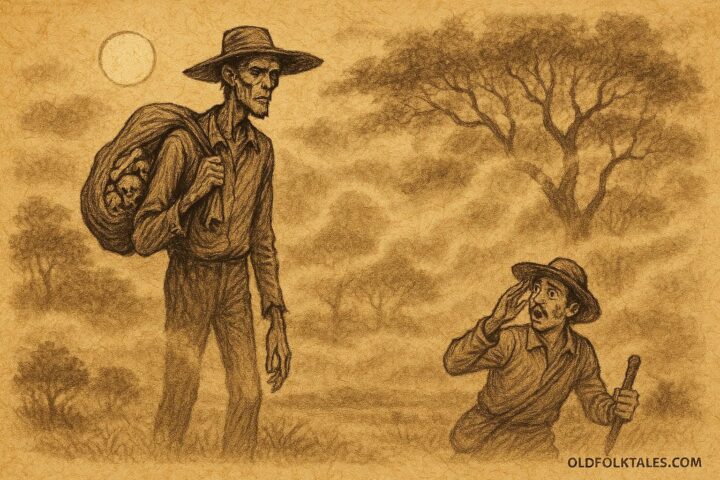
Near Tefé, on the muddy banks of the Amazon River where the jungle pressed close and the water ran dark with secrets, there lived a man consumed by his passion for hunting. Day after day, he ventured into the green cathedral of the forest, his rifle slung over his shoulder, returning each evening with tapir, capybara, or wild pigs to feed his family. Hunting was not merely his livelihood but his obsession, an unquenchable thirst that left him restless even on days of rest.
One Sunday morning, as church bells echoed faintly through the humid air and neighbors dressed in their finest clothes, the hunter announced to his wife, “I’m going to that place upriver where the hunting is good. I know there are many animals there.”
His wife, stirring a pot of manioc flour over the fire, looked up with worry creasing her brow. “Husband, please wait until tomorrow. It’s not good to hunt on Sundays. This is the Lord’s Day, a day of rest. Even the forest deserves peace.”
Click to read all South American Folktales — timeless stories from the Andes to the Amazon.
But the hunter’s mind was already in the jungle, imagining the weight of game across his shoulders. He grabbed his rifle from its place on the wall and said dismissively, “No domingo também se come. One must also eat on Sundays.” And with that, he walked out the door, leaving his wife shaking her head with a heavy heart.
On his way to the forest trail, the hunter stopped at his neighbor’s house and knocked loudly. “Come with me! The hunting will be excellent today,” he called out eagerly.
His neighbor, Don Luis, appeared at the doorway, still in his church clothes. “My friend, I cannot. It’s Sunday. We should be at rest, not disturbing the creatures of the forest on the Lord’s day.”
The hunter laughed and clapped him on the shoulder. “Don’t be so serious! No domingo também se come. One must also eat on Sundays. Come, just for a few hours.”
Against his better judgment, swayed by his friend’s persistence and the promise of fresh meat, Don Luis changed his clothes and took up his machete. The two men crossed a narrow stream where caimans sunned themselves on the banks, then pushed deeper into the forest where ancient trees rose like columns supporting the sky. Vines hung thick as ropes, and the air buzzed with insects and bird calls.
But something was wrong. The forest felt empty, as though holding its breath. They walked for hours without seeing so much as a monkey or an agouti. No tracks marked the muddy trails, no rustling betrayed hidden animals. It was as if every living creature had fled from some unseen danger.
“This is strange,” Don Luis muttered, wiping sweat from his face. “I’ve never seen the forest so silent.”
As afternoon shadows lengthened and the light turned golden green through the canopy, a sound split the silence. A scream, terrible and inhuman, echoed through the trees, followed by heavy footsteps that shook the ground. Crash! Crash! Crash! Something enormous was approaching.
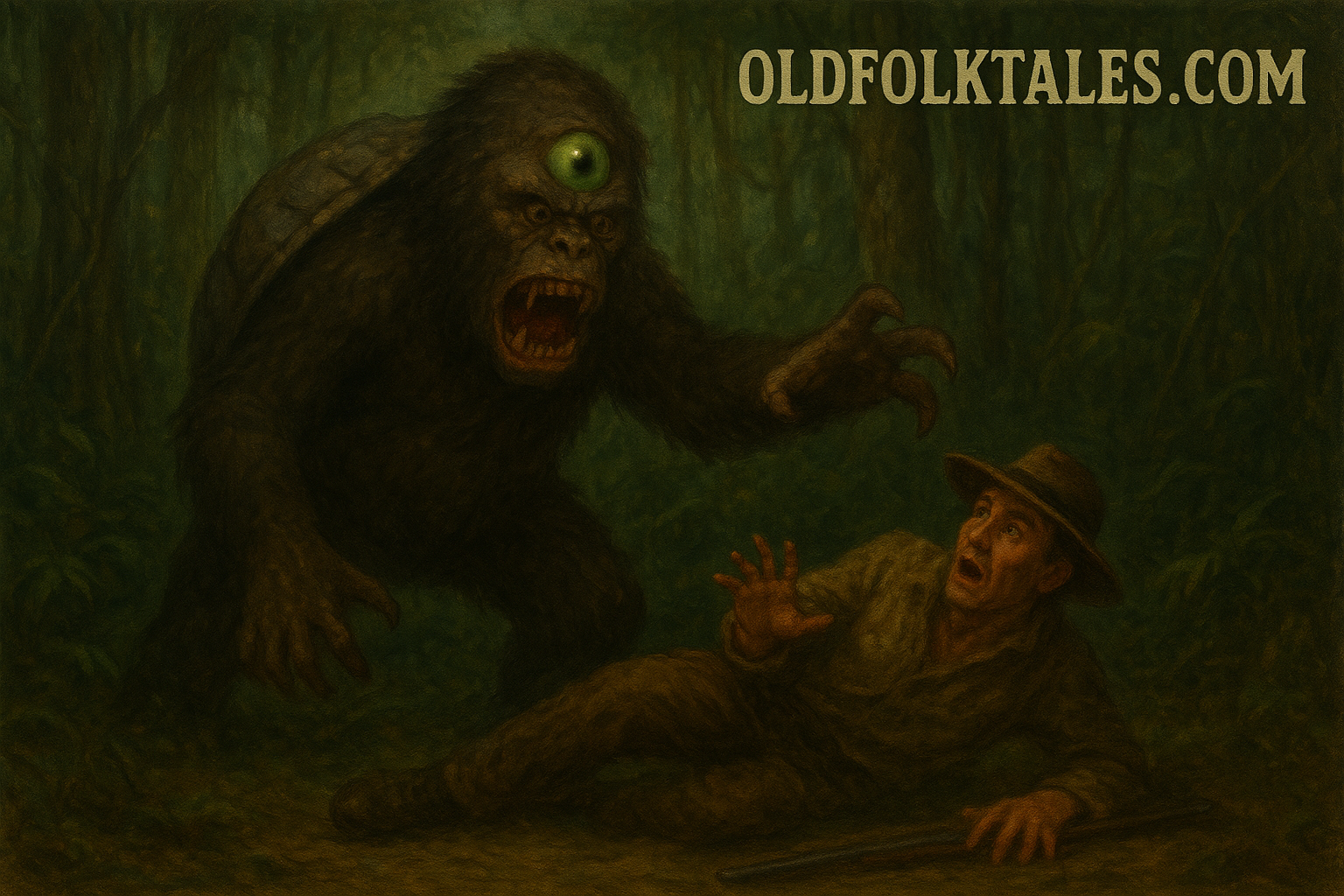
At first, they thought it might be a large man, perhaps another hunter. But as the creature emerged from the undergrowth, both men froze in pure terror. Before them stood a monstrous being unlike anything in God’s natural creation. It was covered in coarse black hair like an ape, but its back bore a thick turtle’s shell that gleamed in the dappled light. Most horrifying of all was its face: where two eyes should have been, there was only one enormous green eye in the center of its forehead, glowing with malevolent intelligence.
The creature was the Mapinguari, guardian of the forest, protector of animals, punisher of those who break sacred laws.
The hunter, though terrified, raised his rifle with shaking hands and fired. The shot rang out, birds screamed and fled, but the bullet bounced harmlessly off the creature’s shell. He fired again and again, the reports echoing through the trees, but each bullet ricocheted away as if striking stone.
The Mapinguari advanced with terrible purpose. With one swing of its massive arm, it grabbed the hunter and threw him to the ground like a rag doll. Don Luis, thinking only of survival, scrambled up the nearest tree, clinging to the trunk as his heart hammered in his chest.
From his perch, he watched in unspeakable horror as the monster tore his friend apart. The Mapinguari gnawed on the hunter’s arm, and as it chewed, it spoke in a voice that was almost human: “No domingo também se come. One must also eat on Sundays.”
Then, biting into the man’s leg, it repeated mockingly, “No domingo também se come. One must also eat on Sundays.”
When the creature had finished its gruesome meal, it yawned widely, showing bloodstained teeth, and lumbered back into the forest depths. Don Luis waited until the footsteps faded completely before descending from the tree. His legs nearly gave way beneath him as he stumbled toward town, running and falling, driven by terror and grief.
When he burst into the town square, gasping and covered in scratches, people rushed to him. Through tears and trembling, he told the terrible story. The townsfolk gathered, some crossing themselves, others arguing about what kind of creature could have committed such an atrocity.
“If it has only one green eye and feet as large as a pestle,” said the dead hunter’s cousin slowly, “then it must be the Mapinguari.”
“It’s a blessing it didn’t eat you, Don Luis,” someone added. “Perhaps because you carried no rifle, only a machete.”
An old man who knew the ancient stories spoke up: “The hunter could have saved himself if he had aimed for the creature’s belly button. That’s where its heart lies. That’s its only weakness.”
Outrage swept through the town. A search party formed immediately, men gathering rifles, machetes, and courage. They marched back to the forest, following the trail of broken branches and bloodstains.
They didn’t have to search long. The Mapinguari had returned to its kill site, licking and gnawing the remaining bones. When it saw the group of armed men, it roared with fury and charged. But these men knew its secret. They aimed carefully at its belly, where the belly button marked the location of its heart, and fired.
The bullets struck true. The Mapinguari shrieked with rage and pain, then turned and fled into the dense jungle, crashing through the undergrowth until its cries faded to nothing.
The men gathered what remained of the hunter’s bones, placing them reverently in a sack. His wife received them with a keening wail that echoed through the town. She placed the bones in a small wooden coffin, and for two nights, she and her children kept vigil, mourning the man who had refused to heed her warning.
“If only he had listened,” the widow sobbed as they buried the coffin in the cemetery. “If only he had respected the Lord’s day and left the forest in peace.”
They say she later took her children upriver to Manaus, where her family lived, leaving behind the town and the forest that had claimed her husband’s life.
The Moral of the Story
This powerful tale teaches us that sacred traditions and rest days exist for important reasons, often protecting us from dangers we cannot see. The hunter’s arrogance and refusal to respect the Sabbath led to his destruction, while his neighbor who hesitated and carried no rifle was spared. The story also illustrates that nature has its guardians and boundaries that demand respect. The Mapinguari serves as the forest’s protector, punishing those who exploit without reverence. Finally, it reminds us that heeding the wisdom of our elders and loved ones can save us from disaster, as the hunter’s wife knew the danger but was ignored. Pride and greed often blind us to warnings that could preserve our lives.
Knowledge Check
Q1: What is the Mapinguari in Brazilian folklore and what does it protect?
A1: The Mapinguari is a terrifying supernatural creature from the Brazilian Amazon with one green eye in the center of its forehead, black ape-like hair, and a turtle shell on its back. It serves as a guardian and protector of forest animals, punishing hunters who violate sacred laws or show disrespect to nature, particularly those who hunt on Sundays.
Q2: Why is the phrase “No domingo também se come” significant in this folktale?
A2: The phrase “No domingo também se come” (One must also eat on Sundays) represents the hunter’s justification for breaking the Sabbath rest. The Mapinguari mockingly repeats this phrase while devouring the hunter, turning his own words against him and emphasizing that his excuse led directly to his punishment. It becomes a chilling reminder that justifying wrongdoing doesn’t make it right.
Q3: What is the Mapinguari’s only weakness and why is this detail important?
A3: The Mapinguari’s only vulnerable spot is its belly button, where its heart is located. This detail is crucial because it shows that even the most powerful supernatural guardians have weaknesses, and that knowledge and proper aim (representing wisdom and precision) can overcome brute force. The hunter failed because he shot at the shell instead of seeking the vulnerable point.
Q4: How does this Brazilian legend reflect Christian influence in the Amazon?
A4: The story reflects the integration of Christian beliefs about Sabbath observance into indigenous Amazonian folklore. The punishment for hunting on Sunday shows how Catholic traditions merged with native beliefs about forest spirits and animal protectors, creating a hybrid folklore that reinforces both religious rest day practices and respect for nature’s guardians.
Q5: What lesson does the survival of Don Luis teach in this tale?
A5: Don Luis survives because he was reluctant to hunt on Sunday, carried no rifle (showing less intent to kill), and was not the instigator of the forbidden hunt. This teaches that those who are coerced into wrongdoing or who show hesitation and respect may receive mercy, while those who actively defy sacred rules face full consequences. Intention and respect matter in both divine and natural justice.
Q6: How is the Mapinguari similar to other forest guardian creatures in South American folklore?
A6: The Mapinguari shares characteristics with other Amazonian protector spirits like the Curupira, who has backward-facing feet to confuse hunters. Both creatures guard the forest and its animals from human exploitation. The tale notes that in some regions, the Mapinguari is called Cape-lobo and is described with additional features like a foul smell, a mouth on its stomach, and backward feet, showing regional variations in how communities envision their forest guardians.
Source: Adapted from Brazilian Amazonian oral traditions as documented in Latin American folklore collections.
Cultural Origin: South American, Amazon folktale