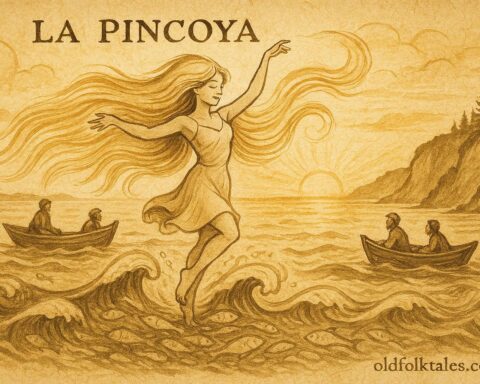
In the golden warmth of Andalusia, where the sun paints the hills and the sea hums ancient songs, there once lived a humble fisherman and his wife. Their days were spent casting nets into the blue waters, praying for a good catch, but what they wanted most was a child to call their own.
Every evening, the fisherman’s wife would light a candle by the window and whisper her wish to the Virgin, while her husband prayed among the waves for a blessing. For years, the sea gave only silence.
Then, one radiant morning, as dawn broke over the waves, the fisherman felt his net grow heavy. He hauled it in and gasped, tangled in the mesh was a golden fish, gleaming like sunlight made flesh.
Before he could speak, the fish turned its shimmering head and said in a voice soft yet commanding:
“Good fisherman, do not kill me. Bury my bones by the seashore, and your heart’s wish shall come true.”
Startled, the man crossed himself but obeyed. He released the fish, carried its remains to shore, and buried them beneath a white stone where the tide kissed the sand.
Days later, the miracle came. His wife gave birth to twin sons, radiant and strong. Upon each boy’s chest glowed the shape of a tiny golden fish, a sign, the village elders said, that heaven itself had touched them.
They named the boys Juan and Pedro, and they grew up brave, kind, and inseparable. When they played by the sea, dolphins seemed to follow them, and fishermen swore the waves shimmered brighter when the brothers passed.
The Brothers’ Oath
Years passed, and as manhood came, so did the call of destiny. One dawn, the brothers kissed their parents goodbye and set off to seek their fortunes. Their mother wept, and their father gave them a blessing.
At a lonely crossroads, they paused beneath an old oak tree. There, they hung a knife on one of its branches, its blade gleaming in the sunlight.
“We will meet again here,” said Juan, “and as long as this blade stays bright, both of us live. If it rusts, one has fallen.”
They embraced, and their paths diverged, Juan heading east toward the king’s lands, Pedro west into the wild.
Juan and the King’s Court
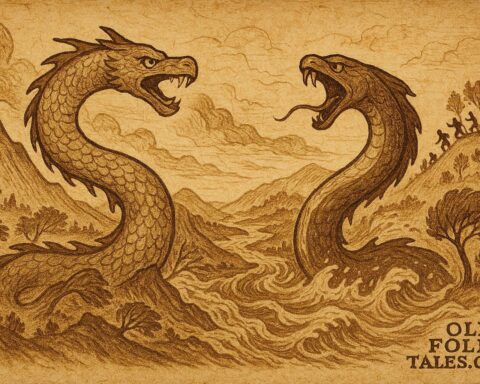
Juan soon reached a distant kingdom plagued by sorrow. A terrible dragon had risen from the mountains, devouring the king’s people and scorching the land. Brave men had tried to slay it, and none returned.
The young man, fearless and faithful, volunteered. Armed with nothing but his sword and courage, he faced the beast as thunder rolled and smoke darkened the sky. The battle raged from dawn to dusk, fire against steel, roar against prayer. When at last the dragon fell, Juan stood battered but triumphant, his fish-mark glowing faintly through the smoke.
The king, overjoyed, offered him gold and his daughter’s hand. Yet envy brewed in the court. Jealous nobles whispered that the stranger was too favored, too blessed. One night, they seized Juan and cast him into the sea.
Far away, the blade at the crossroads dulled, its bright steel turning red with rust.
Pedro’s Journey of Faith
Pedro, waking suddenly from sleep, felt a chill in his heart. Without hesitation, he mounted his horse and rode across forests and plains, following the pull of brotherly love. Days blurred into nights until he reached the distant castle where his spirit told him Juan lay imprisoned.
There, he uncovered the plot, the traitors, the king’s sorrow, and the strange enchantment that kept his brother lost between life and death.
Guided by faith, Pedro sought help from a hermit who lived by the sea. The old man gave him a simple charm and whispered, “Only truth and love stronger than envy can break the spell.”
Pedro rode to the cliffs at dawn, spoke his brother’s name into the wind, and dove into the waters below. The sea opened before him, and from the depths rose Juan, pale but alive. The spell shattered as the brothers clasped hands.
When they returned to the castle, the people rejoiced. The king wept with gratitude, punishing the jealous nobles and honoring the twins. He named them both Los Caballeros del Pez, The Knights of the Fish, for the sacred mark upon their chests was proof of heaven’s favor.
The Legacy of the Brothers
Under their rule, peace returned. Their lands flourished, and songs were sung of the brothers whose courage and faith were as deep as the sea that had blessed their birth. Fishermen still say that when their ships pass beneath a golden sunset, the water sparkles with scales of light, a sign that the Knights of the Fish still watch over Spain’s shores.
Immerse yourself in Latin America’s stories of passion, transformation, and spirit.
Moral Lesson
Faith, gratitude, and loyalty guide the righteous to triumph, while envy and deceit bring only ruin. True brotherhood, built on love and courage, can overcome even the darkest tides of fate.
Knowledge Check
- Who were Los Caballeros del Pez in Spanish folklore?
They were twin brothers, Juan and Pedro, miraculously born from a fisherman’s wish and marked by divine destiny. - What magical sign marked the twins’ birth?
Each bore the shape of a golden fish on his chest, symbolizing heavenly protection. - How did the brothers stay connected while apart?
They hung a knife at a crossroads, its brightness showing both lived, its rust signaling danger. - What major trial did Juan face at the king’s court?
He heroically defeated a dragon but was betrayed by jealous courtiers and cast into the sea. - How did Pedro save his brother from enchantment?
He followed faith and brotherly love to break the spell and restore Juan to life. - What is the moral of “The Knights of the Fish”?
Faith, gratitude, and loyalty bring divine reward, while envy and betrayal lead to ruin.
Source: Adapted from “Los Caballeros del Pez” by Fernán Caballero, Cuentos, Oraciones, Adivinanzas y Refranes Populares (1878).
Cultural Origin: Spain (Andalusian folklore; 19th century, public domain).