Long ago, in the deep frozen forests of Quebec, a group of lumberjacks worked through a bitterly cold winter. They lived far from home, surrounded by endless pines and the silence of snow. Their days were filled with hard labor, cutting trees from dawn to dusk. At night, they sat around the fire in their cabin, drinking and singing to chase away loneliness. But as the New Year approached, their hearts ached for home. They missed their families, the church bells, and the laughter of the village celebrations.
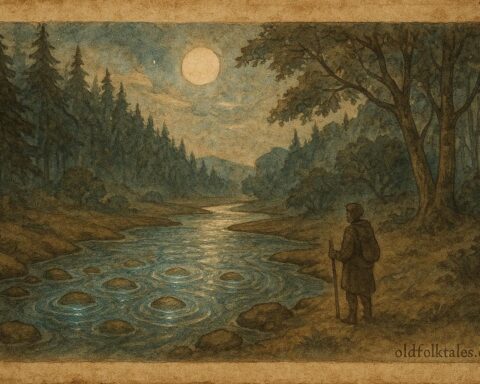
Among them was a young man named Baptiste. He was strong and kindhearted, but sorrow often clouded his eyes. Each night, he would stare out at the glowing moon and think of his wife waiting for him. He longed to hold her again, to dance with her at the New Year’s feast. His companions teased him for his sadness, yet they understood. The forest was a lonely place, and even the strongest men dreamed of home when winter grew long.
On New Year’s Eve, as the men sat together by the fire, the wind began to howl in strange patterns outside. The door suddenly creaked open, though no one had touched it. In the cold air stood a tall man dressed all in black. His eyes glowed like red embers, and his smile was sharp as a blade. The lumberjacks felt their hearts freeze with fear, but they could not look away.
The stranger spoke softly. “You wish to see your families tonight, do you not?”
Journey into the rhythm, wit, and wonder of Caribbean storytelling — from Haiti to Jamaica
Baptiste rose to his feet, his voice trembling. “We do, monsieur, but the snow is too deep and the journey too long. We cannot leave this forest.”
The stranger’s smile widened. “Then fly. I can give you a canoe that will carry you through the sky. You will soar over trees, rivers, and mountains, and by midnight, you will be home.”
The men stared in disbelief. A canoe that could fly seemed impossible. But the stranger gestured to the shadows, and before their eyes appeared a long wooden canoe glowing faintly with a strange light. The men gasped in wonder.
“But how can this be?” one of them whispered.
The stranger’s voice turned low and cold. “You may use this canoe to fly wherever you wish, but there are two rules you must never break. You must not speak the name of God, and you must not touch a church steeple as you pass. If you do, your souls will belong to me forever.”
The cabin fell silent. The men looked at one another, torn between fear and desire. Then Baptiste spoke firmly. “We agree. Let us see our loved ones.”
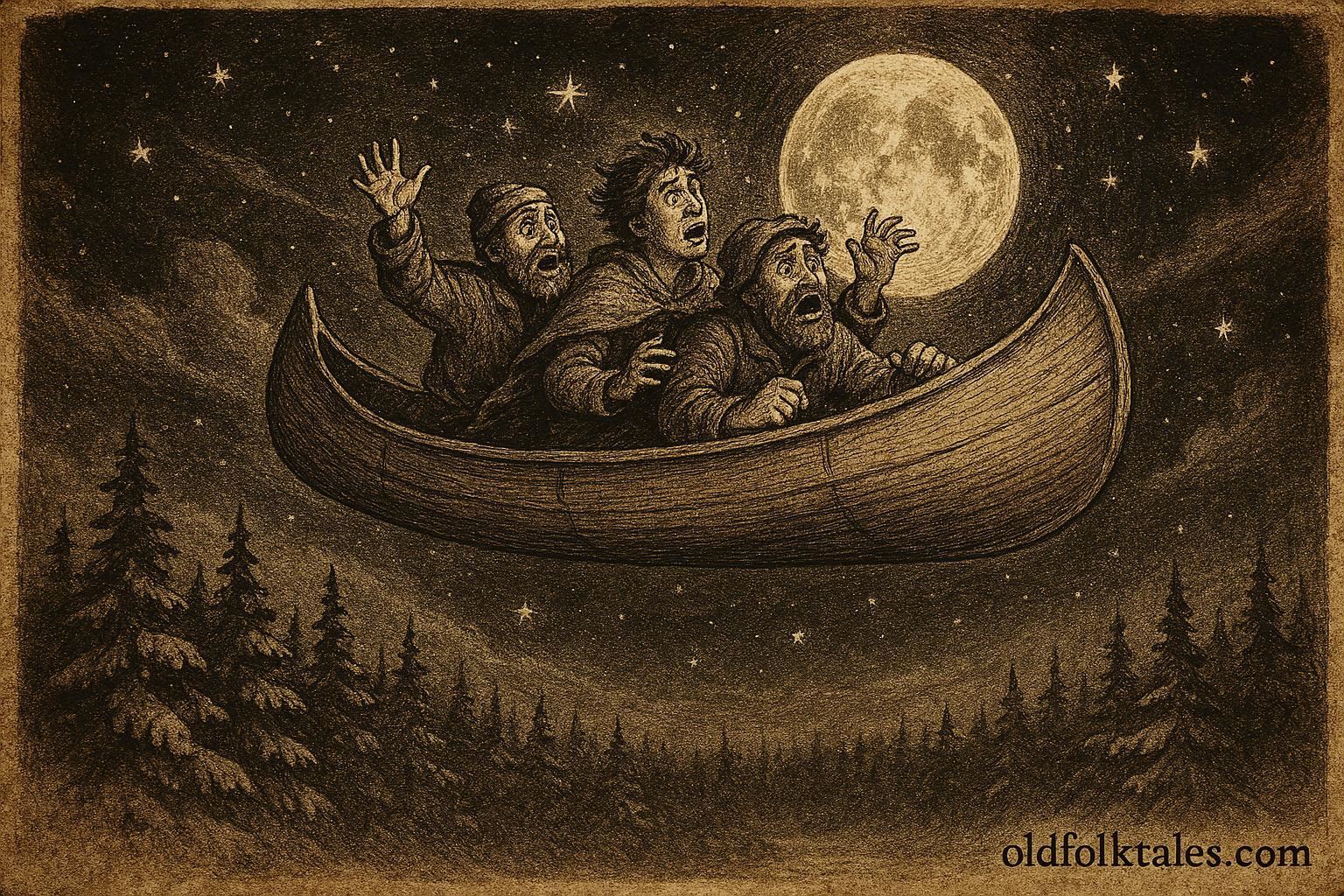
The stranger nodded and stepped back into the shadows. The canoe began to tremble, then lifted gently from the ground. The men shouted in astonishment as it rose higher and higher, until the forest disappeared beneath them.
The night sky stretched vast and bright above. The stars shimmered like ice crystals, and the moon guided their path. They glided over frozen rivers and snow-covered villages. Their laughter filled the air as they sang songs of home. Beneath them, wolves howled and deer fled into the trees, frightened by the sight of the flying canoe.
Before long, they saw the lights of their village glowing in the distance. Baptiste’s heart leapt when he spotted his house, a warm glow in the darkness. He guided the canoe down softly until it landed in the snow outside his door.
Inside, his wife was sitting by the fire, her face pale with worry. When she saw him, she cried out in joy and threw her arms around him. The other men ran to their own families, filling the village with shouts and laughter. For a few hours, they danced, sang, and feasted. The church bells rang, and candles flickered in every window.
But as the night passed, Baptiste grew uneasy. The stranger’s warning echoed in his mind. The first light of dawn would soon appear, and they had to return before morning. He gathered his companions, many of whom were drunk and merry.
“We must go,” he said urgently. “If we stay too long, we will lose our souls.”
Reluctantly, they stumbled back to the canoe and climbed in. The canoe lifted again into the dark sky. The men sang and laughed, but the wind grew stronger, and clouds began to cover the stars. The canoe rocked back and forth.
One of the men, terrified by the height, cried out in fear. “Mon Dieu, help us!”
At the sound of God’s name, the canoe shuddered violently. The air filled with a roar like thunder. Lightning flashed across the sky, and the canoe began to spin. The men screamed as they lost control, tumbling through the air. Baptiste tried to steady it, but the wind tore at their clothes and hair.
Below, the earth seemed to twist and blur. The canoe tilted sharply, and one by one, the men were thrown into the storm. Baptiste clung to the edge, praying silently, but the light grew brighter and brighter until everything vanished into darkness.
When the storm passed, the forest was still again. The cabin stood empty, its fire long gone cold. Some say that the next morning, villagers found pieces of wood scattered across the snow, burned and broken. Others claimed to hear strange laughter echoing through the wind each New Year’s Eve.
It is said that on cold winter nights, when the moon is full and the air is silent, you can still see a canoe gliding across the stars. The spirits of the lumberjacks ride within, forever bound to the skies, paying the price of their forbidden flight. Their story remains a warning whispered by firesides across Quebec, a reminder that no bargain with darkness comes without cost.
Moral Lesson
The tale of La Chasse-Galerie teaches that temptation often hides behind beautiful promises. True freedom cannot come from forbidden paths, and those who give in to pride or impatience may lose what they hold most dear. The story reminds listeners to value faith, patience, and the strength to resist easy but dangerous choices.
Knowledge Check
1. Why did the lumberjacks make a deal with the stranger?
They wanted to return home to their families for New Year’s Eve but were trapped in the snowy forest.
2. What were the two rules they had to follow while using the flying canoe?
They could not speak the name of God or touch a church steeple.
3. What happened when one of the men broke the rule?
The canoe lost control, and the men were thrown into the storm, disappearing into the night.
4. What did the flying canoe symbolize in the story?
It represented temptation and the dangerous lure of easy solutions offered by dark powers.
5. How does this folktale reflect French-Canadian beliefs?
It blends Christian moral lessons with rural folklore, showing the struggle between faith and temptation.
6. What is the lasting message of La Chasse-Galerie?
That choices made in desperation or pride can lead to ruin, and one must always be cautious of promises that defy natural or spiritual laws.
Source: Adapted from The Flying Canoe and Other Canadian Folktales by Cyrus Macmillan (1922).
Cultural Origin: Quebec, French-Canadian folklore