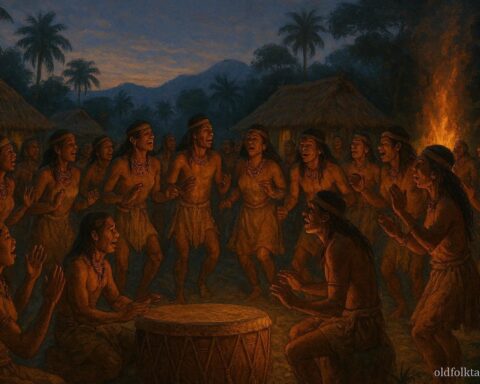
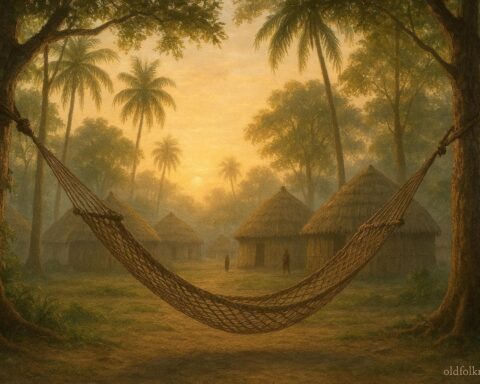
In a time before roads carved their way through the forests, when the Guaraní villages thrived in close harmony with the land, there lay a village called Ka’aguy Poty. It was a place where the river sang its own lullaby, and the air carried the fragrance of wild citrus, jasmine, and above all the sacred yerba mate. The people here believed the forest was alive with secrets. They revered the spirits that wandered its labyrinth of roots and leaves, and none was more celebrated or feared than Jasy Jatere.
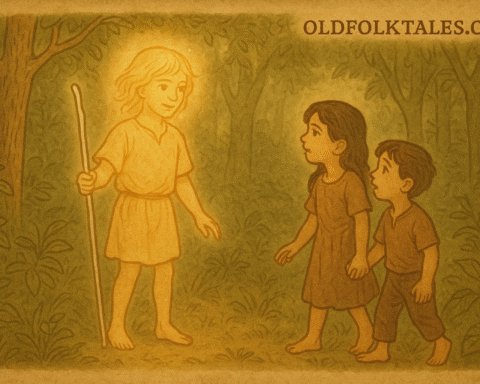
He was never seen by adults, only by those whose hearts were still tender and unburdened by the world’s seriousness. The village elders described him in hushed voices around evening fires: a childlike man, no taller than a six-year-old, with skin that glowed as if touched by perpetual sunlight and hair as pale as ripe maize silk. His voice was soft as wind whispering through tall grass, and his laughter sounded like distant chimes carried on a breeze. He walked barefoot through the forest, leaving no mark upon the earth, as if he were made of something lighter than flesh. Wherever he passed, the yerba mate flourished with new vigor, its leaves growing thick and green. It was said that his silver staff could make the thickest vines part like curtains, and that wild guavira fruit sweetened in his presence, becoming impossibly delicious.
Click to read all South American Folktales — timeless stories from the Andes to the Amazon.
One particular day, as the air thickened with the promise of noon and the cicadas sang their shrill, insistent chorus, a curious boy named Mateo lingered by the doorway of his family’s adobe home. The sun had climbed to its highest point, and the entire village was preparing for siesta that sacred time of rest when the heat pressed down like a heavy blanket and all sensible people sought the cool darkness of their homes.
Mateo’s mother, a woman with hair black as the moonless night and eyes wise as the owl’s that watched from the ceibo trees, called for him to come inside and rest. “Siesta is sacred, hijo,” she warned, her voice carrying the weight of generations of wisdom. “The forest watches over those who disobey. Jasy Jatere wanders during these hours, and curious children who ignore the call to rest may find themselves enchanted, led so deep into the green that they forget the way home.”
But Mateo was restless, his young mind buzzing with questions and wonder. He loved stories more than anything, especially those of Jasy Jatere. When he closed his eyes at night, he imagined a golden boy gliding through the undergrowth, whispering to birds in their own language and coaxing flowers to bloom with merely a touch. He longed to see this spirit for himself, to discover if the tales were true or only the inventions of tired adults seeking to keep their children safe and obedient during the hottest hours.
As his mother’s voice faded and the house grew quiet with the heavy silence of sleep, Mateo made his decision. His heart thumped like a partridge hidden in brambles as he tiptoed outside, careful not to wake anyone. The floorboards creaked softly beneath his feet, but no one stirred.
The world beyond the village shimmered with heat. The sky was a bowl of blue fire, endless and burning. The trees cast trembling shadows on the red earth, their leaves barely moving in the still air. Everything seemed to hold its breath, waiting. Mateo followed a narrow path lined with wild violets, their purple faces turned toward the sun. He moved carefully, trying to be silent as he had seen the hunters do when they tracked deer through the forest. Every snap of a twig made him pause, his heart leaping. Every flit of a butterfly seemed a sign, a message from the forest itself.
It was in a patch of brilliant sunlight, where the yerba mate bushes grew thickest and most lush, that Mateo first heard the music—a faint melody, neither sung nor played on any instrument, but woven into the very air itself. It beckoned him deeper into the forest, calling to something wild and curious in his young soul. The forest seemed to close behind him like a door, and soon he was lost in a world far removed from the familiar village. The cicadas’ harsh chorus faded to nothing. In its place rose a hush as profound as the deepest sleep, a silence that was somehow full of presence.
Suddenly, in a glade where the air sparkled with motes of gold dust dancing in shafts of sunlight, he saw him: Jasy Jatere. The spirit stood with his back to a mighty lapacho tree, its trunk wide and ancient. His silver staff glimmered in his small hand, catching the light and throwing it back in rainbow fragments. His golden hair shone like captured sunshine, and his eyes blue as a cloudless sky at dawn met Mateo’s gaze with an expression of gentle mischief and knowing.
“Why do you wander when the village sleeps?” the spirit asked, his voice as clear and pure as water from a mountain spring.
Mateo stammered an answer, his tongue feeling thick and clumsy in his mouth. He was torn between overwhelming awe and a trembling fear. “I wanted to see you,” he finally admitted, the words tumbling out. “I wanted to know if you were real.”
Jasy Jatere smiled, and his teeth were like perfect pearls. “All things are real to those who believe,” he replied with simple wisdom. He knelt gracefully, his movements fluid as water, and motioned for Mateo to join him on the soft forest floor. “Come. There is much to learn in the quiet of the forest, more than you could discover in a lifetime of ordinary days.”
In that enchanted moment, time seemed to slow and stretch like honey poured from a jar. Mateo forgot the warnings that had been drummed into him since he was old enough to understand words. He forgot the siesta’s sacred rule, forgot everything except the wonder before him, as he followed Jasy Jatere deeper into the heart of green.
He saw wonders he’d never imagined in his wildest dreams: hummingbirds with feathers like jewels sipping nectar from flowers that seemed to appear and disappear, agoutis sharing their burrows with snakes in peaceful truce, and streams that ran sweet with the flavor of wild honey. Jasy Jatere taught him the names of every plant and bird, speaking in a mixture of Guaraní and the language of the forest itself. He showed Mateo how the yerba mate’s leaves held the stories of rain and sun, each leaf a page in nature’s book. He explained with infinite patience how every living thing was bound together by an invisible thread of respect and interdependence how the butterfly needed the flower, how the flower needed the bee, how the tree needed the rain, and how all of them together created the tapestry of life.
But as the sun slid toward the western hills, beginning its slow descent toward evening, shadows grew long and cool across the forest floor. A chill crept into the air. Mateo felt a sudden pang of longing for home, for his mother’s voice, for the familiar smells of the adobe house and the sound of his family’s laughter. The spirit’s blue eyes turned serious, losing their playful gleam.
“You must return,” Jasy Jatere said with unexpected gravity. “For those who tarry too long in the forest’s embrace forget the path to their world. They become lost between the green and the village, neither fully here nor fully there.”
With a wave of his silver staff that left trails of light in the air, Jasy Jatere pointed the way back through the trees. Mateo ran through the undergrowth, his heart wild with new knowledge and memories that seemed almost like dreams. Branches caught at his clothes, and roots tried to trip his feet, but he pressed forward, driven by the need to return home.
When he reached the edge of the village, breathing hard and flushed with exertion, he glanced back over his shoulder but the magical glade had vanished completely, and only the ordinary hush of siesta remained. The forest looked like any forest, with no hint of the wonders he had witnessed.
He slipped inside his home just as his mother stirred from her rest, her eyes opening slowly. She looked at him with initial suspicion, then relief flooded her face. “Did you dream, hijo?” she asked softly, her voice still thick with sleep.
Mateo nodded, unsure whether to share his adventure or keep it locked away like treasure. He kept the secrets of the forest close to his heart, and from that day on, he understood the true meaning of siesta: it was not merely a time for sleep, but a time for listening to stories both spoken and silent that lived in the whispering green of the world around him
Explore myths and legends from Brazil, Peru, and Argentina rooted in spirit and survival.
The Moral Lesson
The tale of Jasy Jatere teaches us about the delicate balance between curiosity and obedience, between the pull of adventure and the wisdom of respecting boundaries set by those who came before us. While curiosity and wonder are precious gifts that keep our hearts young, there are times and seasons for everything moments when we must honor tradition and listen to the voices of experience. The story reminds us that magic exists for those who believe and remain open to wonder, but also that we must know when to return home, keeping one foot in the enchanted world and one in the reality of our community and family.
Knowledge Check
Q1: Who is Jasy Jatere in Guaraní mythology and what does he look like? A: Jasy Jatere is a forest spirit from Guaraní tradition, described as a childlike man no taller than a six-year-old with glowing skin and hair as pale as maize silk. He carries a silver staff, walks barefoot leaving no marks, and can only be seen by children with pure, unburdened hearts. His presence causes yerba mate to flourish and wild fruit to sweeten.
Q2: Why is siesta time considered sacred in the story? A: Siesta is considered sacred because it’s the time when Jasy Jatere wanders the forest. During these hottest hours of the day, children who disobey and venture outside risk being enchanted and led so deep into the forest that they forget the way home, becoming lost between the spirit world and the human world.
Q3: What special powers does Jasy Jatere possess? A: Jasy Jatere can make thick vines part with his silver staff, causes yerba mate to grow with new vigor wherever he passes, sweetens wild guavira fruit in his presence, and can teach the names and secrets of all plants and birds. He understands the invisible thread that connects all living things and can show these mysteries to those who encounter him.
Q4: What does Mateo learn from his encounter with Jasy Jatere? A: Mateo learns the names of every plant and bird, discovers how yerba mate leaves hold stories of rain and sun, and understands that all living things are bound together by an invisible thread of respect and interdependence. He also learns that magic is real for those who believe, but that one must know when to return home.
Q5: What is the cultural significance of yerba mate in this legend? A: Yerba mate is portrayed as a sacred plant that flourishes in Jasy Jatere’s presence, symbolizing the connection between the spirit world and the natural world. The spirit teaches that its leaves hold stories of rain and sun, representing how this culturally important plant carries the wisdom and memory of the land itself.
Q6: What warning does Jasy Jatere give Mateo before he returns home? A: Jasy Jatere warns Mateo that “those who tarry too long forget the path to their world,” meaning children who spend too much time in the enchanted forest risk becoming lost between the spirit realm and the human world, unable to find their way back to their families and communities.
Source: Adapted from traditional Guaraní oral folklore and mythology passed down through generations in Paraguay and surrounding regions.
Cultural Origin: Guaraní Indigenous People, Paraguay (also present in parts of Argentina, Brazil, and Bolivia)